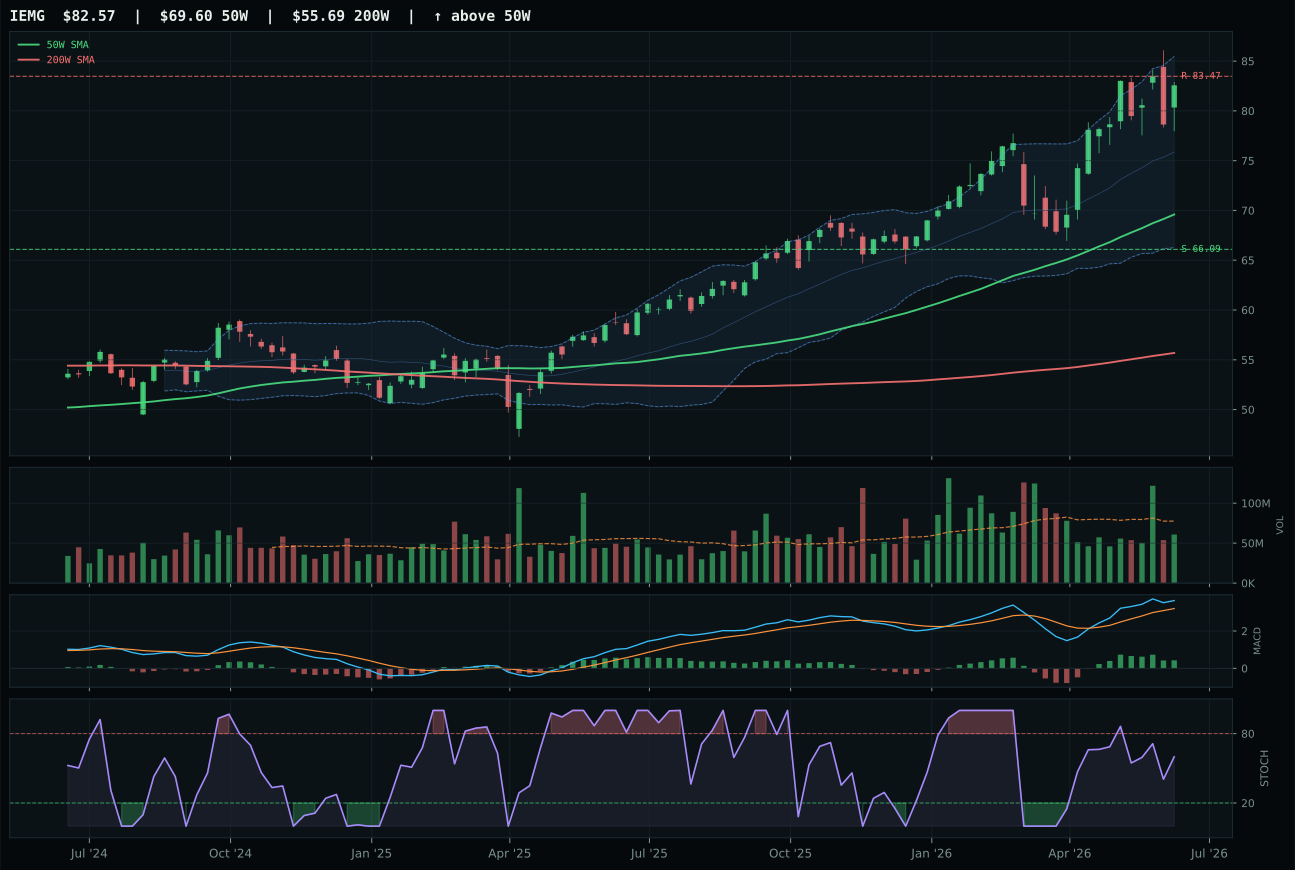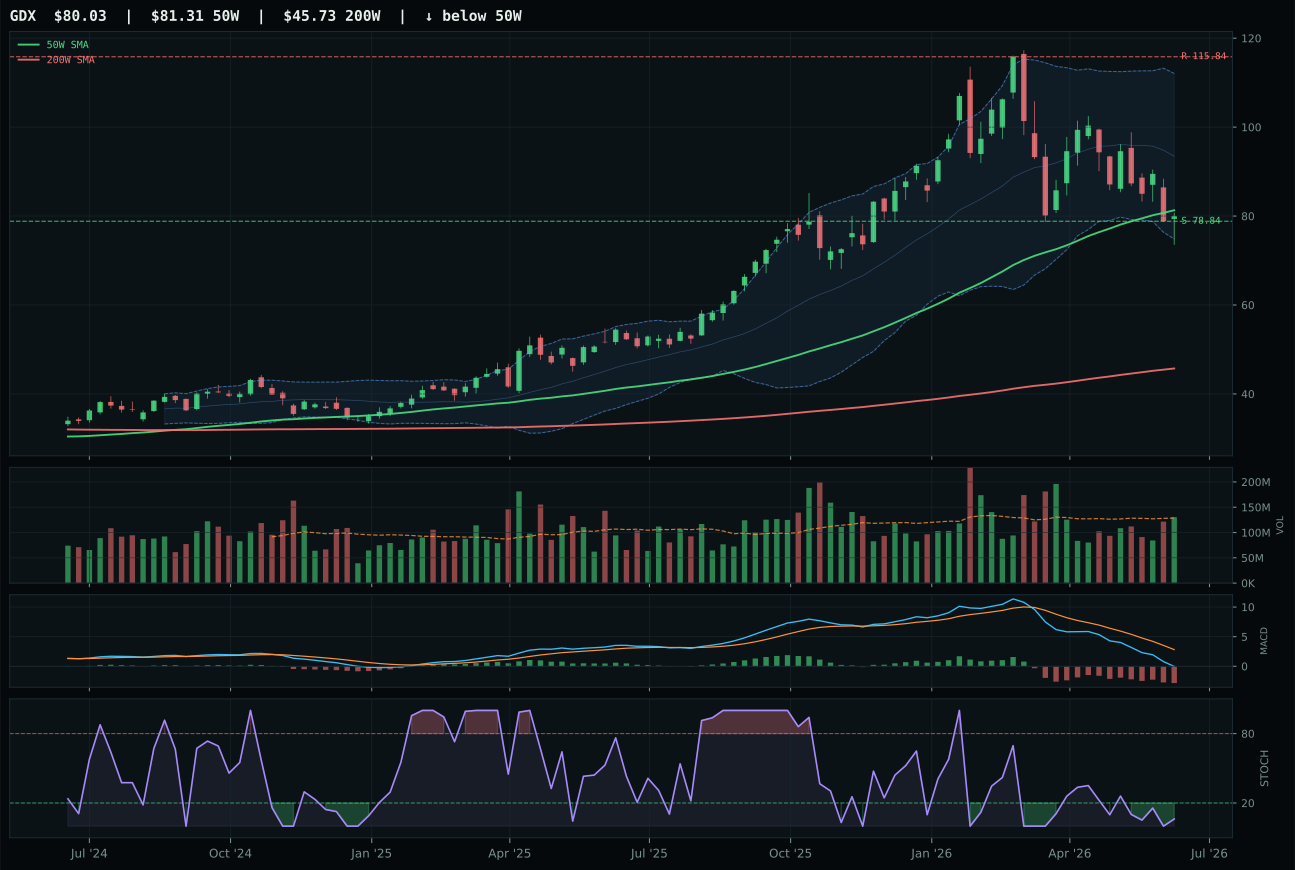
Hibernot Report
Run date: 2026-06-12
Data quality note: core market prices are live, but one or more secondary datasets are missing or stale. Review the Data Quality Section before acting.
1. Weekly Report Orientation
This weekly report is the current evidence packet, not the permanent thesis document. The durable investment theses now live on the site Theses page. The operating process lives on the Framework page. The category universe, macro playbooks, and category-plus-macro method matrix live on the Categories page.
This note focuses on what changed this week: current macro regime, crypto state, category scores, representative tickers, allocation weights, rolling four-week performance, decision rationale, and data-quality warnings.
The public scorecard is the rolling four-week portfolio. Each Friday report creates a 25% tranche bought at the next Monday open and held for four weeks. The newest tranche replaces the tranche from four weeks earlier.
2. Executive Summary
Current allocation state: NoCrypto. Crypto regime is NoCrypto and is unchanged versus last week. The coming-week allocation is determined by confirmed crypto-cycle state first, then broad Defensive risk if crypto is NoCrypto, then category leadership. If Bitcoin or AltSeason is active, the model takes the 50% crypto overlay through macro deterioration; bad macro can restrict AltSeason and keep the overlay in Bitcoin, but it does not replace confirmed crypto exposure with the slow Defensive trigger.
Report actionability: live but degraded; review missing inputs.
Top allocation sleeves: SLV (Precious Metals) 30%, COPX (Industrial Metals) 30%, PAVE (Utilities & Infrastructure) 5%, ROKT (Defense & Aerospace) 5%.
Current allocation:
| Ticker | Category | Weight | Reason |
|---|---|---|---|
| SLV | Precious Metals | 30% | top-2 category winner |
| COPX | Industrial Metals | 30% | top-2 category winner |
| PAVE | Utilities & Infrastructure | 5% | category representative sleeve |
| ROKT | Defense & Aerospace | 5% | category representative sleeve |
| XLE | Oil | 5% | category representative sleeve |
| URNM | Uranium | 5% | category representative sleeve |
| ENFR | Natural Gas | 5% | category representative sleeve |
| SMH | AI | 5% | category representative sleeve |
| XLK | Technology | 5% | category representative sleeve |
| MOO | Agriculture & Livestock | 5% | category representative sleeve |
Weekly operating instructions:
- Treat this Friday report as the instruction set for the next Monday open.
- On Monday, sell the tranche created by the report five Fridays earlier; that tranche has completed its four-week Monday-open-to-Monday-open holding window.
- Allocate that freed 25% tranche into the new report's allocation table at the Monday open.
- Leave the three newer tranches unchanged. The live portfolio is always the blend of the newest four report tranches.
- If the report is marked unreliable, do not change the allocation automatically until the data warning is resolved.
What changed from last week: crypto state unchanged; category winner changes: none flagged.
Key risks for the four-week tranche: failed support tests in the top selections, loss of BTC trend confirmation, stale macro inputs, and extension risk where winners are stretched above the 50W SMA.
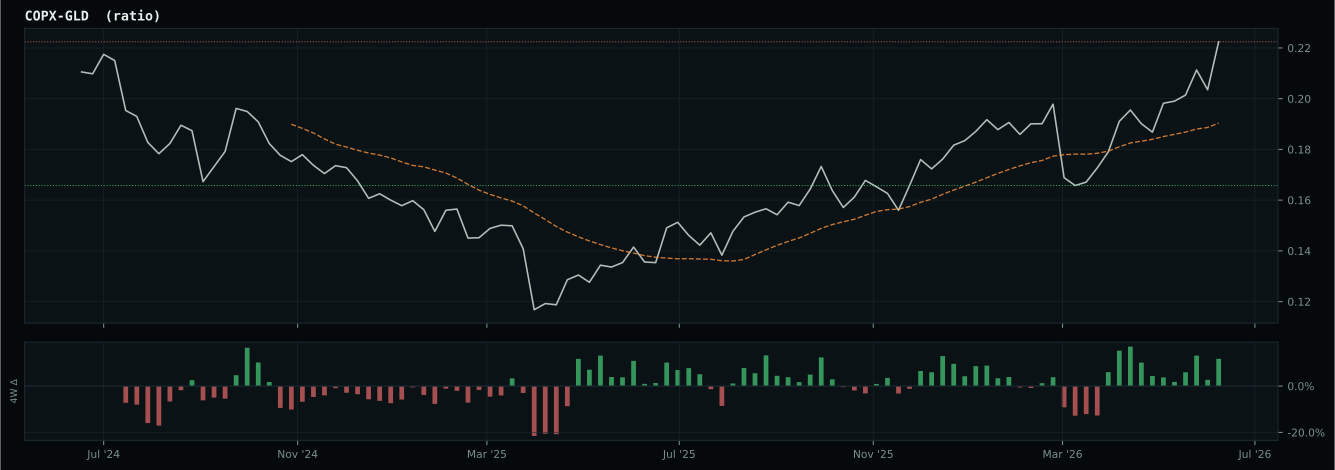
Highest-conviction opportunities: SLV, COPX. These are the execution tickers for the highest-ranked categories by final proof-burden category score, so the 30% sleeves are awarded to basket strength, sponsorship, macro fit, and tactical confirmation rather than a lone outlier.
3. Macro Regime Dashboard
Current macro regime used by the model: Risk-Off Deterioration. Structural regime: Stagflation Risk. Tactical overlay: Risk-Off Deterioration.
Interpretation: the structural regime is the slower macro anchor. The tactical overlay is a faster market-implied modifier. If the tactical overlay is anything other than Transition / Mixed, it becomes the current macro regime used by the model; if the tactical overlay is Transition / Mixed, the model uses the structural regime. A Transition / Mixed tactical overlay therefore means the short-term market read is not strong enough to override the structural regime.
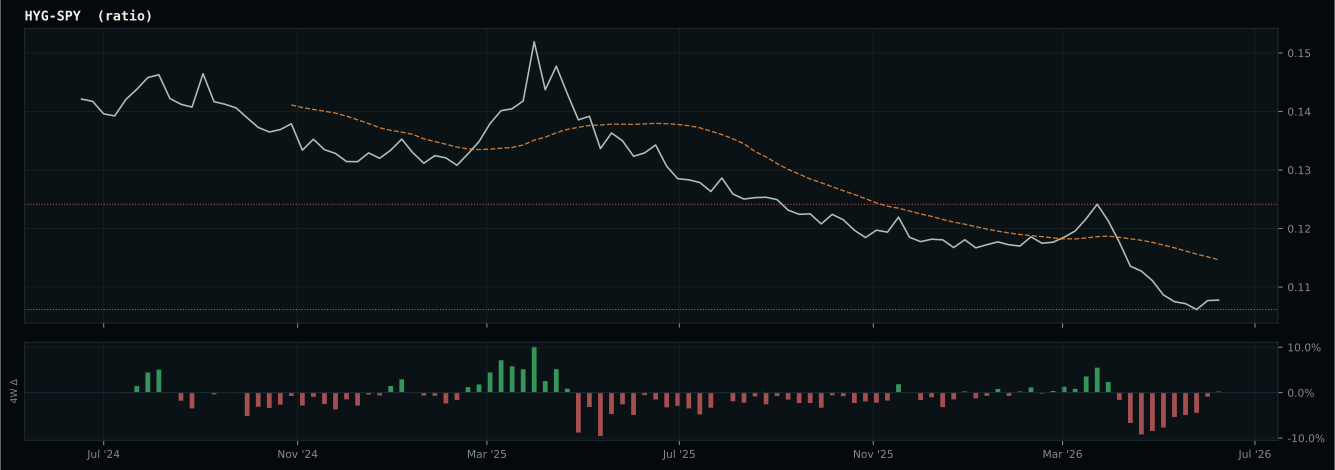
The macro engine classifies the structural regime as Stagflation Risk with a tactical overlay of Risk-Off Deterioration. Growth score is 41.6, inflation pressure is 67.4, liquidity is 38.0, credit stress is 68.3, and macro risk is 46.4. Cash is not required because crisis macro risk is inactive and bear-defense structure has 1/5 required checks. The active Defensive trigger is none and the Defensive cause is none.
- Macro supports: ISM Manufacturing PMI 47.9, Fed balance sheet contracting, Commodity breadth score 85.9, Risk appetite score 100.0, Bear-defense cash checks 1/5, Defensive cause selector inactive.
- Macro contradictions: none flagged.
- Favored categories: Defense & Aerospace, Agriculture & Livestock, Precious Metals, Oil, Natural Gas, Utilities & Infrastructure.
- Challenged categories: AI, Technology.
- Defensive state: Defensive overlay not required.
- Crypto risk eligibility: allowed.
- AltSeason macro gate: closed.
| Macro Signal | Score | Read |
|---|---|---|
| Growth | 41.6 | Based primarily on ISM Manufacturing PMI. |
| Inflation | 67.4 | Market-implied commodity and energy pressure. |
| Liquidity | 38.0 | Fed balance sheet four-week direction. |
| Credit Stress | 68.3 | Credit stress proxy; lower is healthier. |
| Rates/Yields | 50.0 | Proxy score from gold/growth relationships. |
| Dollar Pressure | 48.5 | DXY/UUP trend proxy when available. |
| Commodity Breadth | 85.9 | Percent of commodity-related investable proxies above 50W/200W SMAs. |
| Risk Appetite | 100.0 | Market-implied growth leadership and defensive rotation. |
| Bear Defense Cash Trigger | 20.0 | Rare 50% cash overlay trigger based on broad market bear structure, credit, dollar pressure, and risk appetite. |
| Defensive Cause Selector | 0.0 | Inactive because Defensive overlay is not required. |
| Macro Risk | 46.4 | Defensive overlay not required |
| Defensive Cause | 0.0 | none; Defensive overlay not active. |
4. Crypto Regime Dashboard
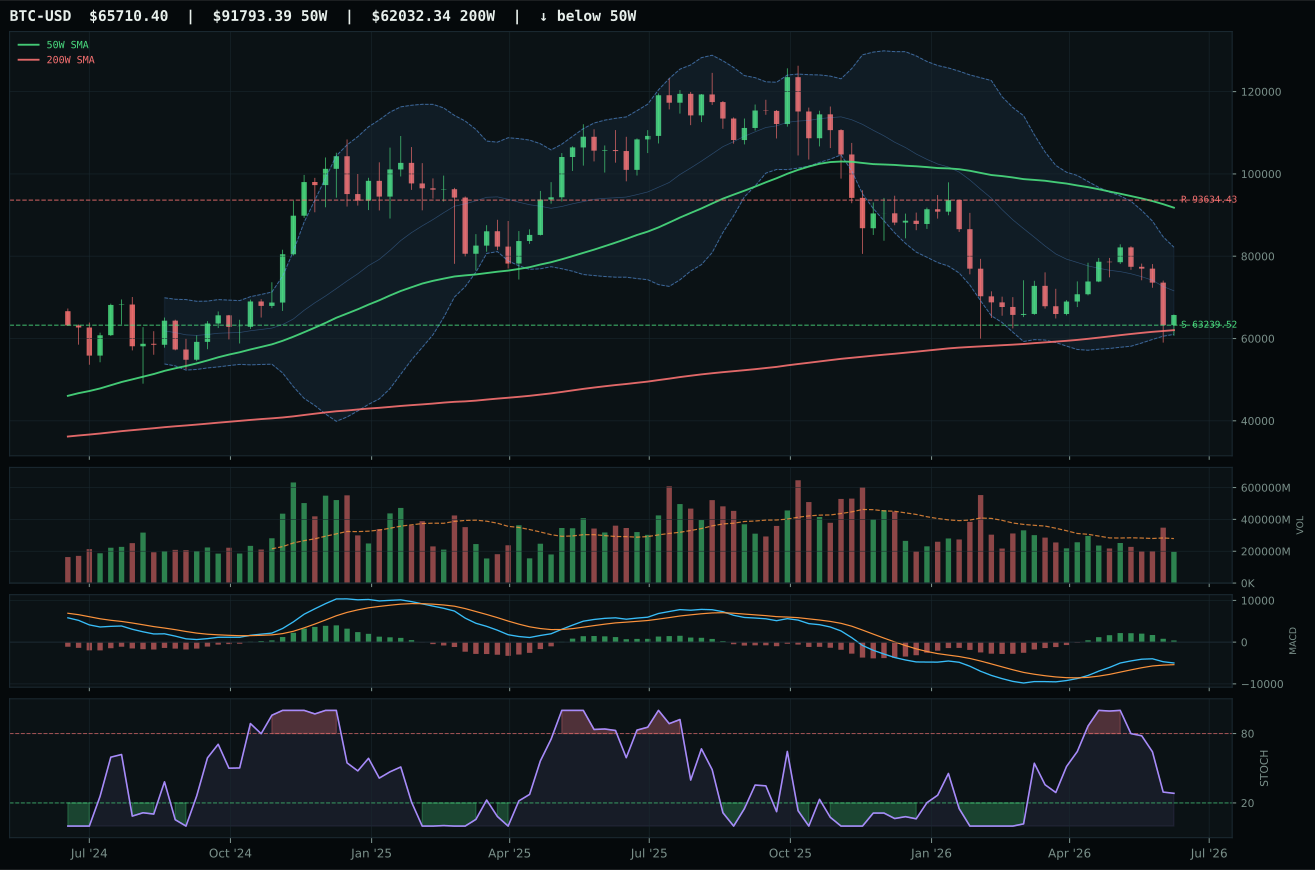
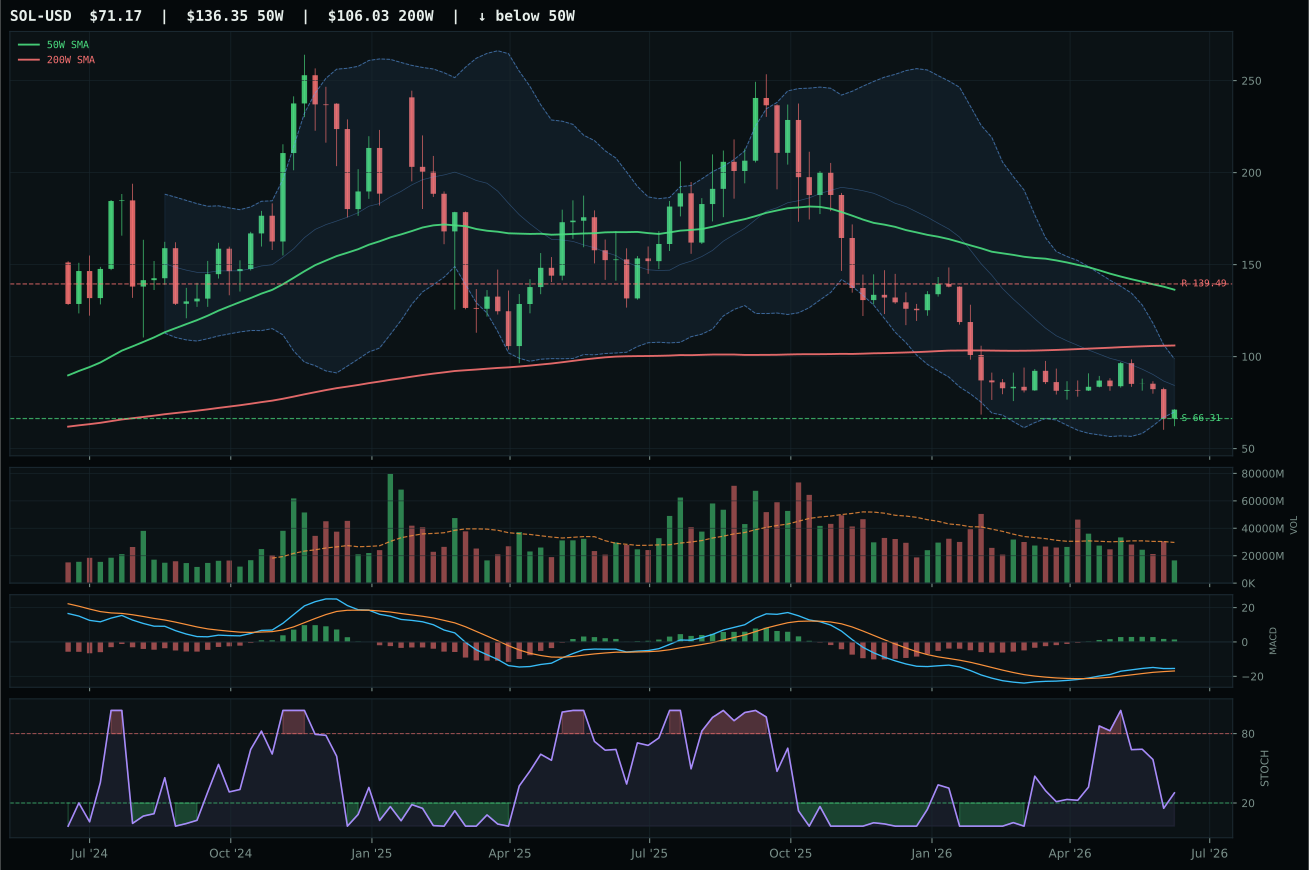
BTC weekly trend analysis: close 64421.32 versus 50W 91767.60, 100W 88463.39, and 200W 62025.90.
- BTC range status: 200W buy zone touched; waiting for post-touch range formation and decisive range break; support 63239.52, resistance 82138.93.
- ValueBTC status: ValueBTC armed; waiting for 50W reclaim, decisive close above post-touch range resistance by 3%, breakout volume above 20W average.
- TrendBTC status: TrendBTC not confirmed.
- AltSeason status: one or more available conditions failed.
- Fear & Greed value: 20.
- ISM PMI value: 47.9.
- Fed balance sheet trend: falling.
- OTHERS/BTC 50W slope: n/a.
- Crypto allocation decision: no crypto overlay.
AltSeason has two gates. First, the crypto chart must qualify: BTC risk-on state, BTC trend strength, BTC distance above the 50W, sentiment, liquidity, and alt-relative-strength checks. Second, the macro gate must also be open: macro risk below the crypto-risk cutoff, credit stress below the stress cutoff, liquidity at or above neutral, risk appetite supportive, and dollar pressure not aggressively tightening. If the crypto chart passes but the macro gate closes, AltSeason is downgraded to the active BTC state if TrendBTC is confirmed; otherwise it stays NoCrypto. TrendBTC itself is simpler: two consecutive weekly BTC closes above a rising or flat 50W SMA.
| Condition | Status | Value | Threshold |
|---|---|---|---|
| Already crypto risk-on | Fail | False | ValueBTC or TrendBTC |
| BTC distance above 50W | Fail | -29.80% | >= 20% |
| ISM Manufacturing PMI | Fail | 47.9 | >= 50 |
| BTC 50W SMA rising | Fail | -0.95% | > 0 week-over-week |
| Fear & Greed | Fail | 20 | 50-90 |
| OTHERS/BTC 50W rising | Skipped | missing/skipped | > 0 week-over-week |
| Fed balance sheet flat/rising | Fail | False | latest WALCL >= 4 weeks ago |
5. Macro and Liquidity Backdrop
- Rates/inflation regime: live macro feed; interpret with latest rates/inflation context.
- Growth vs slowdown read: manufacturing contraction.
- Liquidity conditions: contracting; WALCL latest 6725397.00 versus four weeks ago 6728502.00.
- Commodity cycle read: price-confirmed through category leadership.
- Risk-on/risk-off environment: derived from regime and breadth signals.
- Portfolio implication: macro is used as confirmation, not permission to override price. When macro conflicts with trend, the system sizes from the deterministic allocation rules and flags the conflict rather than forcing a narrative.
6. Decision Weighting
The ranking engine uses normalized buckets, but the current public scorecard is the four-week rolling portfolio. Trend includes price versus 50W/100W/200W SMAs, SMA slopes, relative strength, and weekly MACD confirmation. Structure includes trend cleanliness, compression, support/resistance clarity, and volume quality. Timing includes pullback/breakout classification, distance from the 50W, stochastic RSI, MACD histogram improvement, and whether price is sitting in a useful Fib retracement zone. Risk/reward uses upside to resistance versus downside to support/invalidation, ATR/volatility, Fib location, and whether volume confirms or contradicts the move. Volume in relation to price is a major input because the model wants evidence of sponsorship, not just a price mark.
Category selection uses a category-plus-macro proof-burden playbook, not a permanent strategic bonus. The prior configured strategic overweight bias has been removed. Macro still matters, but through the active playbook and stance. Favored means macro and narrative are aligned, but at least two ETFs still need to confirm. Neutral means the category gets no story credit and must win on the evidence. Headwind means the category is capped unless volume and relative strength are exceptional across the basket. Risk-on tapes reward sponsored leadership, reflation rewards broad volume-backed breakouts, slowdown rewards quality pullbacks with defined support, stagflation rewards scarcity and real-asset sponsorship, risk-off rewards relative-strength survival, and transition regimes demand balanced confirmation.
Scores are bounded 0-100 diagnostics, not claims of perfection. A 100 means a bucket hit its configured cap for the current formula and data window. A 0 means the bucket hit its floor, usually because the asset failed the specific trend, momentum, liquidity, or structure tests being measured. These extremes should be read as capped evidence signals, not literal certainty.
7. Category Ranking Dashboard
The table below is the exact sorted decision table used for top-two category selection. The model sorts by final eligible category score after applying the active macro-condition playbook to the 3/2/1 weighted ETF basket, leadership, volume/price confirmation, persistence, tactical timing, risk/reward, setup quality, and stance/cap rules. Ineligible categories cannot receive the 30% normal sleeve or the 13% overlay top-two sleeve.
How to read the score columns:
- Final Score is the deterministic category rank score after the active macro playbook, proof-burden checks, stance/cap rules, and eligibility filters.
- Macro Method is the active playbook used to interpret the category and its representative.
- Evidence shows the weighted basket evidence and points the reader to the category section for price, volume, MACD, stochastic RSI, Fib, support/resistance, and risk/reward detail.
- The representative ticker is the execution vehicle after the category wins; the category earns the capital first.
| Rank | Category | Final Score | Macro Method | Eligible | Representative | Evidence | Decision |
|---|---|---|---|---|---|---|---|
| 1 | Precious Metals | 60.0 | stagflation scarcity | yes | SLV | weighted basket proof-burden score 60.0; ETF basket GDX, SLV, GLD; volume/price and setup evidence in category section | Selected for top-2 because Precious Metals ranked among the two highest eligible final category scores at 60.0. That score came from the active stagflation scarcity method, 3/2/1 weighted ETF basket proof-burden score 60.0, and representative evidence: trend 67.0/100 from price above the 50W, above the 200W, 50W slope 1.0%, and RS vs SPY -14.7%; structure 59.4/100 from pullback into support, cleanliness 41.7, compression 44.1, support 61.29 and resistance 92.91; timing 87.0/100 from distance to 50W 7.2%, MACD bearish/weakening, stochastic RSI oversold, and Fib zone deep retracement / value zone; risk/reward 83.0/100 from upside to resistance -34.0%, downside to support 0.0%, volume thin participation at 0.10x 20W average; momentum confirmation 0.0/100 from 4W return -10.3%, 13W return -0.4%, category-relative strength 0.0%, MACD bearish/weakening, and volume thin participation; volume-price confirmation 29.7/100 and persistence 30.5/100, which combine trend, relative strength, MACD, and whether volume is confirming or rejecting the price move. |
| 2 | Industrial Metals | 58.0 | stagflation scarcity | yes | COPX | weighted basket proof-burden score 58.0; ETF basket COPX, PICK, REMX; volume/price and setup evidence in category section | Selected for top-2 because Industrial Metals ranked among the two highest eligible final category scores at 58.0. That score came from the active stagflation scarcity method, 3/2/1 weighted ETF basket proof-burden score 58.0, and representative evidence: trend 100.0/100 from price above the 50W, above the 200W, 50W slope 1.2%, and RS vs SPY 10.1%; structure 69.1/100 from vertical extension, cleanliness 66.7, compression 54.2, support 69.08 and resistance 95.70; timing 61.0/100 from distance to 50W 23.7%, MACD bearish but improving, stochastic RSI rising mid-zone, and Fib zone upper retracement / momentum zone; risk/reward 37.5/100 from upside to resistance -10.2%, downside to support 24.4%, volume thin participation at 0.19x 20W average; momentum confirmation 91.8/100 from 4W return 3.1%, 13W return 24.4%, category-relative strength 0.0%, MACD bearish but improving, and volume thin participation; volume-price confirmation 67.2/100 and persistence 65.4/100, which combine trend, relative strength, MACD, and whether volume is confirming or rejecting the price move. |
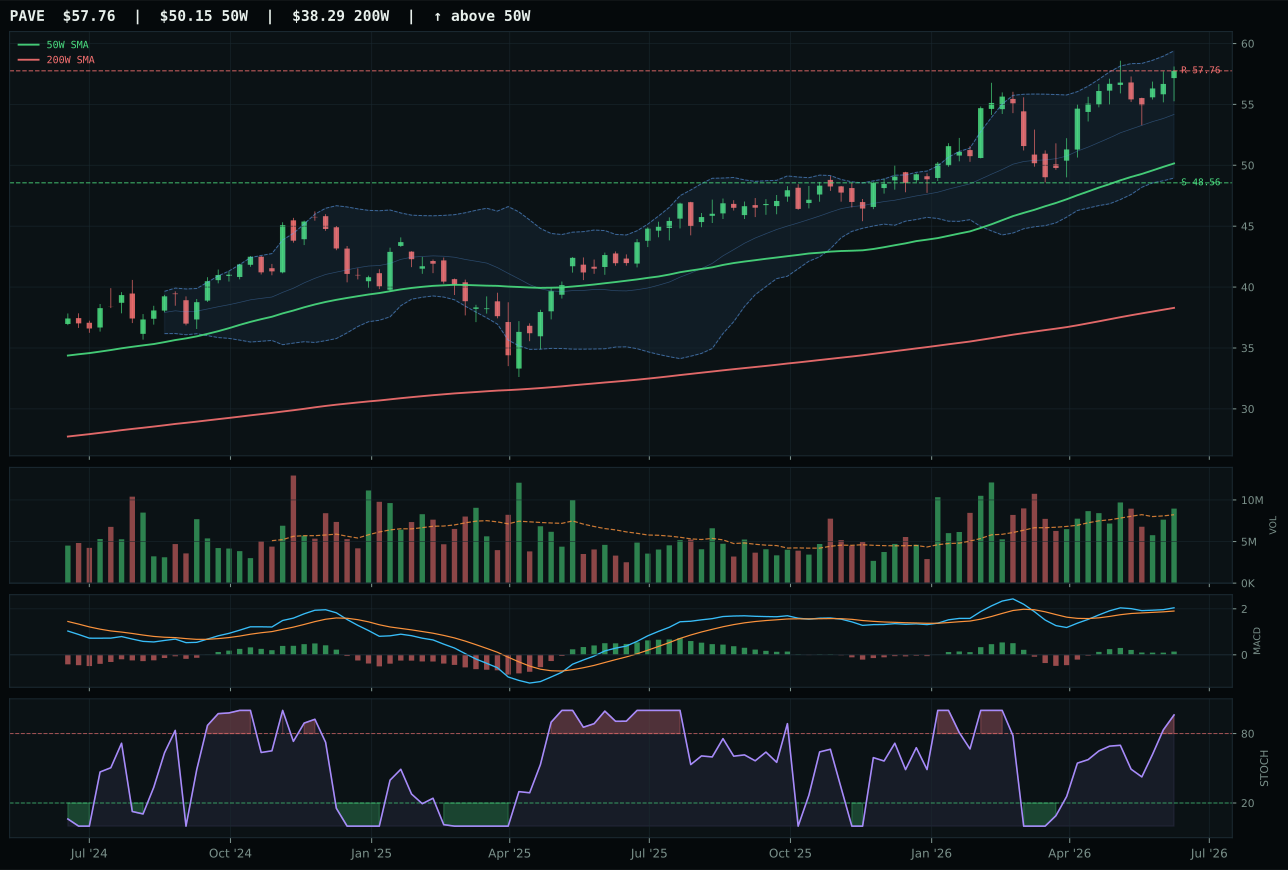
| 3 | Utilities & Infrastructure | 55.7 | stagflation scarcity | yes | PAVE | weighted basket proof-burden score 55.7; ETF basket PAVE, XLU, IGF; volume/price and setup evidence in category section | Not selected for top-2 because either two higher eligible final category scores ranked above it or the category/representative failed eligibility. Final category score 55.7 came from the active stagflation scarcity method, 3/2/1 weighted ETF basket proof-burden score 55.7, and eligibility filters; eligible: True. Representative evidence: trend 100.0/100 from price above the 50W, above the 200W, 50W slope 0.5%, and RS vs SPY 3.5%; structure 79.7/100 from neutral structure, cleanliness 83.3, compression 79.4, support 48.85 and resistance 57.76; timing 59.0/100 from distance to 50W 14.6%, MACD bullish and improving, stochastic RSI overbought momentum, and Fib zone near 52W high / extension; risk/reward 44.9/100 from upside to resistance 0.0%, downside to support 18.2%, volume thin participation at 0.19x 20W average; momentum confirmation 100.0/100 from 4W return 5.1%, 13W return 17.8%, category-relative strength 14.8%, MACD bullish and improving, and volume thin participation; volume-price confirmation 83.8/100 and persistence 82.9/100, which combine trend, relative strength, MACD, and whether volume is confirming or rejecting the price move. |
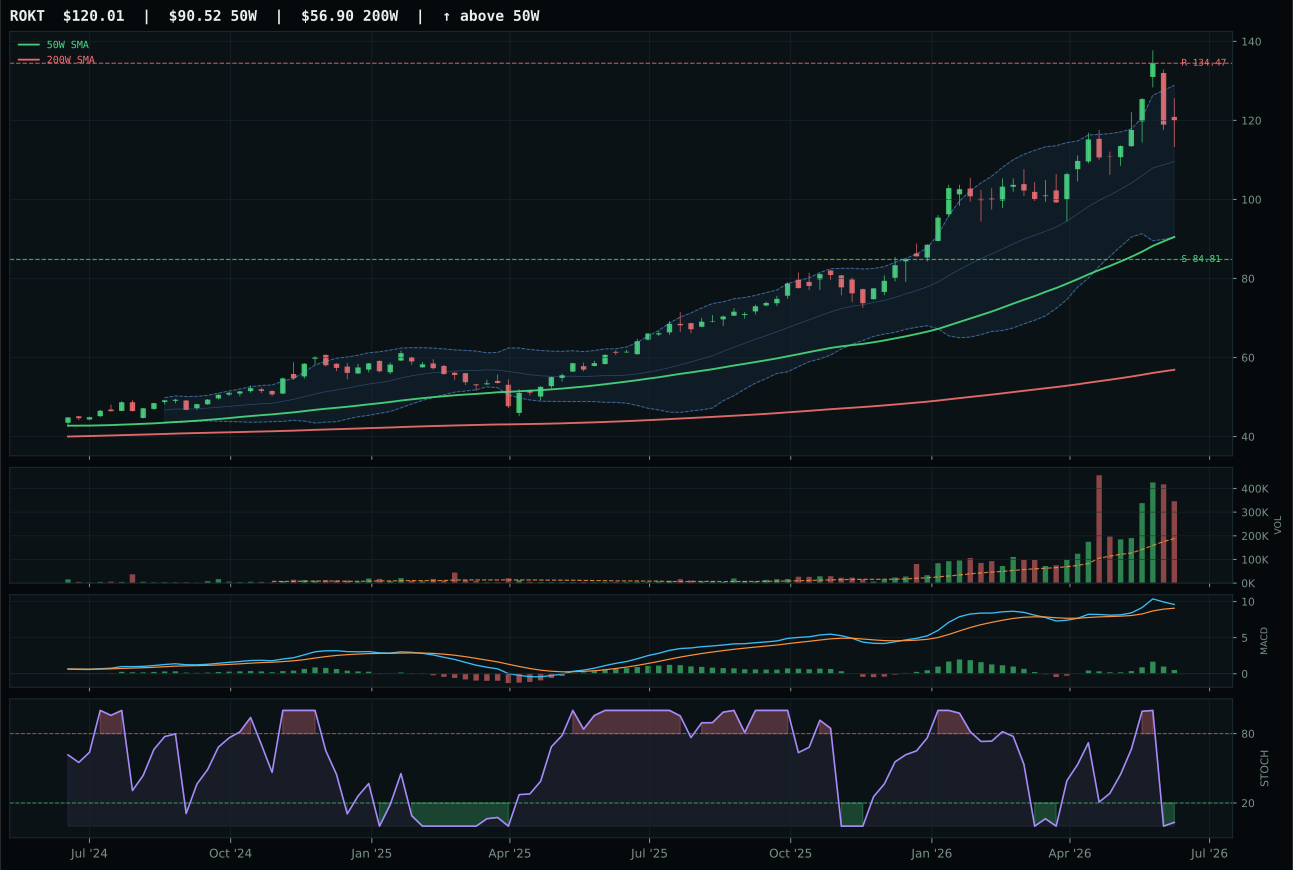
| 4 | Defense & Aerospace | 54.6 | stagflation scarcity | yes | ROKT | weighted basket proof-burden score 54.6; ETF basket ROKT, ITA, PPA; volume/price and setup evidence in category section | Not selected for top-2 because either two higher eligible final category scores ranked above it or the category/representative failed eligibility. Final category score 54.6 came from the active stagflation scarcity method, 3/2/1 weighted ETF basket proof-burden score 54.6, and eligibility filters; eligible: True. Representative evidence: trend 100.0/100 from price above the 50W, above the 200W, 50W slope 1.2%, and RS vs SPY 4.4%; structure 76.1/100 from vertical extension, cleanliness 83.3, compression 63.2, support 85.61 and resistance 134.47; timing 48.0/100 from distance to 50W 31.0%, MACD bullish but flattening, stochastic RSI oversold, and Fib zone upper retracement / momentum zone; risk/reward 49.8/100 from upside to resistance -10.8%, downside to support 40.2%, volume thin participation at 0.30x 20W average; momentum confirmation 89.4/100 from 4W return -4.3%, 13W return 18.8%, category-relative strength 13.8%, MACD bullish but flattening, and volume thin participation; volume-price confirmation 72.0/100 and persistence 73.1/100, which combine trend, relative strength, MACD, and whether volume is confirming or rejecting the price move. |
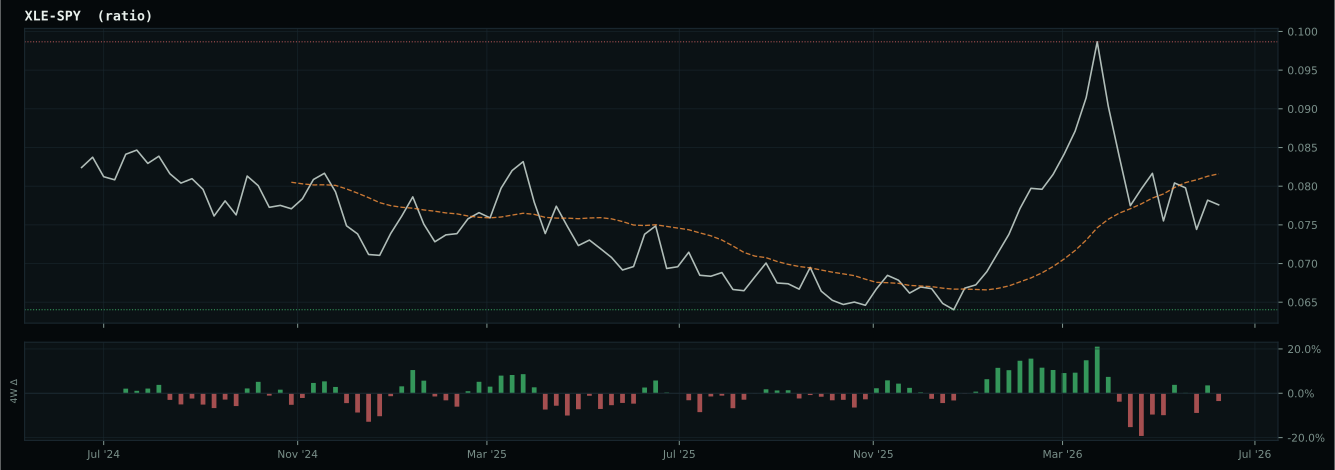
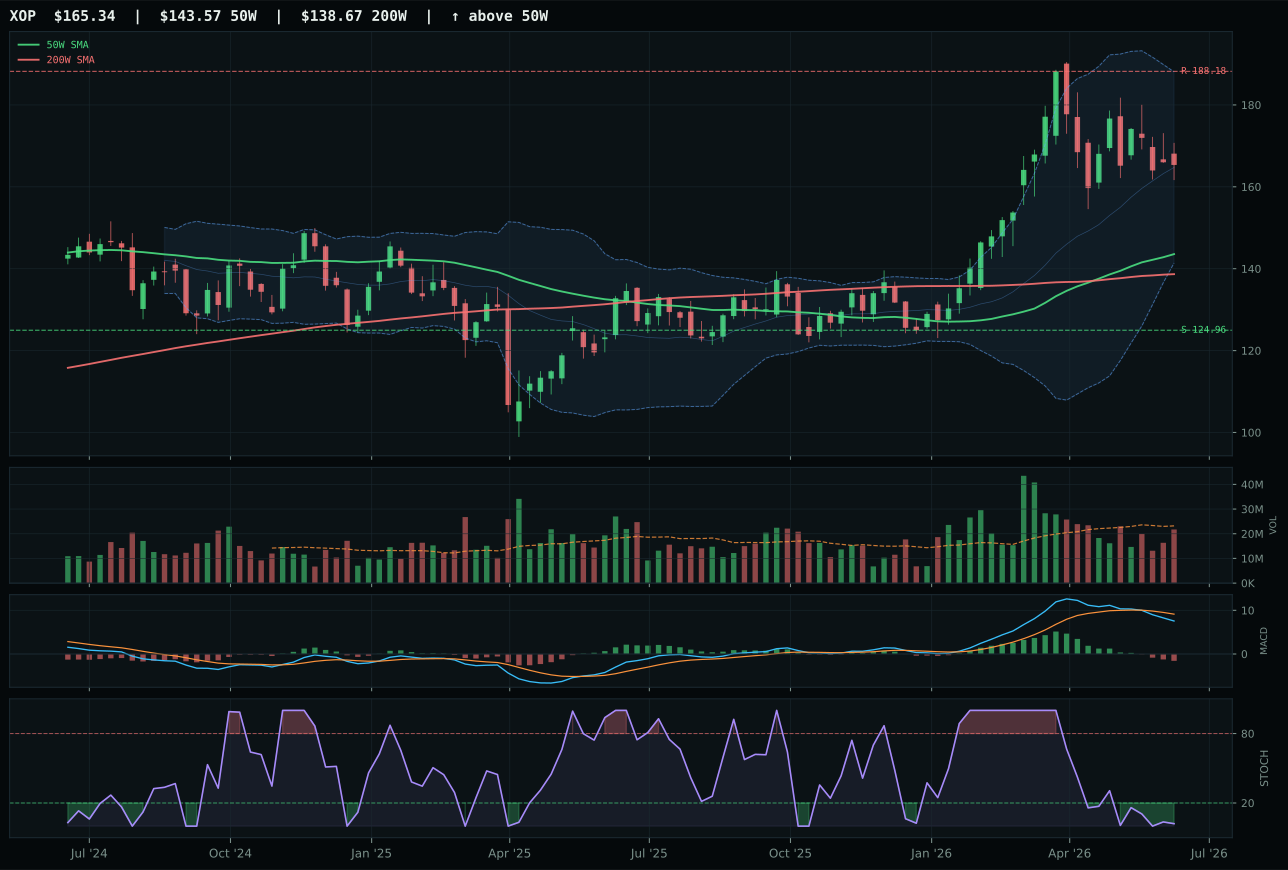
| 5 | Oil | 52.3 | stagflation scarcity | yes | XLE | weighted basket proof-burden score 52.3; ETF basket OIH, XLE, XOP; volume/price and setup evidence in category section | Not selected for top-2 because either two higher eligible final category scores ranked above it or the category/representative failed eligibility. Final category score 52.3 came from the active stagflation scarcity method, 3/2/1 weighted ETF basket proof-burden score 52.3, and eligibility filters; eligible: True. Representative evidence: trend 67.0/100 from price above the 50W, above the 200W, 50W slope 0.6%, and RS vs SPY -17.3%; structure 67.4/100 from vertical extension, cleanliness 50.0, compression 69.1, support 44.20 and resistance 62.56; timing 62.0/100 from distance to 50W 15.5%, MACD bearish/weakening, stochastic RSI oversold turn up, and Fib zone upper retracement / momentum zone; risk/reward 49.8/100 from upside to resistance -8.0%, downside to support 30.2%, volume thin participation at 0.13x 20W average; momentum confirmation 0.0/100 from 4W return -3.3%, 13W return -3.0%, category-relative strength 0.0%, MACD bearish/weakening, and volume thin participation; volume-price confirmation 21.3/100 and persistence 34.4/100, which combine trend, relative strength, MACD, and whether volume is confirming or rejecting the price move. |
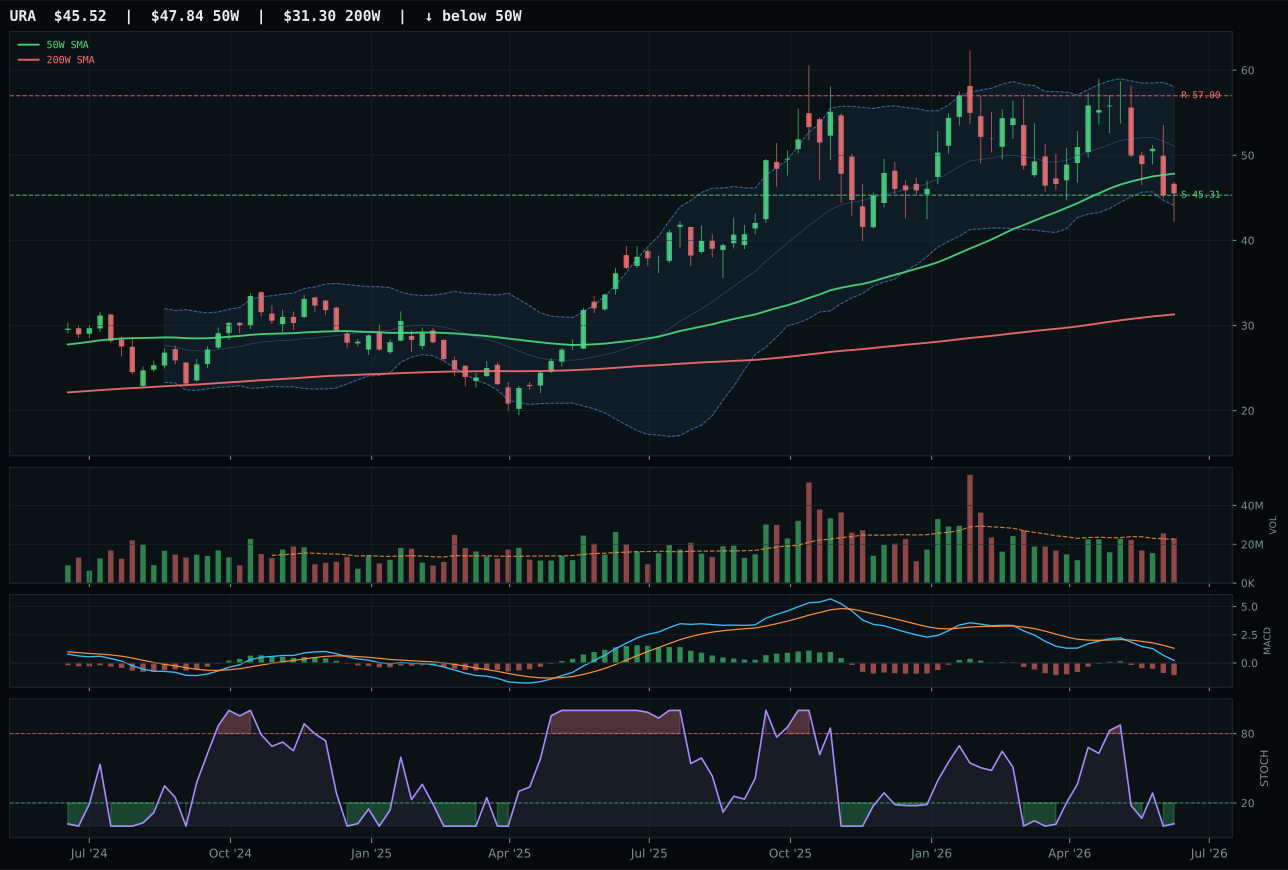
| 6 | Uranium | 51.3 | stagflation scarcity | yes | URNM | weighted basket proof-burden score 51.3; ETF basket NLR, URNM; volume/price and setup evidence in category section | Not selected for top-2 because either two higher eligible final category scores ranked above it or the category/representative failed eligibility. Final category score 51.3 came from the active stagflation scarcity method, 3/2/1 weighted ETF basket proof-burden score 51.3, and eligibility filters; eligible: True. Representative evidence: trend 52.0/100 from price below the 50W, above the 200W, 50W slope 0.2%, and RS vs SPY -20.5%; structure 61.2/100 from pullback into support, cleanliness 50.0, compression 41.0, support 54.58 and resistance 75.95; timing 87.0/100 from distance to 50W -8.0%, MACD bearish/weakening, stochastic RSI oversold, and Fib zone deep retracement / value zone; risk/reward 75.0/100 from upside to resistance -28.1%, downside to support 0.0%, volume thin participation at 0.10x 20W average; momentum confirmation 0.0/100 from 4W return -6.3%, 13W return -6.1%, category-relative strength -0.8%, MACD bearish/weakening, and volume thin participation; volume-price confirmation 15.1/100 and persistence 23.4/100, which combine trend, relative strength, MACD, and whether volume is confirming or rejecting the price move. |
| 7 | Natural Gas | 41.0 | stagflation scarcity | yes | ENFR | weighted basket proof-burden score 41.0; ETF basket ENFR, MLPX, FCG; volume/price and setup evidence in category section | Not selected for top-2 because either two higher eligible final category scores ranked above it or the category/representative failed eligibility. Final category score 41.0 came from the active stagflation scarcity method, 3/2/1 weighted ETF basket proof-burden score 41.0, and eligibility filters; eligible: True. Representative evidence: trend 67.0/100 from price above the 50W, above the 200W, 50W slope 0.4%, and RS vs SPY -12.1%; structure 71.9/100 from neutral structure, cleanliness 58.3, compression 78.2, support 31.05 and resistance 40.29; timing 84.0/100 from distance to 50W 14.0%, MACD bearish/weakening, stochastic RSI oversold turn up, and Fib zone upper retracement / momentum zone; risk/reward 47.7/100 from upside to resistance -3.7%, downside to support 24.9%, volume thin participation at 0.11x 20W average; momentum confirmation 12.3/100 from 4W return -3.7%, 13W return 2.2%, category-relative strength 1.1%, MACD bearish/weakening, and volume thin participation; volume-price confirmation 34.1/100 and persistence 38.2/100, which combine trend, relative strength, MACD, and whether volume is confirming or rejecting the price move. |
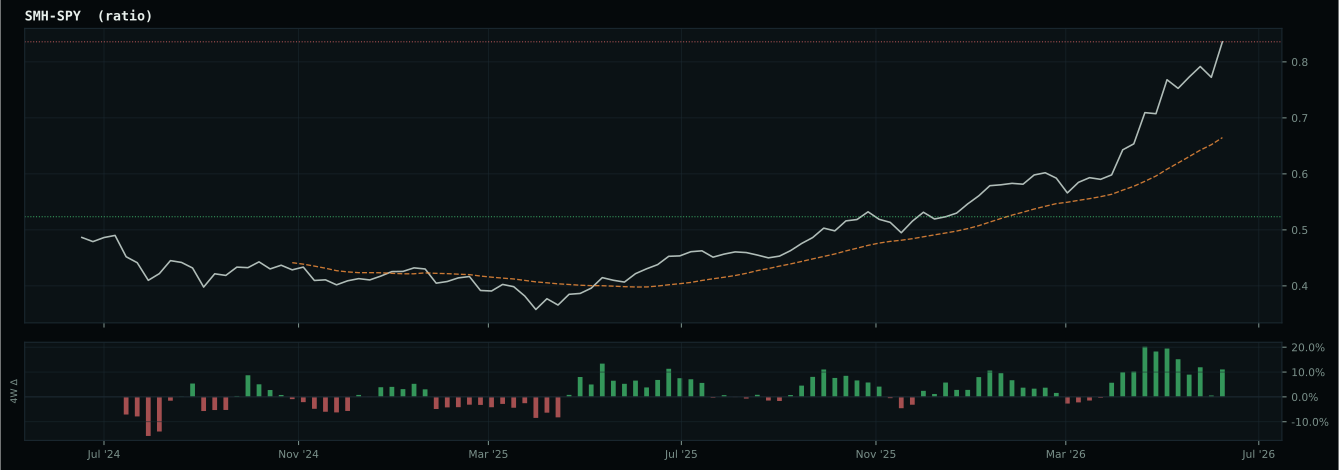
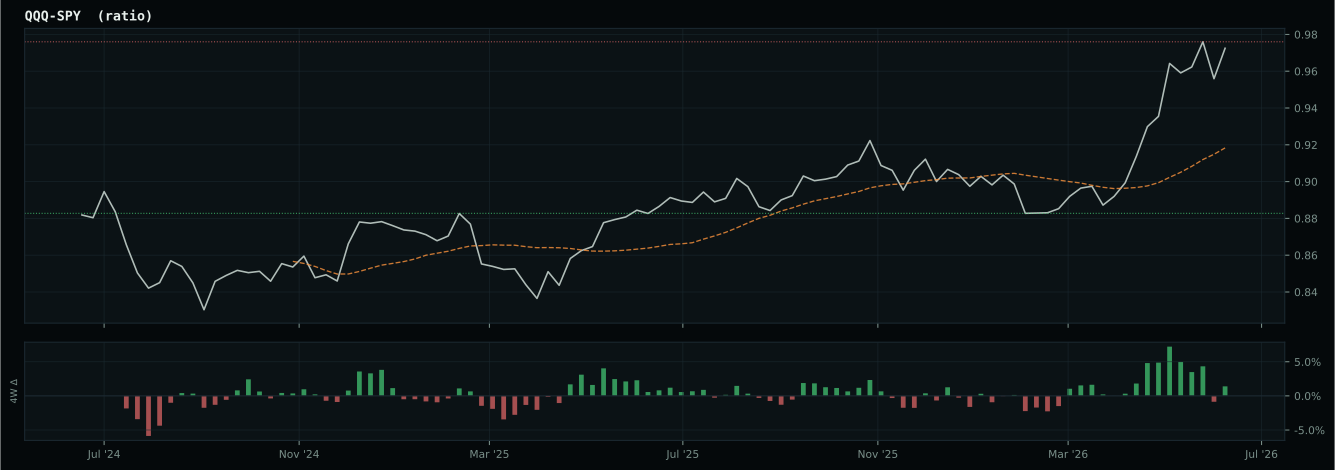
| 8 | AI | 40.9 | stagflation scarcity | yes | SMH | weighted basket proof-burden score 40.9; ETF basket SMH, AIQ, BOTZ; volume/price and setup evidence in category section | Not selected for top-2 because either two higher eligible final category scores ranked above it or the category/representative failed eligibility. Final category score 40.9 came from the active stagflation scarcity method, 3/2/1 weighted ETF basket proof-burden score 40.9, and eligibility filters; eligible: True. Representative evidence: trend 100.0/100 from price above the 50W, above the 200W, 50W slope 1.7%, and RS vs SPY 46.8%; structure 76.5/100 from vertical extension, cleanliness 83.3, compression 65.0, support 365.86 and resistance 619.96; timing 22.0/100 from distance to 50W 57.9%, MACD bullish but flattening, stochastic RSI overbought rolling over, and Fib zone near 52W high / extension; risk/reward 39.1/100 from upside to resistance 0.0%, downside to support 69.5%, volume thin participation at 0.20x 20W average; momentum confirmation 100.0/100 from 4W return 7.6%, 13W return 61.1%, category-relative strength 26.0%, MACD bullish but flattening, and volume thin participation; volume-price confirmation 75.0/100 and persistence 100.0/100, which combine trend, relative strength, MACD, and whether volume is confirming or rejecting the price move. |
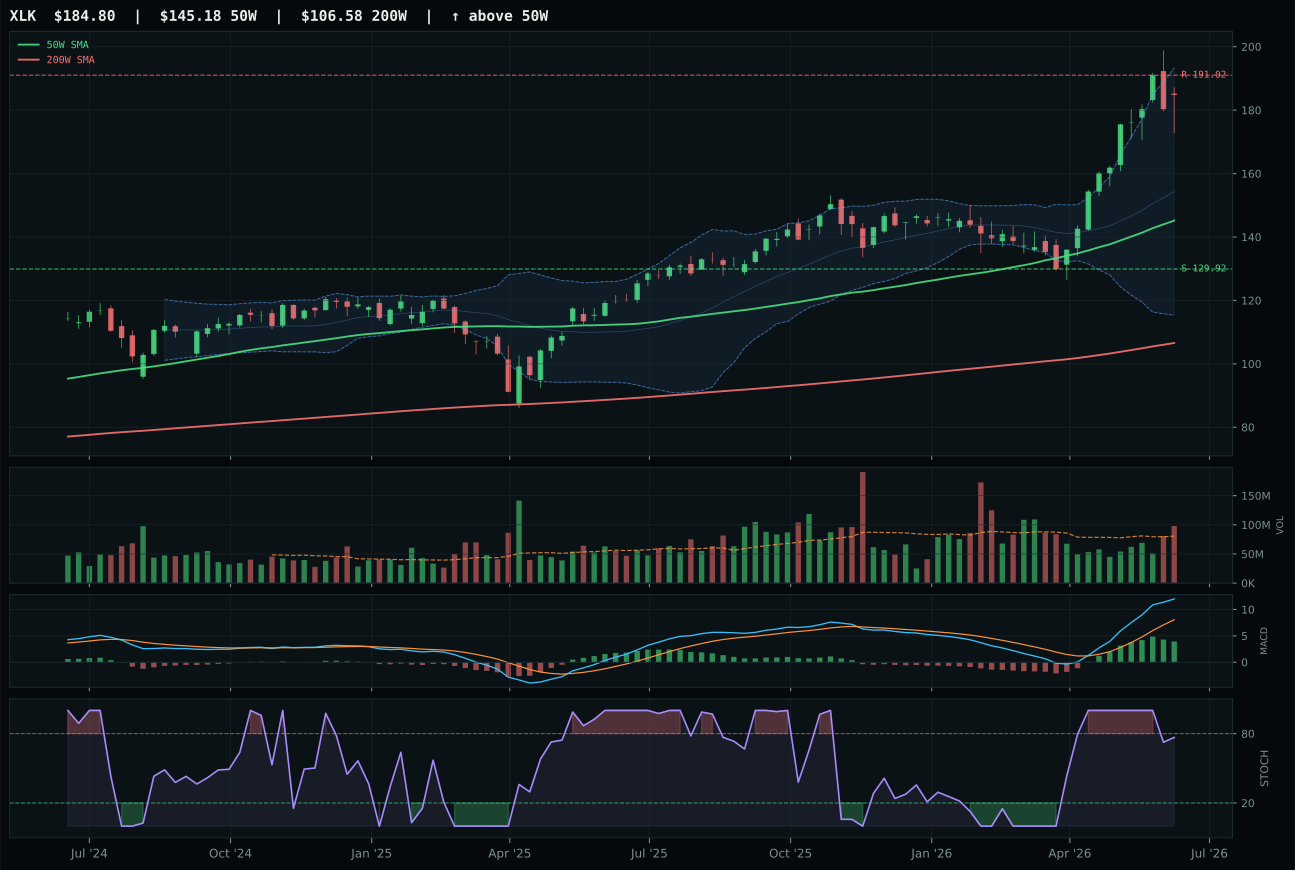
| 9 | Technology | 40.4 | stagflation scarcity | yes | XLK | weighted basket proof-burden score 40.4; ETF basket XLK, CIBR, IGV; volume/price and setup evidence in category section | Not selected for top-2 because either two higher eligible final category scores ranked above it or the category/representative failed eligibility. Final category score 40.4 came from the active stagflation scarcity method, 3/2/1 weighted ETF basket proof-burden score 40.4, and eligibility filters; eligible: True. Representative evidence: trend 100.0/100 from price above the 50W, above the 200W, 50W slope 0.8%, and RS vs SPY 22.2%; structure 80.6/100 from vertical extension, cleanliness 91.7, compression 72.2, support 129.92 and resistance 191.02; timing 48.0/100 from distance to 50W 26.3%, MACD bullish but flattening, stochastic RSI falling/neutral, and Fib zone upper retracement / momentum zone; risk/reward 46.4/100 from upside to resistance -3.3%, downside to support 42.2%, volume thin participation at 0.19x 20W average; momentum confirmation 100.0/100 from 4W return 2.4%, 13W return 36.6%, category-relative strength 3.3%, MACD bullish but flattening, and volume thin participation; volume-price confirmation 73.6/100 and persistence 83.1/100, which combine trend, relative strength, MACD, and whether volume is confirming or rejecting the price move. |
| 10 | Agriculture & Livestock | 27.7 | stagflation scarcity | yes | MOO | weighted basket proof-burden score 27.7; ETF basket FTAG, VEGI, MOO; volume/price and setup evidence in category section | Not selected for top-2 because either two higher eligible final category scores ranked above it or the category/representative failed eligibility. Final category score 27.7 came from the active stagflation scarcity method, 3/2/1 weighted ETF basket proof-burden score 27.7, and eligibility filters; eligible: True. Representative evidence: trend 57.0/100 from price above the 50W, above the 200W, 50W slope 0.1%, and RS vs SPY -16.4%; structure 63.3/100 from compression near 50W, cleanliness 25.0, compression 84.5, support 73.03 and resistance 85.90; timing 100.0/100 from distance to 50W 1.7%, MACD bearish/weakening, stochastic RSI oversold turn up, and Fib zone middle retracement / decision zone; risk/reward 73.1/100 from upside to resistance -8.5%, downside to support 7.6%, volume thin participation at 0.07x 20W average; momentum confirmation 0.0/100 from 4W return -2.1%, 13W return -2.0%, category-relative strength -2.7%, MACD bearish/weakening, and volume thin participation; volume-price confirmation 26.0/100 and persistence 33.3/100, which combine trend, relative strength, MACD, and whether volume is confirming or rejecting the price move. |
8. Category Representative Selection
Technology
- Current basket: XLK, IGV, CIBR
- Winner: XLK
- Runner-up: CIBR
- Winner changed from last week: no
- Why winner represents the category: XLK wins because price is above the 50W and 200W with a non-deteriorating 50W slope and the chart is extended at 26.3% above the 50W, so strength is being penalized for entry risk. Its 13W return is 36.6%, 26W return is 27.8%, RS versus SPY is 22.2%, and RS versus the category median is 3.3%. It is 26.3% from the 50W with volume at 0.19x its 20W average (thin participation). MACD is bullish but flattening, stochastic RSI is falling/neutral at 0.77, and price sits in the upper retracement / momentum zone near Fib 0.236 at 180.00. Score drivers: trend 100.0/100 from price above the 50W, above the 200W, 50W slope 0.8%, and RS vs SPY 22.2%; structure 80.6/100 from vertical extension, cleanliness 91.7, compression 72.2, support 129.92 and resistance 191.02; timing 48.0/100 from distance to 50W 26.3%, MACD bullish but flattening, stochastic RSI falling/neutral, and Fib zone upper retracement / momentum zone; risk/reward 46.4/100 from upside to resistance -3.3%, downside to support 42.2%, volume thin participation at 0.19x 20W average; momentum confirmation 100.0/100 from 4W return 2.4%, 13W return 36.6%, category-relative strength 3.3%, MACD bullish but flattening, and volume thin participation; volume-price confirmation 73.6/100 and persistence 83.1/100, which combine trend, relative strength, MACD, and whether volume is confirming or rejecting the price move. That blend is why the selection is being driven by timing/risk-reward as much as raw strength. The score gap versus CIBR is -5.4 points, so this is a clear category decision.
- Why runner-up lost: CIBR lost to XLK because timing score was weaker (35.0 vs 48.0); structure was less clean (75.0 vs 80.6); MACD confirmation was weaker (bullish and improving vs bullish but flattening); category-relative strength lagged (0.0% vs 3.3%). CIBR's setup is vertical extension, with 13W RS vs SPY at 18.9% and support/resistance at 60.74/89.04. Its MACD is bullish and improving, stochastic RSI is overbought rolling over, volume is thin participation, and Fib location is upper retracement / momentum zone.
- ETF basket: XLK, IGV, CIBR.
- Category score assets: XLK, CIBR, IGV.
- Category score: 66.2, calculated with the 3/2/1 weighted ETF basket formula: first-ranked ETF x3, second-ranked ETF x2, third-ranked ETF x1, divided by 6.
- Final category method: stagflation scarcity. The weighted basket score is only the starting evidence. The final category score applies the proof-burden layer: weighted basket strength, relative-strength leadership, volume-price sponsorship, persistence, timing, risk/reward, setup quality, and macro stance/cap rules. Favored categories still need confirmation; neutral categories win only on evidence; headwind categories are capped unless sponsorship is exceptional.
- Asset selection playbook: stagflation scarcity. The representative ETF is chosen separately from the category score by the four-week ETF execution score. That score prioritizes peer leadership, price/volume sponsorship, trend persistence, MACD confirmation, stochastic RSI timing, support/resistance asymmetry, and extension risk. The active macro regime changes the weight of those inputs: risk-on regimes emphasize leadership and upside sponsorship; reflation regimes emphasize volume-backed breakouts and commodity breadth; slowdown/disinflation regimes emphasize quality pullbacks and risk/reward; risk-off regimes emphasize defensive relative strength and lower failure risk. The category also changes the execution formula: AI/Technology reward leadership, Utilities/Defense reward defensive relative strength and failure avoidance, and commodity sleeves require more price/volume confirmation, support/retest quality, and extension discipline.
- Macro alignment: Technology has a mixed macro backdrop in Risk-Off Deterioration. Technical/breadth score 40.4, macro tailwind -1.6, risk adjustment -2.0 (growth/high-beta risk haircut; macro risk 46.4, credit stress 68.3, liquidity 38.0, dollar pressure 48.5), macro-adjusted pre-strategic-bias score 36.7.
- Category allocation rationale: ETF basket: XLK, CIBR, IGV. The 3/2/1 weighted ETF basket score is 66.2, calculated as ((first-ranked ETF x 3) + (second-ranked ETF x 2) + (third-ranked ETF x 1)) / 6 using the active category-plus-macro execution score. The final category score is 40.4, after the institutional proof-burden layer checks macro stance, basket confirmation, volume-price sponsorship, persistence, relative strength, and whether risk/reward is dominating actual leadership. The category representative is chosen separately by the four-week ETF execution score, which emphasizes peer leadership, volume-price sponsorship, persistence, and clean entry quality. The basket contributes this evidence: XLK: category/macro score 78.0, volume-price 73.6, persistence 83.1, trend 100.0, timing 48.0, 13W RS vs SPY 22.2%, setup vertical extension, volume thin participation at 0.19x 20W average | CIBR: category/macro score 70.3, volume-price 64.4, persistence 84.7, trend 100.0, timing 35.0, 13W RS vs SPY 18.9%, setup vertical extension, volume thin participation at 0.16x 20W average | IGV: category/macro score 22.1, volume-price 17.6, persistence 31.9, trend 53.4, timing 77.0, 13W RS vs SPY -5.1%, setup neutral structure, volume thin participation at 0.13x 20W average. Tactical edge is a four-week basket leadership score. It blends the 3/2/1 weighted ETF basket score 66.2, second-ranked ETF confirmation 70.3, weakest-member score 22.1, relative-strength leadership 64.0, volume-price confirmation 51.9, persistence 66.6, proof score 60.4, and macro-playbook prior 47.0. The final blend is 40% ETF-basket proof and 60% macro/narrative playbook fit before hard penalties, concentration/separation adjustment -0.0, and macro stance adjustment -12.0. The active category stance is headwind: macro is working against the category, so it needs exceptional relative strength and volume sponsorship before it can receive an overweight. 2 of 3 ETFs confirmed with enough score, volume-price evidence, and SPY-relative behavior; 0 had positive volume sponsorship. This asks whether the active macro playbook, price strength, volume participation, and peer-relative leadership agree over the four-week tranche window, not merely whether the category has attractive constituents or a clean-looking support level. The category was penalized because it was fighting the active macro playbook without exceptional basket confirmation. Macro-condition playbook scoring was not available, so the category relies on price, breadth, and volume confirmation. Final category score 40.4 is the category-plus-macro playbook score. Macro tailwind -1.6 and risk adjustment -2.0 are logged as context and eligibility inputs, not added as a second score boost. Technology has a mixed macro backdrop in Risk-Off Deterioration. Technical/breadth score 40.4, macro tailwind -1.6, risk adjustment -2.0 (growth/high-beta risk haircut; macro risk 46.4, credit stress 68.3, liquidity 38.0, dollar pressure 48.5), macro-adjusted pre-strategic-bias score 36.7.
- Top-2 decision: Not selected for top-2 because either two higher eligible final category scores ranked above it or the category/representative failed eligibility. Final category score 40.4 came from the active stagflation scarcity method, 3/2/1 weighted ETF basket proof-burden score 40.4, and eligibility filters; eligible: True. Representative evidence: trend 100.0/100 from price above the 50W, above the 200W, 50W slope 0.8%, and RS vs SPY 22.2%; structure 80.6/100 from vertical extension, cleanliness 91.7, compression 72.2, support 129.92 and resistance 191.02; timing 48.0/100 from distance to 50W 26.3%, MACD bullish but flattening, stochastic RSI falling/neutral, and Fib zone upper retracement / momentum zone; risk/reward 46.4/100 from upside to resistance -3.3%, downside to support 42.2%, volume thin participation at 0.19x 20W average; momentum confirmation 100.0/100 from 4W return 2.4%, 13W return 36.6%, category-relative strength 3.3%, MACD bullish but flattening, and volume thin participation; volume-price confirmation 73.6/100 and persistence 83.1/100, which combine trend, relative strength, MACD, and whether volume is confirming or rejecting the price move.
| Rank | Ticker | Score | 13W Return | RS vs SPY | Vol | MACD | StochRSI | Fib Zone | Phase |
|---|---|---|---|---|---|---|---|---|---|
| 1 | XLK | 66.3 | 36.6% | 22.2% | thin participation | bullish but flattening | falling/neutral | upper retracement / momentum zone | Phase 4: Extended / late trend |
| 2 | CIBR | 71.7 | 33.3% | 18.9% | thin participation | bullish and improving | overbought rolling over | upper retracement / momentum zone | Phase 4: Extended / late trend |
| 3 | IGV | 45.9 | 9.3% | -5.1% | thin participation | bullish but flattening | falling/neutral | deep retracement / value zone | Phase 1: Base / accumulation |
AI
- Current basket: AIQ, SMH, BOTZ
- Winner: SMH
- Runner-up: AIQ
- Winner changed from last week: no
- Why winner represents the category: SMH wins because price is above the 50W and 200W with a non-deteriorating 50W slope and the chart is extended at 57.9% above the 50W, so strength is being penalized for entry risk. Its 13W return is 61.1%, 26W return is 74.0%, RS versus SPY is 46.8%, and RS versus the category median is 26.0%. It is 57.9% from the 50W with volume at 0.20x its 20W average (thin participation). MACD is bullish but flattening, stochastic RSI is overbought rolling over at 0.82, and price sits in the near 52W high / extension near Fib 0.236 at 551.76. Score drivers: trend 100.0/100 from price above the 50W, above the 200W, 50W slope 1.7%, and RS vs SPY 46.8%; structure 76.5/100 from vertical extension, cleanliness 83.3, compression 65.0, support 365.86 and resistance 619.96; timing 22.0/100 from distance to 50W 57.9%, MACD bullish but flattening, stochastic RSI overbought rolling over, and Fib zone near 52W high / extension; risk/reward 39.1/100 from upside to resistance 0.0%, downside to support 69.5%, volume thin participation at 0.20x 20W average; momentum confirmation 100.0/100 from 4W return 7.6%, 13W return 61.1%, category-relative strength 26.0%, MACD bullish but flattening, and volume thin participation; volume-price confirmation 75.0/100 and persistence 100.0/100, which combine trend, relative strength, MACD, and whether volume is confirming or rejecting the price move. That blend is why the selection is being driven by timing/risk-reward as much as raw strength. The score gap versus AIQ is -12.3 points, so this is a clear category decision.
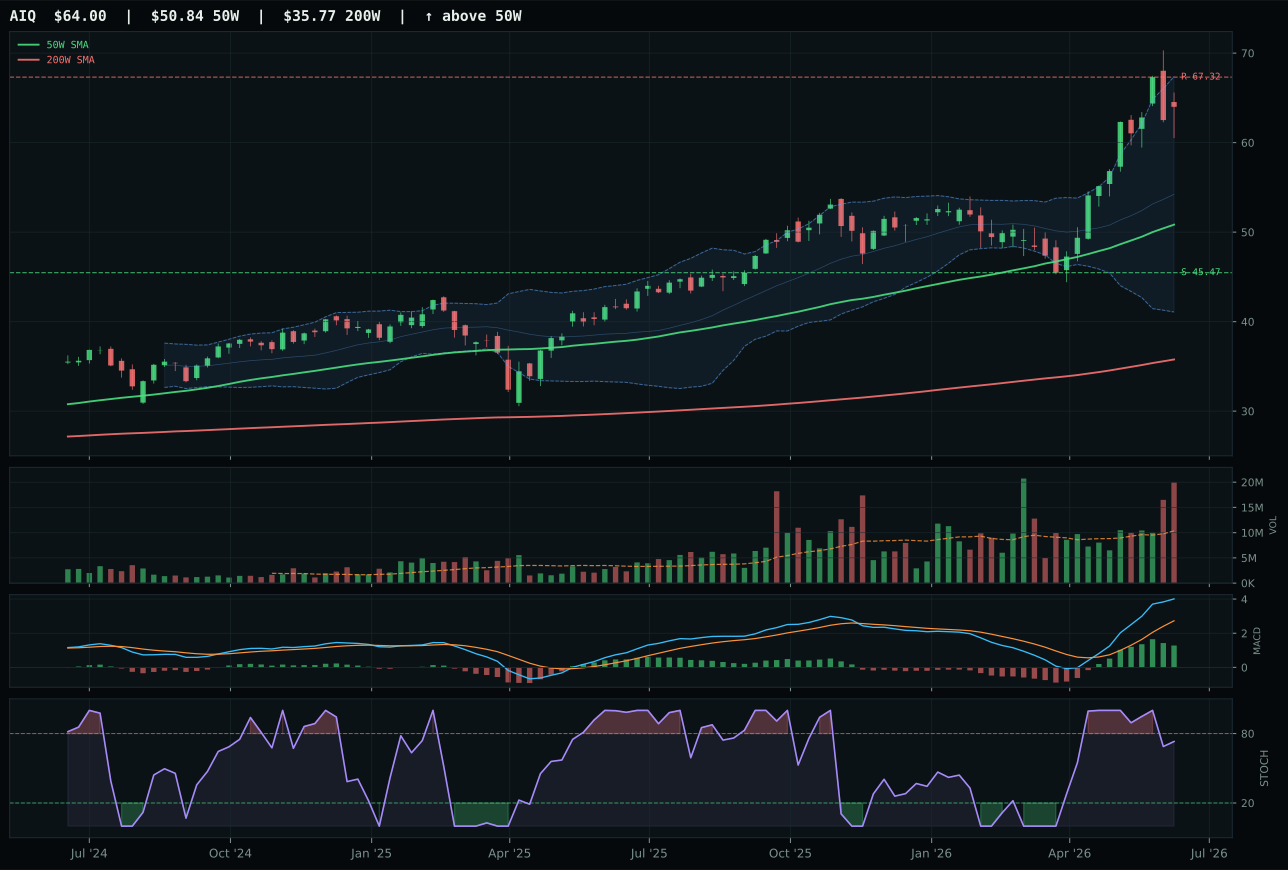
- Why runner-up lost: AIQ lost to SMH because category-relative strength lagged (0.0% vs 26.0%). AIQ's setup is vertical extension, with 13W RS vs SPY at 20.7% and support/resistance at 45.47/67.32. Its MACD is bullish but flattening, stochastic RSI is falling/neutral, volume is thin participation, and Fib location is upper retracement / momentum zone.
- ETF basket: AIQ, SMH, BOTZ.
- Category score assets: SMH, AIQ, BOTZ.
- Category score: 82.0, calculated with the 3/2/1 weighted ETF basket formula: first-ranked ETF x3, second-ranked ETF x2, third-ranked ETF x1, divided by 6.
- Final category method: stagflation scarcity. The weighted basket score is only the starting evidence. The final category score applies the proof-burden layer: weighted basket strength, relative-strength leadership, volume-price sponsorship, persistence, timing, risk/reward, setup quality, and macro stance/cap rules. Favored categories still need confirmation; neutral categories win only on evidence; headwind categories are capped unless sponsorship is exceptional.
- Asset selection playbook: stagflation scarcity. The representative ETF is chosen separately from the category score by the four-week ETF execution score. That score prioritizes peer leadership, price/volume sponsorship, trend persistence, MACD confirmation, stochastic RSI timing, support/resistance asymmetry, and extension risk. The active macro regime changes the weight of those inputs: risk-on regimes emphasize leadership and upside sponsorship; reflation regimes emphasize volume-backed breakouts and commodity breadth; slowdown/disinflation regimes emphasize quality pullbacks and risk/reward; risk-off regimes emphasize defensive relative strength and lower failure risk. The category also changes the execution formula: AI/Technology reward leadership, Utilities/Defense reward defensive relative strength and failure avoidance, and commodity sleeves require more price/volume confirmation, support/retest quality, and extension discipline.
- Macro alignment: AI has a mixed macro backdrop in Risk-Off Deterioration. Technical/breadth score 40.9, macro tailwind -1.6, risk adjustment -2.0 (growth/high-beta risk haircut; macro risk 46.4, credit stress 68.3, liquidity 38.0, dollar pressure 48.5), macro-adjusted pre-strategic-bias score 37.2.
- Category allocation rationale: ETF basket: SMH, AIQ, BOTZ. The 3/2/1 weighted ETF basket score is 82.0, calculated as ((first-ranked ETF x 3) + (second-ranked ETF x 2) + (third-ranked ETF x 1)) / 6 using the active category-plus-macro execution score. The final category score is 40.9, after the institutional proof-burden layer checks macro stance, basket confirmation, volume-price sponsorship, persistence, relative strength, and whether risk/reward is dominating actual leadership. The category representative is chosen separately by the four-week ETF execution score, which emphasizes peer leadership, volume-price sponsorship, persistence, and clean entry quality. The basket contributes this evidence: SMH: category/macro score 106.8, volume-price 75.0, persistence 100.0, trend 100.0, timing 22.0, 13W RS vs SPY 46.8%, setup vertical extension, volume thin participation at 0.20x 20W average | AIQ: category/macro score 79.2, volume-price 71.8, persistence 79.5, trend 100.0, timing 48.0, 13W RS vs SPY 20.7%, setup vertical extension, volume thin participation at 0.33x 20W average | BOTZ: category/macro score 12.9, volume-price 21.9, persistence 23.9, trend 76.2, timing 100.0, 13W RS vs SPY -3.9%, setup compression near 50W, volume thin participation at 0.17x 20W average. Tactical edge is a four-week basket leadership score. It blends the 3/2/1 weighted ETF basket score 82.0, second-ranked ETF confirmation 79.2, weakest-member score 12.9, relative-strength leadership 69.1, volume-price confirmation 56.2, persistence 67.8, proof score 67.2, and macro-playbook prior 52.0. The final blend is 40% ETF-basket proof and 60% macro/narrative playbook fit before hard penalties, concentration/separation adjustment -5.2, and macro stance adjustment -12.0. The active category stance is headwind: macro is working against the category, so it needs exceptional relative strength and volume sponsorship before it can receive an overweight. 2 of 3 ETFs confirmed with enough score, volume-price evidence, and SPY-relative behavior; 0 had positive volume sponsorship. This asks whether the active macro playbook, price strength, volume participation, and peer-relative leadership agree over the four-week tranche window, not merely whether the category has attractive constituents or a clean-looking support level. The category was penalized because it was fighting the active macro playbook without exceptional basket confirmation. Macro-condition playbook scoring was not available, so the category relies on price, breadth, and volume confirmation. Final category score 40.9 is the category-plus-macro playbook score. Macro tailwind -1.6 and risk adjustment -2.0 are logged as context and eligibility inputs, not added as a second score boost. AI has a mixed macro backdrop in Risk-Off Deterioration. Technical/breadth score 40.9, macro tailwind -1.6, risk adjustment -2.0 (growth/high-beta risk haircut; macro risk 46.4, credit stress 68.3, liquidity 38.0, dollar pressure 48.5), macro-adjusted pre-strategic-bias score 37.2.
- Top-2 decision: Not selected for top-2 because either two higher eligible final category scores ranked above it or the category/representative failed eligibility. Final category score 40.9 came from the active stagflation scarcity method, 3/2/1 weighted ETF basket proof-burden score 40.9, and eligibility filters; eligible: True. Representative evidence: trend 100.0/100 from price above the 50W, above the 200W, 50W slope 1.7%, and RS vs SPY 46.8%; structure 76.5/100 from vertical extension, cleanliness 83.3, compression 65.0, support 365.86 and resistance 619.96; timing 22.0/100 from distance to 50W 57.9%, MACD bullish but flattening, stochastic RSI overbought rolling over, and Fib zone near 52W high / extension; risk/reward 39.1/100 from upside to resistance 0.0%, downside to support 69.5%, volume thin participation at 0.20x 20W average; momentum confirmation 100.0/100 from 4W return 7.6%, 13W return 61.1%, category-relative strength 26.0%, MACD bullish but flattening, and volume thin participation; volume-price confirmation 75.0/100 and persistence 100.0/100, which combine trend, relative strength, MACD, and whether volume is confirming or rejecting the price move.
| Rank | Ticker | Score | 13W Return | RS vs SPY | Vol | MACD | StochRSI | Fib Zone | Phase |
|---|---|---|---|---|---|---|---|---|---|
| 1 | SMH | 60.6 | 61.1% | 46.8% | thin participation | bullish but flattening | overbought rolling over | near 52W high / extension | Phase 4: Extended / late trend |
| 2 | AIQ | 72.9 | 35.1% | 20.7% | thin participation | bullish but flattening | falling/neutral | upper retracement / momentum zone | Phase 4: Extended / late trend |
| 3 | BOTZ | 62.0 | 10.5% | -3.9% | thin participation | bearish/weakening | falling/neutral | middle retracement / decision zone | Phase 2: Breakout / repricing |
Defense & Aerospace
- Current basket: ITA, PPA, ROKT
- Winner: ROKT
- Runner-up: PPA
- Winner changed from last week: no
- Why winner represents the category: ROKT wins because price is above the 50W and 200W with a non-deteriorating 50W slope and the chart is extended at 31.0% above the 50W, so strength is being penalized for entry risk. Its 13W return is 18.8%, 26W return is 41.5%, RS versus SPY is 4.4%, and RS versus the category median is 13.8%. It is 31.0% from the 50W with volume at 0.30x its 20W average (thin participation). MACD is bullish but flattening, stochastic RSI is oversold at 0.03, and price sits in the upper retracement / momentum zone near Fib 0.236 at 119.51. Score drivers: trend 100.0/100 from price above the 50W, above the 200W, 50W slope 1.2%, and RS vs SPY 4.4%; structure 76.1/100 from vertical extension, cleanliness 83.3, compression 63.2, support 85.61 and resistance 134.47; timing 48.0/100 from distance to 50W 31.0%, MACD bullish but flattening, stochastic RSI oversold, and Fib zone upper retracement / momentum zone; risk/reward 49.8/100 from upside to resistance -10.8%, downside to support 40.2%, volume thin participation at 0.30x 20W average; momentum confirmation 89.4/100 from 4W return -4.3%, 13W return 18.8%, category-relative strength 13.8%, MACD bullish but flattening, and volume thin participation; volume-price confirmation 72.0/100 and persistence 73.1/100, which combine trend, relative strength, MACD, and whether volume is confirming or rejecting the price move. That blend is why the selection is being driven by timing/risk-reward as much as raw strength. The score gap versus PPA is -9.6 points, so this is a clear category decision.
- Why runner-up lost: PPA lost to ROKT because structure was less clean (74.2 vs 76.1); MACD confirmation was weaker (bearish but improving vs bullish but flattening); category-relative strength lagged (-2.1% vs 13.8%). PPA's setup is neutral structure, with 13W RS vs SPY at -11.5% and support/resistance at 158.94/181.07. Its MACD is bearish but improving, stochastic RSI is rising mid-zone, volume is thin participation, and Fib location is upper retracement / momentum zone.
- ETF basket: ITA, PPA, ROKT.
- Category score assets: ROKT, ITA, PPA.
- Category score: 66.9, calculated with the 3/2/1 weighted ETF basket formula: first-ranked ETF x3, second-ranked ETF x2, third-ranked ETF x1, divided by 6.
- Final category method: stagflation scarcity. The weighted basket score is only the starting evidence. The final category score applies the proof-burden layer: weighted basket strength, relative-strength leadership, volume-price sponsorship, persistence, timing, risk/reward, setup quality, and macro stance/cap rules. Favored categories still need confirmation; neutral categories win only on evidence; headwind categories are capped unless sponsorship is exceptional.
- Asset selection playbook: stagflation scarcity. The representative ETF is chosen separately from the category score by the four-week ETF execution score. That score prioritizes peer leadership, price/volume sponsorship, trend persistence, MACD confirmation, stochastic RSI timing, support/resistance asymmetry, and extension risk. The active macro regime changes the weight of those inputs: risk-on regimes emphasize leadership and upside sponsorship; reflation regimes emphasize volume-backed breakouts and commodity breadth; slowdown/disinflation regimes emphasize quality pullbacks and risk/reward; risk-off regimes emphasize defensive relative strength and lower failure risk. The category also changes the execution formula: AI/Technology reward leadership, Utilities/Defense reward defensive relative strength and failure avoidance, and commodity sleeves require more price/volume confirmation, support/retest quality, and extension discipline.
- Macro alignment: Defense & Aerospace has a tailwind macro backdrop in Risk-Off Deterioration. Technical/breadth score 54.6, macro tailwind +5.0, risk adjustment +0.0 (neutral risk adjustment; macro risk 46.4, credit stress 68.3, liquidity 38.0, dollar pressure 48.5), macro-adjusted pre-strategic-bias score 59.6.
- Category allocation rationale: ETF basket: ROKT, ITA, PPA. The 3/2/1 weighted ETF basket score is 66.9, calculated as ((first-ranked ETF x 3) + (second-ranked ETF x 2) + (third-ranked ETF x 1)) / 6 using the active category-plus-macro execution score. The final category score is 54.6, after the institutional proof-burden layer checks macro stance, basket confirmation, volume-price sponsorship, persistence, relative strength, and whether risk/reward is dominating actual leadership. The category representative is chosen separately by the four-week ETF execution score, which emphasizes peer leadership, volume-price sponsorship, persistence, and clean entry quality. The basket contributes this evidence: ROKT: category/macro score 81.7, volume-price 72.0, persistence 73.1, trend 100.0, timing 48.0, 13W RS vs SPY 4.4%, setup vertical extension, volume thin participation at 0.30x 20W average | ITA: category/macro score 53.7, volume-price 53.0, persistence 53.6, trend 79.0, timing 75.0, 13W RS vs SPY -9.3%, setup neutral structure, volume thin participation at 0.13x 20W average | PPA: category/macro score 49.0, volume-price 48.3, persistence 51.0, trend 78.0, timing 83.0, 13W RS vs SPY -11.5%, setup neutral structure, volume thin participation at 0.17x 20W average. Tactical edge is a four-week basket leadership score. It blends the 3/2/1 weighted ETF basket score 66.9, second-ranked ETF confirmation 53.8, weakest-member score 49.0, relative-strength leadership 56.4, volume-price confirmation 57.8, persistence 59.2, proof score 56.9, and macro-playbook prior 62.0. The final blend is 40% ETF-basket proof and 60% macro/narrative playbook fit before hard penalties, concentration/separation adjustment -5.4, and macro stance adjustment +0.0. The active category stance is neutral: macro is not decisive, so category-average price, volume, and relative strength decide. 1 of 3 ETFs confirmed with enough score, volume-price evidence, and SPY-relative behavior; 0 had positive volume sponsorship. This asks whether the active macro playbook, price strength, volume participation, and peer-relative leadership agree over the four-week tranche window, not merely whether the category has attractive constituents or a clean-looking support level. Macro-condition playbook scoring was not available, so the category relies on price, breadth, and volume confirmation. Final category score 54.6 is the category-plus-macro playbook score. Macro tailwind +5.0 and risk adjustment +0.0 are logged as context and eligibility inputs, not added as a second score boost. Defense & Aerospace has a tailwind macro backdrop in Risk-Off Deterioration. Technical/breadth score 54.6, macro tailwind +5.0, risk adjustment +0.0 (neutral risk adjustment; macro risk 46.4, credit stress 68.3, liquidity 38.0, dollar pressure 48.5), macro-adjusted pre-strategic-bias score 59.6.
- Top-2 decision: Not selected for top-2 because either two higher eligible final category scores ranked above it or the category/representative failed eligibility. Final category score 54.6 came from the active stagflation scarcity method, 3/2/1 weighted ETF basket proof-burden score 54.6, and eligibility filters; eligible: True. Representative evidence: trend 100.0/100 from price above the 50W, above the 200W, 50W slope 1.2%, and RS vs SPY 4.4%; structure 76.1/100 from vertical extension, cleanliness 83.3, compression 63.2, support 85.61 and resistance 134.47; timing 48.0/100 from distance to 50W 31.0%, MACD bullish but flattening, stochastic RSI oversold, and Fib zone upper retracement / momentum zone; risk/reward 49.8/100 from upside to resistance -10.8%, downside to support 40.2%, volume thin participation at 0.30x 20W average; momentum confirmation 89.4/100 from 4W return -4.3%, 13W return 18.8%, category-relative strength 13.8%, MACD bullish but flattening, and volume thin participation; volume-price confirmation 72.0/100 and persistence 73.1/100, which combine trend, relative strength, MACD, and whether volume is confirming or rejecting the price move.
| Rank | Ticker | Score | 13W Return | RS vs SPY | Vol | MACD | StochRSI | Fib Zone | Phase |
|---|---|---|---|---|---|---|---|---|---|
| 1 | ROKT | 56.4 | 18.8% | 4.4% | thin participation | bullish but flattening | oversold | upper retracement / momentum zone | Phase 4: Extended / late trend |
| 2 | PPA | 66.0 | 2.9% | -11.5% | thin participation | bearish but improving | rising mid-zone | upper retracement / momentum zone | Phase 3: Early trend |
| 3 | ITA | 67.5 | 5.0% | -9.3% | thin participation | bearish but improving | overbought momentum | upper retracement / momentum zone | Phase 3: Early trend |
Agriculture & Livestock
- Current basket: MOO, VEGI, FTAG
- Winner: MOO
- Runner-up: VEGI
- Winner changed from last week: no
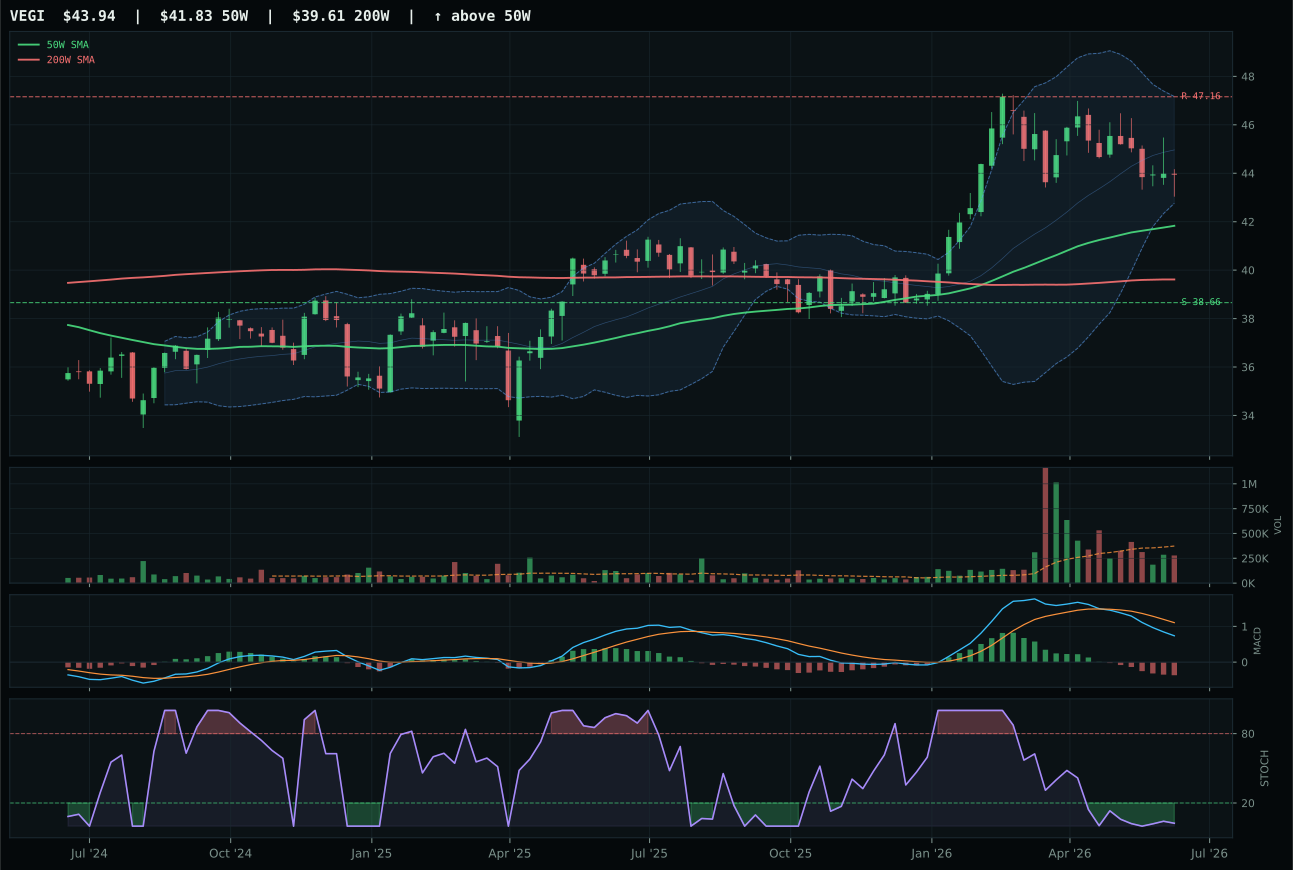
- Why winner represents the category: MOO wins because price is above the 50W and 200W with a non-deteriorating 50W slope and the chart is compressing near the 50W, which can provide expansion potential if buyers defend the level. Its 13W return is -2.0%, 26W return is 5.8%, RS versus SPY is -16.4%, and RS versus the category median is -2.7%. It is 1.7% from the 50W with volume at 0.07x its 20W average (thin participation). MACD is bearish/weakening, stochastic RSI is oversold turn up at 0.00, and price sits in the middle retracement / decision zone near Fib 0.500 at 77.94. Score drivers: trend 57.0/100 from price above the 50W, above the 200W, 50W slope 0.1%, and RS vs SPY -16.4%; structure 63.3/100 from compression near 50W, cleanliness 25.0, compression 84.5, support 73.03 and resistance 85.90; timing 100.0/100 from distance to 50W 1.7%, MACD bearish/weakening, stochastic RSI oversold turn up, and Fib zone middle retracement / decision zone; risk/reward 73.1/100 from upside to resistance -8.5%, downside to support 7.6%, volume thin participation at 0.07x 20W average; momentum confirmation 0.0/100 from 4W return -2.1%, 13W return -2.0%, category-relative strength -2.7%, MACD bearish/weakening, and volume thin participation; volume-price confirmation 26.0/100 and persistence 33.3/100, which combine trend, relative strength, MACD, and whether volume is confirming or rejecting the price move. That blend is why the selection is being driven by timing/risk-reward as much as raw strength. The score gap versus VEGI is 2.8 points, so this is a clear category decision.
- Why runner-up lost: VEGI lost to MOO because timing score was weaker (99.0 vs 100.0); risk/reward was weaker (54.3 vs 73.1). VEGI's setup is neutral structure, with 13W RS vs SPY at -13.7% and support/resistance at 38.83/47.16. Its MACD is bearish/weakening, stochastic RSI is oversold turn up, volume is thin participation, and Fib location is upper retracement / momentum zone.
- ETF basket: MOO, VEGI, FTAG.
- Category score assets: FTAG, VEGI, MOO.
- Category score: 36.5, calculated with the 3/2/1 weighted ETF basket formula: first-ranked ETF x3, second-ranked ETF x2, third-ranked ETF x1, divided by 6.
- Final category method: stagflation scarcity. The weighted basket score is only the starting evidence. The final category score applies the proof-burden layer: weighted basket strength, relative-strength leadership, volume-price sponsorship, persistence, timing, risk/reward, setup quality, and macro stance/cap rules. Favored categories still need confirmation; neutral categories win only on evidence; headwind categories are capped unless sponsorship is exceptional.
- Asset selection playbook: stagflation scarcity. The representative ETF is chosen separately from the category score by the four-week ETF execution score. That score prioritizes peer leadership, price/volume sponsorship, trend persistence, MACD confirmation, stochastic RSI timing, support/resistance asymmetry, and extension risk. The active macro regime changes the weight of those inputs: risk-on regimes emphasize leadership and upside sponsorship; reflation regimes emphasize volume-backed breakouts and commodity breadth; slowdown/disinflation regimes emphasize quality pullbacks and risk/reward; risk-off regimes emphasize defensive relative strength and lower failure risk. The category also changes the execution formula: AI/Technology reward leadership, Utilities/Defense reward defensive relative strength and failure avoidance, and commodity sleeves require more price/volume confirmation, support/retest quality, and extension discipline.
- Macro alignment: Agriculture & Livestock has a tailwind macro backdrop in Risk-Off Deterioration. Technical/breadth score 27.7, macro tailwind +8.9, risk adjustment -0.7 (neutral risk adjustment; macro risk 46.4, credit stress 68.3, liquidity 38.0, dollar pressure 48.5), macro-adjusted pre-strategic-bias score 35.9.
- Category allocation rationale: ETF basket: FTAG, VEGI, MOO. The 3/2/1 weighted ETF basket score is 36.5, calculated as ((first-ranked ETF x 3) + (second-ranked ETF x 2) + (third-ranked ETF x 1)) / 6 using the active category-plus-macro execution score. The final category score is 27.7, after the institutional proof-burden layer checks macro stance, basket confirmation, volume-price sponsorship, persistence, relative strength, and whether risk/reward is dominating actual leadership. The category representative is chosen separately by the four-week ETF execution score, which emphasizes peer leadership, volume-price sponsorship, persistence, and clean entry quality. The basket contributes this evidence: FTAG: category/macro score 38.8, volume-price 33.6, persistence 40.3, trend 57.0, timing 100.0, 13W RS vs SPY -11.9%, setup neutral structure, volume thin participation at 0.03x 20W average | VEGI: category/macro score 35.2, volume-price 33.7, persistence 39.8, trend 67.0, timing 99.0, 13W RS vs SPY -13.7%, setup neutral structure, volume thin participation at 0.08x 20W average | MOO: category/macro score 32.0, volume-price 26.0, persistence 33.3, trend 57.0, timing 100.0, 13W RS vs SPY -16.4%, setup compression near 50W, volume thin participation at 0.07x 20W average. Tactical edge is a four-week basket leadership score. It blends the 3/2/1 weighted ETF basket score 36.5, second-ranked ETF confirmation 35.2, weakest-member score 32.0, relative-strength leadership 37.7, volume-price confirmation 31.1, persistence 37.8, proof score 33.7, and macro-playbook prior 72.0. The final blend is 40% ETF-basket proof and 60% macro/narrative playbook fit before hard penalties, concentration/separation adjustment -0.0, and macro stance adjustment -6.0. The active category stance is favored: macro and narrative are aligned with the category, but price and volume still have to confirm. 0 of 3 ETFs confirmed with enough score, volume-price evidence, and SPY-relative behavior; 0 had positive volume sponsorship. This asks whether the active macro playbook, price strength, volume participation, and peer-relative leadership agree over the four-week tranche window, not merely whether the category has attractive constituents or a clean-looking support level. The category was penalized because its representative is not top-2 eligible. The category was penalized because a favorable macro label was not enough without two confirmed ETFs. The category was penalized because its macro-friendly cyclical thesis lacked enough volume-backed leadership. The category was also penalized because support/asymmetry was dominating confirmed leadership. 1 ETF(s) failed structural or liquidity checks, so the weighted basket evidence was capped lower. Macro-condition playbook scoring was not available, so the category relies on price, breadth, and volume confirmation. Final category score 27.7 is the category-plus-macro playbook score. Macro tailwind +8.9 and risk adjustment -0.7 are logged as context and eligibility inputs, not added as a second score boost. Agriculture & Livestock has a tailwind macro backdrop in Risk-Off Deterioration. Technical/breadth score 27.7, macro tailwind +8.9, risk adjustment -0.7 (neutral risk adjustment; macro risk 46.4, credit stress 68.3, liquidity 38.0, dollar pressure 48.5), macro-adjusted pre-strategic-bias score 35.9.
- Top-2 decision: Not selected for top-2 because either two higher eligible final category scores ranked above it or the category/representative failed eligibility. Final category score 27.7 came from the active stagflation scarcity method, 3/2/1 weighted ETF basket proof-burden score 27.7, and eligibility filters; eligible: True. Representative evidence: trend 57.0/100 from price above the 50W, above the 200W, 50W slope 0.1%, and RS vs SPY -16.4%; structure 63.3/100 from compression near 50W, cleanliness 25.0, compression 84.5, support 73.03 and resistance 85.90; timing 100.0/100 from distance to 50W 1.7%, MACD bearish/weakening, stochastic RSI oversold turn up, and Fib zone middle retracement / decision zone; risk/reward 73.1/100 from upside to resistance -8.5%, downside to support 7.6%, volume thin participation at 0.07x 20W average; momentum confirmation 0.0/100 from 4W return -2.1%, 13W return -2.0%, category-relative strength -2.7%, MACD bearish/weakening, and volume thin participation; volume-price confirmation 26.0/100 and persistence 33.3/100, which combine trend, relative strength, MACD, and whether volume is confirming or rejecting the price move.
| Rank | Ticker | Score | 13W Return | RS vs SPY | Vol | MACD | StochRSI | Fib Zone | Phase |
|---|---|---|---|---|---|---|---|---|---|
| 1 | MOO | 64.8 | -2.0% | -16.4% | thin participation | bearish/weakening | oversold turn up | middle retracement / decision zone | Phase 3: Early trend |
| 2 | VEGI | 62.0 | 0.7% | -13.7% | thin participation | bearish/weakening | oversold turn up | upper retracement / momentum zone | Phase 3: Early trend |
| 3 | FTAG | 42.1 | 2.4% | -11.9% | thin participation | bearish/weakening | oversold turn up | middle retracement / decision zone | Phase 3: Early trend |
Precious Metals
- Current basket: GLD, SLV, GDX
- Winner: SLV
- Runner-up: GDX
- Winner changed from last week: no
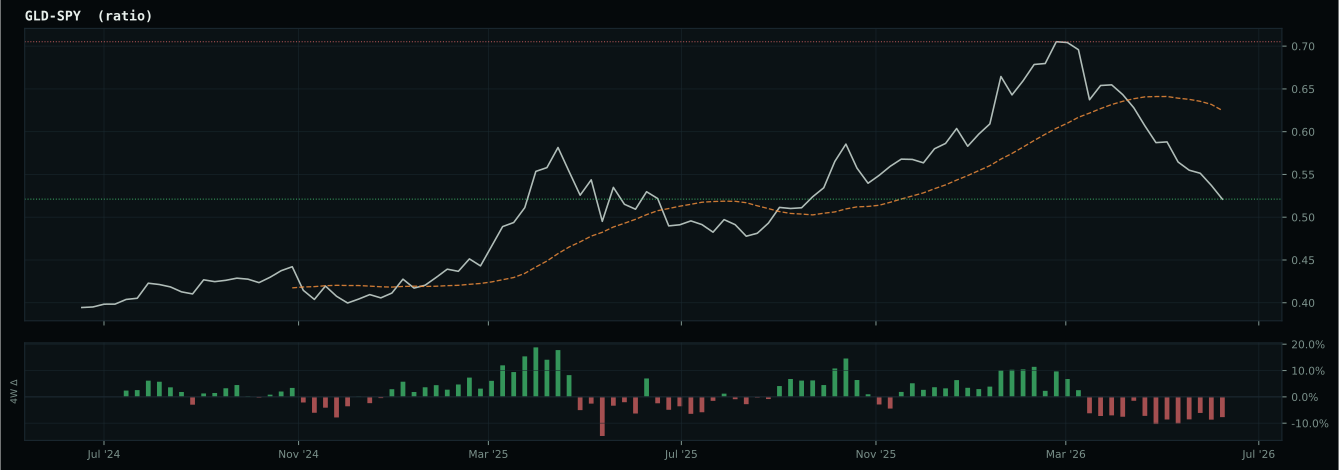
- Why winner represents the category: SLV wins because price is above the 50W and 200W with a non-deteriorating 50W slope and the chart is pulling into support near 61.29, giving the setup a defined invalidation area. Its 13W return is -0.4%, 26W return is 0.6%, RS versus SPY is -14.7%, and RS versus the category median is 0.0%. It is 7.2% from the 50W with volume at 0.10x its 20W average (thin participation). MACD is bearish/weakening, stochastic RSI is oversold at 0.00, and price sits in the deep retracement / value zone near Fib 0.618 at 61.77. Score drivers: trend 67.0/100 from price above the 50W, above the 200W, 50W slope 1.0%, and RS vs SPY -14.7%; structure 59.4/100 from pullback into support, cleanliness 41.7, compression 44.1, support 61.29 and resistance 92.91; timing 87.0/100 from distance to 50W 7.2%, MACD bearish/weakening, stochastic RSI oversold, and Fib zone deep retracement / value zone; risk/reward 83.0/100 from upside to resistance -34.0%, downside to support 0.0%, volume thin participation at 0.10x 20W average; momentum confirmation 0.0/100 from 4W return -10.3%, 13W return -0.4%, category-relative strength 0.0%, MACD bearish/weakening, and volume thin participation; volume-price confirmation 29.7/100 and persistence 30.5/100, which combine trend, relative strength, MACD, and whether volume is confirming or rejecting the price move. That blend is why the selection is being driven by timing/risk-reward as much as raw strength. The score gap versus GDX is 12.9 points, so this is a clear category decision.
- Why runner-up lost: GDX lost to SLV because risk/reward was weaker (75.0 vs 83.0). GDX's setup is pullback into support, with 13W RS vs SPY at -14.5% and support/resistance at 78.84/115.84. Its MACD is bearish/weakening, stochastic RSI is oversold, volume is thin participation, and Fib location is middle retracement / decision zone.
- ETF basket: GLD, SLV, GDX.
- Category score assets: GDX, SLV, GLD.
- Category score: 29.9, calculated with the 3/2/1 weighted ETF basket formula: first-ranked ETF x3, second-ranked ETF x2, third-ranked ETF x1, divided by 6.
- Final category method: stagflation scarcity. The weighted basket score is only the starting evidence. The final category score applies the proof-burden layer: weighted basket strength, relative-strength leadership, volume-price sponsorship, persistence, timing, risk/reward, setup quality, and macro stance/cap rules. Favored categories still need confirmation; neutral categories win only on evidence; headwind categories are capped unless sponsorship is exceptional.
- Asset selection playbook: stagflation scarcity. The representative ETF is chosen separately from the category score by the four-week ETF execution score. That score prioritizes peer leadership, price/volume sponsorship, trend persistence, MACD confirmation, stochastic RSI timing, support/resistance asymmetry, and extension risk. The active macro regime changes the weight of those inputs: risk-on regimes emphasize leadership and upside sponsorship; reflation regimes emphasize volume-backed breakouts and commodity breadth; slowdown/disinflation regimes emphasize quality pullbacks and risk/reward; risk-off regimes emphasize defensive relative strength and lower failure risk. The category also changes the execution formula: AI/Technology reward leadership, Utilities/Defense reward defensive relative strength and failure avoidance, and commodity sleeves require more price/volume confirmation, support/retest quality, and extension discipline.
- Macro alignment: Precious Metals has a tailwind macro backdrop in Risk-Off Deterioration. Technical/breadth score 60.0, macro tailwind +4.8, risk adjustment +0.0 (neutral risk adjustment; macro risk 46.4, credit stress 68.3, liquidity 38.0, dollar pressure 48.5), macro-adjusted pre-strategic-bias score 64.8.
- Category allocation rationale: ETF basket: GDX, SLV, GLD. The 3/2/1 weighted ETF basket score is 29.9, calculated as ((first-ranked ETF x 3) + (second-ranked ETF x 2) + (third-ranked ETF x 1)) / 6 using the active category-plus-macro execution score. The final category score is 60.0, after the institutional proof-burden layer checks macro stance, basket confirmation, volume-price sponsorship, persistence, relative strength, and whether risk/reward is dominating actual leadership. The category representative is chosen separately by the four-week ETF execution score, which emphasizes peer leadership, volume-price sponsorship, persistence, and clean entry quality. The basket contributes this evidence: GDX: category/macro score 31.7, volume-price 26.5, persistence 27.1, trend 52.0, timing 100.0, 13W RS vs SPY -14.5%, setup pullback into support, volume thin participation at 0.21x 20W average | SLV: category/macro score 31.0, volume-price 29.7, persistence 30.5, trend 67.0, timing 87.0, 13W RS vs SPY -14.7%, setup pullback into support, volume thin participation at 0.10x 20W average | GLD: category/macro score 22.5, volume-price 12.6, persistence 19.4, trend 52.0, timing 100.0, 13W RS vs SPY -20.9%, setup pullback into support, volume thin participation at 0.14x 20W average. Tactical edge is a four-week basket leadership score. It blends the 3/2/1 weighted ETF basket score 29.9, second-ranked ETF confirmation 30.9, weakest-member score 22.5, relative-strength leadership 28.5, volume-price confirmation 22.9, persistence 25.6, proof score 27.4, and macro-playbook prior 92.0. The final blend is 40% ETF-basket proof and 60% macro/narrative playbook fit before hard penalties, concentration/separation adjustment -0.0, and macro stance adjustment -6.0. The active category stance is favored: macro and narrative are aligned with the category, but price and volume still have to confirm. 0 of 3 ETFs confirmed with enough score, volume-price evidence, and SPY-relative behavior; 0 had positive volume sponsorship. This asks whether the active macro playbook, price strength, volume participation, and peer-relative leadership agree over the four-week tranche window, not merely whether the category has attractive constituents or a clean-looking support level. The category was penalized because a favorable macro label was not enough without two confirmed ETFs. Macro-condition playbook scoring was not available, so the category relies on price, breadth, and volume confirmation. Final category score 60.0 is the category-plus-macro playbook score. Macro tailwind +4.8 and risk adjustment +0.0 are logged as context and eligibility inputs, not added as a second score boost. Precious Metals has a tailwind macro backdrop in Risk-Off Deterioration. Technical/breadth score 60.0, macro tailwind +4.8, risk adjustment +0.0 (neutral risk adjustment; macro risk 46.4, credit stress 68.3, liquidity 38.0, dollar pressure 48.5), macro-adjusted pre-strategic-bias score 64.8.
- Top-2 decision: Selected for top-2 because Precious Metals ranked among the two highest eligible final category scores at 60.0. That score came from the active stagflation scarcity method, 3/2/1 weighted ETF basket proof-burden score 60.0, and representative evidence: trend 67.0/100 from price above the 50W, above the 200W, 50W slope 1.0%, and RS vs SPY -14.7%; structure 59.4/100 from pullback into support, cleanliness 41.7, compression 44.1, support 61.29 and resistance 92.91; timing 87.0/100 from distance to 50W 7.2%, MACD bearish/weakening, stochastic RSI oversold, and Fib zone deep retracement / value zone; risk/reward 83.0/100 from upside to resistance -34.0%, downside to support 0.0%, volume thin participation at 0.10x 20W average; momentum confirmation 0.0/100 from 4W return -10.3%, 13W return -0.4%, category-relative strength 0.0%, MACD bearish/weakening, and volume thin participation; volume-price confirmation 29.7/100 and persistence 30.5/100, which combine trend, relative strength, MACD, and whether volume is confirming or rejecting the price move.
| Rank | Ticker | Score | 13W Return | RS vs SPY | Vol | MACD | StochRSI | Fib Zone | Phase |
|---|---|---|---|---|---|---|---|---|---|
| 1 | SLV | 57.4 | -0.4% | -14.7% | thin participation | bearish/weakening | oversold | deep retracement / value zone | Phase 2: Breakout / repricing |
| 2 | GDX | 44.5 | -0.1% | -14.5% | thin participation | bearish/weakening | oversold | middle retracement / decision zone | Phase 1: Base / accumulation |
| 3 | GLD | 38.6 | -6.5% | -20.9% | thin participation | bearish/weakening | oversold | middle retracement / decision zone | Phase 1: Base / accumulation |
Industrial Metals
- Current basket: COPX, REMX, PICK
- Winner: COPX
- Runner-up: PICK
- Winner changed from last week: no
- Why winner represents the category: COPX wins because price is above the 50W and 200W with a non-deteriorating 50W slope and the chart is extended at 23.7% above the 50W, so strength is being penalized for entry risk. Its 13W return is 24.4%, 26W return is 22.3%, RS versus SPY is 10.1%, and RS versus the category median is 0.0%. It is 23.7% from the 50W with volume at 0.19x its 20W average (thin participation). MACD is bearish but improving, stochastic RSI is rising mid-zone at 0.63, and price sits in the upper retracement / momentum zone near Fib 0.236 at 86.19. Score drivers: trend 100.0/100 from price above the 50W, above the 200W, 50W slope 1.2%, and RS vs SPY 10.1%; structure 69.1/100 from vertical extension, cleanliness 66.7, compression 54.2, support 69.08 and resistance 95.70; timing 61.0/100 from distance to 50W 23.7%, MACD bearish but improving, stochastic RSI rising mid-zone, and Fib zone upper retracement / momentum zone; risk/reward 37.5/100 from upside to resistance -10.2%, downside to support 24.4%, volume thin participation at 0.19x 20W average; momentum confirmation 91.8/100 from 4W return 3.1%, 13W return 24.4%, category-relative strength 0.0%, MACD bearish but improving, and volume thin participation; volume-price confirmation 67.2/100 and persistence 65.4/100, which combine trend, relative strength, MACD, and whether volume is confirming or rejecting the price move. That blend is why the selection is being driven by timing/risk-reward as much as raw strength. The score gap versus PICK is 11.4 points, so this is a clear category decision.
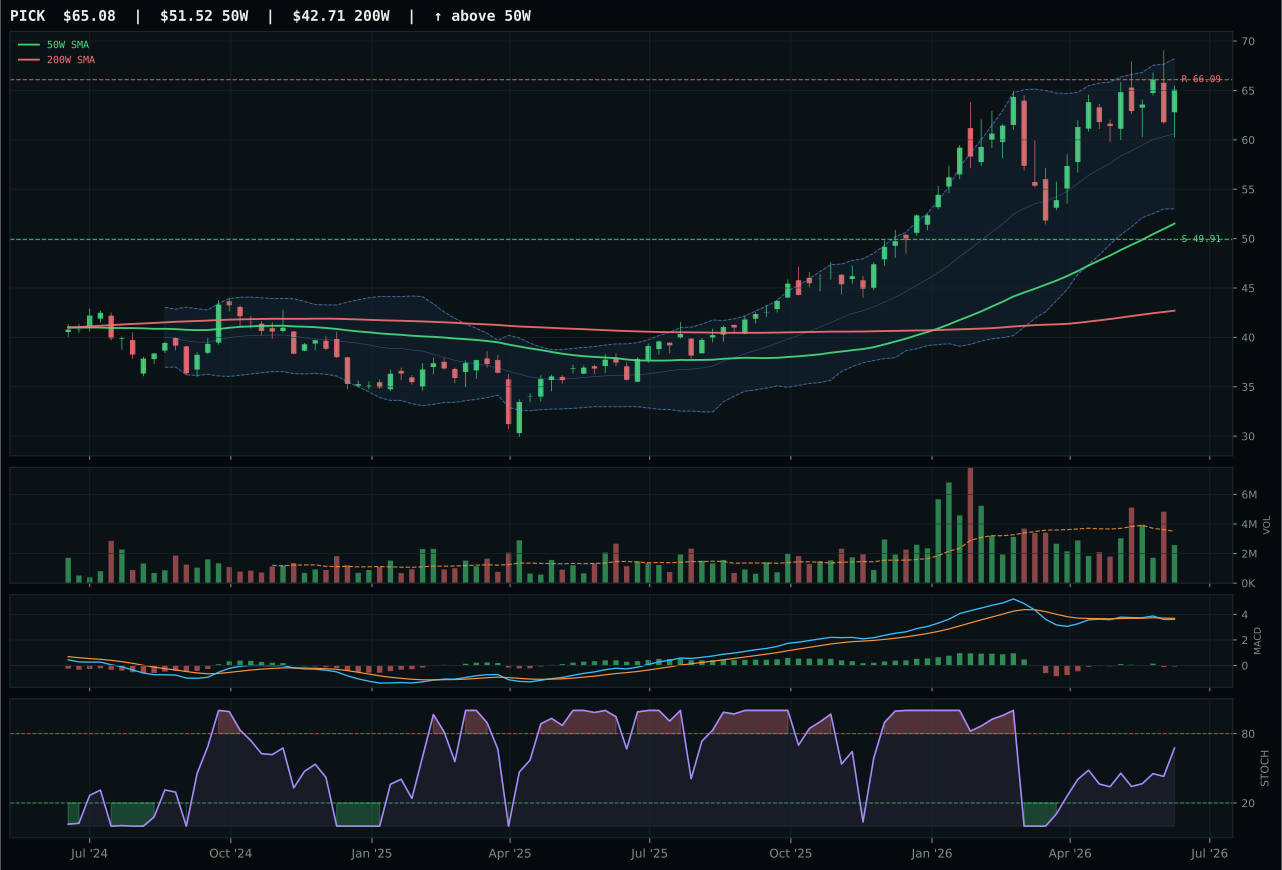
- Why runner-up lost: PICK lost to COPX because timing score was weaker (56.0 vs 61.0). PICK's setup is vertical extension, with 13W RS vs SPY at 11.2% and support/resistance at 51.83/66.09. Its MACD is bearish/weakening, stochastic RSI is rising mid-zone, volume is thin participation, and Fib location is upper retracement / momentum zone.
- ETF basket: COPX, REMX, PICK.
- Category score assets: COPX, PICK, REMX.
- Category score: 66.4, calculated with the 3/2/1 weighted ETF basket formula: first-ranked ETF x3, second-ranked ETF x2, third-ranked ETF x1, divided by 6.
- Final category method: stagflation scarcity. The weighted basket score is only the starting evidence. The final category score applies the proof-burden layer: weighted basket strength, relative-strength leadership, volume-price sponsorship, persistence, timing, risk/reward, setup quality, and macro stance/cap rules. Favored categories still need confirmation; neutral categories win only on evidence; headwind categories are capped unless sponsorship is exceptional.
- Asset selection playbook: stagflation scarcity. The representative ETF is chosen separately from the category score by the four-week ETF execution score. That score prioritizes peer leadership, price/volume sponsorship, trend persistence, MACD confirmation, stochastic RSI timing, support/resistance asymmetry, and extension risk. The active macro regime changes the weight of those inputs: risk-on regimes emphasize leadership and upside sponsorship; reflation regimes emphasize volume-backed breakouts and commodity breadth; slowdown/disinflation regimes emphasize quality pullbacks and risk/reward; risk-off regimes emphasize defensive relative strength and lower failure risk. The category also changes the execution formula: AI/Technology reward leadership, Utilities/Defense reward defensive relative strength and failure avoidance, and commodity sleeves require more price/volume confirmation, support/retest quality, and extension discipline.
- Macro alignment: Industrial Metals has a tailwind macro backdrop in Risk-Off Deterioration. Technical/breadth score 58.0, macro tailwind +3.9, risk adjustment -1.5 (growth/high-beta risk haircut; macro risk 46.4, credit stress 68.3, liquidity 38.0, dollar pressure 48.5), macro-adjusted pre-strategic-bias score 60.4.
- Category allocation rationale: ETF basket: COPX, PICK, REMX. The 3/2/1 weighted ETF basket score is 66.4, calculated as ((first-ranked ETF x 3) + (second-ranked ETF x 2) + (third-ranked ETF x 1)) / 6 using the active category-plus-macro execution score. The final category score is 58.0, after the institutional proof-burden layer checks macro stance, basket confirmation, volume-price sponsorship, persistence, relative strength, and whether risk/reward is dominating actual leadership. The category representative is chosen separately by the four-week ETF execution score, which emphasizes peer leadership, volume-price sponsorship, persistence, and clean entry quality. The basket contributes this evidence: COPX: category/macro score 69.5, volume-price 67.2, persistence 65.4, trend 100.0, timing 61.0, 13W RS vs SPY 10.1%, setup vertical extension, volume thin participation at 0.19x 20W average | PICK: category/macro score 68.4, volume-price 53.9, persistence 57.3, trend 92.0, timing 56.0, 13W RS vs SPY 11.2%, setup vertical extension, volume thin participation at 0.20x 20W average | REMX: category/macro score 53.3, volume-price 41.1, persistence 49.5, trend 81.5, timing 48.0, 13W RS vs SPY 6.4%, setup vertical extension, volume thin participation at 0.14x 20W average. Tactical edge is a four-week basket leadership score. It blends the 3/2/1 weighted ETF basket score 66.4, second-ranked ETF confirmation 68.4, weakest-member score 53.3, relative-strength leadership 71.1, volume-price confirmation 54.1, persistence 57.4, proof score 64.6, and macro-playbook prior 67.0. The final blend is 40% ETF-basket proof and 60% macro/narrative playbook fit before hard penalties, concentration/separation adjustment -0.0, and macro stance adjustment +0.0. The active category stance is neutral: macro is not decisive, so category-average price, volume, and relative strength decide. 1 of 3 ETFs confirmed with enough score, volume-price evidence, and SPY-relative behavior; 0 had positive volume sponsorship. This asks whether the active macro playbook, price strength, volume participation, and peer-relative leadership agree over the four-week tranche window, not merely whether the category has attractive constituents or a clean-looking support level. The category was penalized because its macro-friendly cyclical thesis lacked enough volume-backed leadership. Macro-condition playbook scoring was not available, so the category relies on price, breadth, and volume confirmation. Final category score 58.0 is the category-plus-macro playbook score. Macro tailwind +3.9 and risk adjustment -1.5 are logged as context and eligibility inputs, not added as a second score boost. Industrial Metals has a tailwind macro backdrop in Risk-Off Deterioration. Technical/breadth score 58.0, macro tailwind +3.9, risk adjustment -1.5 (growth/high-beta risk haircut; macro risk 46.4, credit stress 68.3, liquidity 38.0, dollar pressure 48.5), macro-adjusted pre-strategic-bias score 60.4.
- Top-2 decision: Selected for top-2 because Industrial Metals ranked among the two highest eligible final category scores at 58.0. That score came from the active stagflation scarcity method, 3/2/1 weighted ETF basket proof-burden score 58.0, and representative evidence: trend 100.0/100 from price above the 50W, above the 200W, 50W slope 1.2%, and RS vs SPY 10.1%; structure 69.1/100 from vertical extension, cleanliness 66.7, compression 54.2, support 69.08 and resistance 95.70; timing 61.0/100 from distance to 50W 23.7%, MACD bearish but improving, stochastic RSI rising mid-zone, and Fib zone upper retracement / momentum zone; risk/reward 37.5/100 from upside to resistance -10.2%, downside to support 24.4%, volume thin participation at 0.19x 20W average; momentum confirmation 91.8/100 from 4W return 3.1%, 13W return 24.4%, category-relative strength 0.0%, MACD bearish but improving, and volume thin participation; volume-price confirmation 67.2/100 and persistence 65.4/100, which combine trend, relative strength, MACD, and whether volume is confirming or rejecting the price move.
| Rank | Ticker | Score | 13W Return | RS vs SPY | Vol | MACD | StochRSI | Fib Zone | Phase |
|---|---|---|---|---|---|---|---|---|---|
| 1 | COPX | 69.7 | 24.4% | 10.1% | thin participation | bearish but improving | rising mid-zone | upper retracement / momentum zone | Phase 4: Extended / late trend |
| 2 | PICK | 58.3 | 25.6% | 11.2% | thin participation | bearish/weakening | rising mid-zone | upper retracement / momentum zone | Phase 4: Extended / late trend |
| 3 | REMX | 54.8 | 20.7% | 6.4% | thin participation | bearish/weakening | falling/neutral | upper retracement / momentum zone | Phase 4: Extended / late trend |
Natural Gas
- Current basket: FCG, MLPX, ENFR
- Winner: ENFR
- Runner-up: FCG
- Winner changed from last week: no
- Why winner represents the category: ENFR wins because price is above the 50W and 200W with a non-deteriorating 50W slope and the structure is neutral, so the allocator needs the score to be supported by breadth, liquidity, and relative strength. Its 13W return is 2.2%, 26W return is 26.1%, RS versus SPY is -12.1%, and RS versus the category median is 1.1%. It is 14.0% from the 50W with volume at 0.11x its 20W average (thin participation). MACD is bearish/weakening, stochastic RSI is oversold turn up at 0.16, and price sits in the upper retracement / momentum zone near Fib 0.236 at 38.07. Score drivers: trend 67.0/100 from price above the 50W, above the 200W, 50W slope 0.4%, and RS vs SPY -12.1%; structure 71.9/100 from neutral structure, cleanliness 58.3, compression 78.2, support 31.05 and resistance 40.29; timing 84.0/100 from distance to 50W 14.0%, MACD bearish/weakening, stochastic RSI oversold turn up, and Fib zone upper retracement / momentum zone; risk/reward 47.7/100 from upside to resistance -3.7%, downside to support 24.9%, volume thin participation at 0.11x 20W average; momentum confirmation 12.3/100 from 4W return -3.7%, 13W return 2.2%, category-relative strength 1.1%, MACD bearish/weakening, and volume thin participation; volume-price confirmation 34.1/100 and persistence 38.2/100, which combine trend, relative strength, MACD, and whether volume is confirming or rejecting the price move. That blend is why the selection is being driven by timing/risk-reward as much as raw strength. The score gap versus FCG is 9.0 points, so this is a clear category decision.
- Why runner-up lost: FCG lost to ENFR because structure was less clean (66.0 vs 71.9); category-relative strength lagged (-8.5% vs 1.1%). FCG's setup is neutral structure, with 13W RS vs SPY at -21.8% and support/resistance at 23.10/32.74. Its MACD is bearish/weakening, stochastic RSI is oversold turn up, volume is thin participation, and Fib location is upper retracement / momentum zone.
- ETF basket: FCG, MLPX, ENFR.
- Category score assets: ENFR, MLPX, FCG.
- Category score: 36.2, calculated with the 3/2/1 weighted ETF basket formula: first-ranked ETF x3, second-ranked ETF x2, third-ranked ETF x1, divided by 6.
- Final category method: stagflation scarcity. The weighted basket score is only the starting evidence. The final category score applies the proof-burden layer: weighted basket strength, relative-strength leadership, volume-price sponsorship, persistence, timing, risk/reward, setup quality, and macro stance/cap rules. Favored categories still need confirmation; neutral categories win only on evidence; headwind categories are capped unless sponsorship is exceptional.
- Asset selection playbook: stagflation scarcity. The representative ETF is chosen separately from the category score by the four-week ETF execution score. That score prioritizes peer leadership, price/volume sponsorship, trend persistence, MACD confirmation, stochastic RSI timing, support/resistance asymmetry, and extension risk. The active macro regime changes the weight of those inputs: risk-on regimes emphasize leadership and upside sponsorship; reflation regimes emphasize volume-backed breakouts and commodity breadth; slowdown/disinflation regimes emphasize quality pullbacks and risk/reward; risk-off regimes emphasize defensive relative strength and lower failure risk. The category also changes the execution formula: AI/Technology reward leadership, Utilities/Defense reward defensive relative strength and failure avoidance, and commodity sleeves require more price/volume confirmation, support/retest quality, and extension discipline.
- Macro alignment: Natural Gas has a tailwind macro backdrop in Risk-Off Deterioration. Technical/breadth score 41.0, macro tailwind +8.9, risk adjustment -1.5 (growth/high-beta risk haircut; macro risk 46.4, credit stress 68.3, liquidity 38.0, dollar pressure 48.5), macro-adjusted pre-strategic-bias score 48.4.
- Category allocation rationale: ETF basket: ENFR, MLPX, FCG. The 3/2/1 weighted ETF basket score is 36.2, calculated as ((first-ranked ETF x 3) + (second-ranked ETF x 2) + (third-ranked ETF x 1)) / 6 using the active category-plus-macro execution score. The final category score is 41.0, after the institutional proof-burden layer checks macro stance, basket confirmation, volume-price sponsorship, persistence, relative strength, and whether risk/reward is dominating actual leadership. The category representative is chosen separately by the four-week ETF execution score, which emphasizes peer leadership, volume-price sponsorship, persistence, and clean entry quality. The basket contributes this evidence: ENFR: category/macro score 40.8, volume-price 34.1, persistence 38.2, trend 67.0, timing 84.0, 13W RS vs SPY -12.1%, setup neutral structure, volume thin participation at 0.11x 20W average | MLPX: category/macro score 38.5, volume-price 31.9, persistence 36.4, trend 67.0, timing 84.0, 13W RS vs SPY -13.2%, setup neutral structure, volume thin participation at 0.19x 20W average | FCG: category/macro score 17.6, volume-price 24.6, persistence 24.5, trend 67.0, timing 84.0, 13W RS vs SPY -21.8%, setup neutral structure, volume thin participation at 0.12x 20W average. Tactical edge is a four-week basket leadership score. It blends the 3/2/1 weighted ETF basket score 36.2, second-ranked ETF confirmation 38.5, weakest-member score 17.6, relative-strength leadership 37.1, volume-price confirmation 30.2, persistence 33.0, proof score 32.1, and macro-playbook prior 82.0. The final blend is 40% ETF-basket proof and 60% macro/narrative playbook fit before hard penalties, concentration/separation adjustment -0.0, and macro stance adjustment -6.0. The active category stance is favored: macro and narrative are aligned with the category, but price and volume still have to confirm. 0 of 3 ETFs confirmed with enough score, volume-price evidence, and SPY-relative behavior; 0 had positive volume sponsorship. This asks whether the active macro playbook, price strength, volume participation, and peer-relative leadership agree over the four-week tranche window, not merely whether the category has attractive constituents or a clean-looking support level. The category was penalized because a favorable macro label was not enough without two confirmed ETFs. The category was penalized because its macro-friendly cyclical thesis lacked enough volume-backed leadership. The category was also penalized because support/asymmetry was dominating confirmed leadership. Macro-condition playbook scoring was not available, so the category relies on price, breadth, and volume confirmation. Final category score 41.0 is the category-plus-macro playbook score. Macro tailwind +8.9 and risk adjustment -1.5 are logged as context and eligibility inputs, not added as a second score boost. Natural Gas has a tailwind macro backdrop in Risk-Off Deterioration. Technical/breadth score 41.0, macro tailwind +8.9, risk adjustment -1.5 (growth/high-beta risk haircut; macro risk 46.4, credit stress 68.3, liquidity 38.0, dollar pressure 48.5), macro-adjusted pre-strategic-bias score 48.4.
- Top-2 decision: Not selected for top-2 because either two higher eligible final category scores ranked above it or the category/representative failed eligibility. Final category score 41.0 came from the active stagflation scarcity method, 3/2/1 weighted ETF basket proof-burden score 41.0, and eligibility filters; eligible: True. Representative evidence: trend 67.0/100 from price above the 50W, above the 200W, 50W slope 0.4%, and RS vs SPY -12.1%; structure 71.9/100 from neutral structure, cleanliness 58.3, compression 78.2, support 31.05 and resistance 40.29; timing 84.0/100 from distance to 50W 14.0%, MACD bearish/weakening, stochastic RSI oversold turn up, and Fib zone upper retracement / momentum zone; risk/reward 47.7/100 from upside to resistance -3.7%, downside to support 24.9%, volume thin participation at 0.11x 20W average; momentum confirmation 12.3/100 from 4W return -3.7%, 13W return 2.2%, category-relative strength 1.1%, MACD bearish/weakening, and volume thin participation; volume-price confirmation 34.1/100 and persistence 38.2/100, which combine trend, relative strength, MACD, and whether volume is confirming or rejecting the price move.
| Rank | Ticker | Score | 13W Return | RS vs SPY | Vol | MACD | StochRSI | Fib Zone | Phase |
|---|---|---|---|---|---|---|---|---|---|
| 1 | ENFR | 58.7 | 2.2% | -12.1% | thin participation | bearish/weakening | oversold turn up | upper retracement / momentum zone | Phase 3: Early trend |
| 2 | FCG | 49.8 | -7.4% | -21.8% | thin participation | bearish/weakening | oversold turn up | upper retracement / momentum zone | Phase 2: Breakout / repricing |
| 3 | MLPX | 51.0 | 1.1% | -13.2% | thin participation | bearish/weakening | oversold turn up | upper retracement / momentum zone | Phase 3: Early trend |
Uranium
- Current basket: URNM, NLR, NUKZ
- Winner: URNM
- Runner-up: NLR
- Winner changed from last week: no
- Why winner represents the category: URNM wins because price is below the 50W but still above the 200W, which makes this more of a reset/pullback setup than a momentum chase and the chart is pulling into support near 54.58, giving the setup a defined invalidation area. Its 13W return is -6.1%, 26W return is -2.0%, RS versus SPY is -20.5%, and RS versus the category median is -0.8%. It is -8.0% from the 50W with volume at 0.10x its 20W average (thin participation). MACD is bearish/weakening, stochastic RSI is oversold at 0.00, and price sits in the deep retracement / value zone near Fib 0.786 at 52.06. Score drivers: trend 52.0/100 from price below the 50W, above the 200W, 50W slope 0.2%, and RS vs SPY -20.5%; structure 61.2/100 from pullback into support, cleanliness 50.0, compression 41.0, support 54.58 and resistance 75.95; timing 87.0/100 from distance to 50W -8.0%, MACD bearish/weakening, stochastic RSI oversold, and Fib zone deep retracement / value zone; risk/reward 75.0/100 from upside to resistance -28.1%, downside to support 0.0%, volume thin participation at 0.10x 20W average; momentum confirmation 0.0/100 from 4W return -6.3%, 13W return -6.1%, category-relative strength -0.8%, MACD bearish/weakening, and volume thin participation; volume-price confirmation 15.1/100 and persistence 23.4/100, which combine trend, relative strength, MACD, and whether volume is confirming or rejecting the price move. That blend is why the selection is being driven by timing/risk-reward as much as raw strength. The score gap versus NLR is -11.0 points, so this is a clear category decision.
- Why runner-up lost: NLR lost to URNM because URNM had a slightly better total blend of trend, structure, timing, and risk/reward despite NLR's competitive setup. NLR's setup is pullback into support, with 13W RS vs SPY at -19.0% and support/resistance at 121.95/152.79. Its MACD is bearish/weakening, stochastic RSI is oversold, volume is thin participation, and Fib location is deep retracement / value zone.
- ETF basket: URNM, NLR, NUKZ.
- Category score assets: NLR, URNM.
- Category score: 31.5, calculated with the 3/2/1 weighted ETF basket formula: first-ranked ETF x3, second-ranked ETF x2, third-ranked ETF x1, divided by 6.
- Final category method: stagflation scarcity. The weighted basket score is only the starting evidence. The final category score applies the proof-burden layer: weighted basket strength, relative-strength leadership, volume-price sponsorship, persistence, timing, risk/reward, setup quality, and macro stance/cap rules. Favored categories still need confirmation; neutral categories win only on evidence; headwind categories are capped unless sponsorship is exceptional.
- Asset selection playbook: stagflation scarcity. The representative ETF is chosen separately from the category score by the four-week ETF execution score. That score prioritizes peer leadership, price/volume sponsorship, trend persistence, MACD confirmation, stochastic RSI timing, support/resistance asymmetry, and extension risk. The active macro regime changes the weight of those inputs: risk-on regimes emphasize leadership and upside sponsorship; reflation regimes emphasize volume-backed breakouts and commodity breadth; slowdown/disinflation regimes emphasize quality pullbacks and risk/reward; risk-off regimes emphasize defensive relative strength and lower failure risk. The category also changes the execution formula: AI/Technology reward leadership, Utilities/Defense reward defensive relative strength and failure avoidance, and commodity sleeves require more price/volume confirmation, support/retest quality, and extension discipline.
- Macro alignment: Uranium has a tailwind macro backdrop in Risk-Off Deterioration. Technical/breadth score 51.3, macro tailwind +3.9, risk adjustment -1.5 (growth/high-beta risk haircut; macro risk 46.4, credit stress 68.3, liquidity 38.0, dollar pressure 48.5), macro-adjusted pre-strategic-bias score 53.6.
- Category allocation rationale: ETF basket: NLR, URNM. The 3/2/1 weighted ETF basket score is 31.5, calculated as ((first-ranked ETF x 3) + (second-ranked ETF x 2) + (third-ranked ETF x 1)) / 6 using the active category-plus-macro execution score. The final category score is 51.3, after the institutional proof-burden layer checks macro stance, basket confirmation, volume-price sponsorship, persistence, relative strength, and whether risk/reward is dominating actual leadership. The category representative is chosen separately by the four-week ETF execution score, which emphasizes peer leadership, volume-price sponsorship, persistence, and clean entry quality. The basket contributes this evidence: NLR: category/macro score 33.2, volume-price 26.1, persistence 24.7, trend 52.0, timing 87.0, 13W RS vs SPY -19.0%, setup pullback into support, volume thin participation at 0.12x 20W average | URNM: category/macro score 28.9, volume-price 15.1, persistence 23.4, trend 52.0, timing 87.0, 13W RS vs SPY -20.5%, setup pullback into support, volume thin participation at 0.10x 20W average. Tactical edge is a four-week basket leadership score. It blends the 3/2/1 weighted ETF basket score 31.5, second-ranked ETF confirmation 28.9, weakest-member score 28.9, relative-strength leadership 28.1, volume-price confirmation 20.6, persistence 24.0, proof score 27.8, and macro-playbook prior 77.0. The final blend is 40% ETF-basket proof and 60% macro/narrative playbook fit before hard penalties, concentration/separation adjustment -0.0, and macro stance adjustment -6.0. The active category stance is favored: macro and narrative are aligned with the category, but price and volume still have to confirm. 0 of 2 ETFs confirmed with enough score, volume-price evidence, and SPY-relative behavior; 0 had positive volume sponsorship. This asks whether the active macro playbook, price strength, volume participation, and peer-relative leadership agree over the four-week tranche window, not merely whether the category has attractive constituents or a clean-looking support level. The category was penalized because a favorable macro label was not enough without two confirmed ETFs. Macro-condition playbook scoring was not available, so the category relies on price, breadth, and volume confirmation. Final category score 51.3 is the category-plus-macro playbook score. Macro tailwind +3.9 and risk adjustment -1.5 are logged as context and eligibility inputs, not added as a second score boost. Uranium has a tailwind macro backdrop in Risk-Off Deterioration. Technical/breadth score 51.3, macro tailwind +3.9, risk adjustment -1.5 (growth/high-beta risk haircut; macro risk 46.4, credit stress 68.3, liquidity 38.0, dollar pressure 48.5), macro-adjusted pre-strategic-bias score 53.6.
- Top-2 decision: Not selected for top-2 because either two higher eligible final category scores ranked above it or the category/representative failed eligibility. Final category score 51.3 came from the active stagflation scarcity method, 3/2/1 weighted ETF basket proof-burden score 51.3, and eligibility filters; eligible: True. Representative evidence: trend 52.0/100 from price below the 50W, above the 200W, 50W slope 0.2%, and RS vs SPY -20.5%; structure 61.2/100 from pullback into support, cleanliness 50.0, compression 41.0, support 54.58 and resistance 75.95; timing 87.0/100 from distance to 50W -8.0%, MACD bearish/weakening, stochastic RSI oversold, and Fib zone deep retracement / value zone; risk/reward 75.0/100 from upside to resistance -28.1%, downside to support 0.0%, volume thin participation at 0.10x 20W average; momentum confirmation 0.0/100 from 4W return -6.3%, 13W return -6.1%, category-relative strength -0.8%, MACD bearish/weakening, and volume thin participation; volume-price confirmation 15.1/100 and persistence 23.4/100, which combine trend, relative strength, MACD, and whether volume is confirming or rejecting the price move.
| Rank | Ticker | Score | 13W Return | RS vs SPY | Vol | MACD | StochRSI | Fib Zone | Phase |
|---|---|---|---|---|---|---|---|---|---|
| 1 | URNM | 31.7 | -6.1% | -20.5% | thin participation | bearish/weakening | oversold | deep retracement / value zone | Phase 1: Base / accumulation |
| 2 | NLR | 42.7 | -4.6% | -19.0% | thin participation | bearish/weakening | oversold | deep retracement / value zone | Phase 1: Base / accumulation |
Oil
- Current basket: XLE, XOP, OIH
- Winner: XLE
- Runner-up: OIH
- Winner changed from last week: no
- Why winner represents the category: XLE wins because price is above the 50W and 200W with a non-deteriorating 50W slope and the chart is extended at 15.5% above the 50W, so strength is being penalized for entry risk. Its 13W return is -3.0%, 26W return is 30.4%, RS versus SPY is -17.3%, and RS versus the category median is 0.0%. It is 15.5% from the 50W with volume at 0.13x its 20W average (thin participation). MACD is bearish/weakening, stochastic RSI is oversold turn up at 0.07, and price sits in the upper retracement / momentum zone near Fib 0.236 at 58.41. Score drivers: trend 67.0/100 from price above the 50W, above the 200W, 50W slope 0.6%, and RS vs SPY -17.3%; structure 67.4/100 from vertical extension, cleanliness 50.0, compression 69.1, support 44.20 and resistance 62.56; timing 62.0/100 from distance to 50W 15.5%, MACD bearish/weakening, stochastic RSI oversold turn up, and Fib zone upper retracement / momentum zone; risk/reward 49.8/100 from upside to resistance -8.0%, downside to support 30.2%, volume thin participation at 0.13x 20W average; momentum confirmation 0.0/100 from 4W return -3.3%, 13W return -3.0%, category-relative strength 0.0%, MACD bearish/weakening, and volume thin participation; volume-price confirmation 21.3/100 and persistence 34.4/100, which combine trend, relative strength, MACD, and whether volume is confirming or rejecting the price move. That blend is why the selection is being driven by timing/risk-reward as much as raw strength. The score gap versus OIH is -3.9 points, so this is a clear category decision.
- Why runner-up lost: OIH lost to XLE because risk/reward was weaker (46.3 vs 49.8); it was more stretched from the 50W (30.4% vs 15.5%). OIH's setup is vertical extension, with 13W RS vs SPY at -3.7% and support/resistance at 281.52/444.73. Its MACD is bearish/weakening, stochastic RSI is oversold turn up, volume is thin participation, and Fib location is upper retracement / momentum zone.
- ETF basket: XLE, XOP, OIH.
- Category score assets: OIH, XLE, XOP.
- Category score: 47.8, calculated with the 3/2/1 weighted ETF basket formula: first-ranked ETF x3, second-ranked ETF x2, third-ranked ETF x1, divided by 6.
- Final category method: stagflation scarcity. The weighted basket score is only the starting evidence. The final category score applies the proof-burden layer: weighted basket strength, relative-strength leadership, volume-price sponsorship, persistence, timing, risk/reward, setup quality, and macro stance/cap rules. Favored categories still need confirmation; neutral categories win only on evidence; headwind categories are capped unless sponsorship is exceptional.
- Asset selection playbook: stagflation scarcity. The representative ETF is chosen separately from the category score by the four-week ETF execution score. That score prioritizes peer leadership, price/volume sponsorship, trend persistence, MACD confirmation, stochastic RSI timing, support/resistance asymmetry, and extension risk. The active macro regime changes the weight of those inputs: risk-on regimes emphasize leadership and upside sponsorship; reflation regimes emphasize volume-backed breakouts and commodity breadth; slowdown/disinflation regimes emphasize quality pullbacks and risk/reward; risk-off regimes emphasize defensive relative strength and lower failure risk. The category also changes the execution formula: AI/Technology reward leadership, Utilities/Defense reward defensive relative strength and failure avoidance, and commodity sleeves require more price/volume confirmation, support/retest quality, and extension discipline.
- Macro alignment: Oil has a tailwind macro backdrop in Risk-Off Deterioration. Technical/breadth score 52.3, macro tailwind +8.9, risk adjustment -1.5 (growth/high-beta risk haircut; macro risk 46.4, credit stress 68.3, liquidity 38.0, dollar pressure 48.5), macro-adjusted pre-strategic-bias score 59.7.
- Category allocation rationale: ETF basket: OIH, XLE, XOP. The 3/2/1 weighted ETF basket score is 47.8, calculated as ((first-ranked ETF x 3) + (second-ranked ETF x 2) + (third-ranked ETF x 1)) / 6 using the active category-plus-macro execution score. The final category score is 52.3, after the institutional proof-burden layer checks macro stance, basket confirmation, volume-price sponsorship, persistence, relative strength, and whether risk/reward is dominating actual leadership. The category representative is chosen separately by the four-week ETF execution score, which emphasizes peer leadership, volume-price sponsorship, persistence, and clean entry quality. The basket contributes this evidence: OIH: category/macro score 58.0, volume-price 46.8, persistence 50.5, trend 76.4, timing 62.0, 13W RS vs SPY -3.7%, setup vertical extension, volume thin participation at 0.14x 20W average | XLE: category/macro score 38.0, volume-price 21.3, persistence 34.4, trend 67.0, timing 62.0, 13W RS vs SPY -17.3%, setup vertical extension, volume thin participation at 0.13x 20W average | XOP: category/macro score 36.8, volume-price 27.0, persistence 29.5, trend 67.0, timing 84.0, 13W RS vs SPY -21.0%, setup neutral structure, volume thin participation at 0.16x 20W average. Tactical edge is a four-week basket leadership score. It blends the 3/2/1 weighted ETF basket score 47.8, second-ranked ETF confirmation 38.0, weakest-member score 36.8, relative-strength leadership 45.0, volume-price confirmation 31.7, persistence 38.2, proof score 39.8, and macro-playbook prior 87.0. The final blend is 40% ETF-basket proof and 60% macro/narrative playbook fit before hard penalties, concentration/separation adjustment -1.8, and macro stance adjustment -6.0. The active category stance is favored: macro and narrative are aligned with the category, but price and volume still have to confirm. 0 of 3 ETFs confirmed with enough score, volume-price evidence, and SPY-relative behavior; 0 had positive volume sponsorship. This asks whether the active macro playbook, price strength, volume participation, and peer-relative leadership agree over the four-week tranche window, not merely whether the category has attractive constituents or a clean-looking support level. The category was penalized because a favorable macro label was not enough without two confirmed ETFs. The category was penalized because its macro-friendly cyclical thesis lacked enough volume-backed leadership. Macro-condition playbook scoring was not available, so the category relies on price, breadth, and volume confirmation. Final category score 52.3 is the category-plus-macro playbook score. Macro tailwind +8.9 and risk adjustment -1.5 are logged as context and eligibility inputs, not added as a second score boost. Oil has a tailwind macro backdrop in Risk-Off Deterioration. Technical/breadth score 52.3, macro tailwind +8.9, risk adjustment -1.5 (growth/high-beta risk haircut; macro risk 46.4, credit stress 68.3, liquidity 38.0, dollar pressure 48.5), macro-adjusted pre-strategic-bias score 59.7.
- Top-2 decision: Not selected for top-2 because either two higher eligible final category scores ranked above it or the category/representative failed eligibility. Final category score 52.3 came from the active stagflation scarcity method, 3/2/1 weighted ETF basket proof-burden score 52.3, and eligibility filters; eligible: True. Representative evidence: trend 67.0/100 from price above the 50W, above the 200W, 50W slope 0.6%, and RS vs SPY -17.3%; structure 67.4/100 from vertical extension, cleanliness 50.0, compression 69.1, support 44.20 and resistance 62.56; timing 62.0/100 from distance to 50W 15.5%, MACD bearish/weakening, stochastic RSI oversold turn up, and Fib zone upper retracement / momentum zone; risk/reward 49.8/100 from upside to resistance -8.0%, downside to support 30.2%, volume thin participation at 0.13x 20W average; momentum confirmation 0.0/100 from 4W return -3.3%, 13W return -3.0%, category-relative strength 0.0%, MACD bearish/weakening, and volume thin participation; volume-price confirmation 21.3/100 and persistence 34.4/100, which combine trend, relative strength, MACD, and whether volume is confirming or rejecting the price move.
| Rank | Ticker | Score | 13W Return | RS vs SPY | Vol | MACD | StochRSI | Fib Zone | Phase |
|---|---|---|---|---|---|---|---|---|---|
| 1 | XLE | 46.1 | -3.0% | -17.3% | thin participation | bearish/weakening | oversold turn up | upper retracement / momentum zone | Phase 4: Extended / late trend |
| 2 | OIH | 50.0 | 10.6% | -3.7% | thin participation | bearish/weakening | oversold turn up | upper retracement / momentum zone | Phase 4: Extended / late trend |
| 3 | XOP | 55.9 | -6.7% | -21.0% | thin participation | bearish/weakening | oversold turn up | upper retracement / momentum zone | Phase 2: Breakout / repricing |
Utilities & Infrastructure
- Current basket: XLU, PAVE, IGF
- Winner: PAVE
- Runner-up: IGF
- Winner changed from last week: no
- Why winner represents the category: PAVE wins because price is above the 50W and 200W with a non-deteriorating 50W slope and the structure is neutral, so the allocator needs the score to be supported by breadth, liquidity, and relative strength. Its 13W return is 17.8%, 26W return is 18.9%, RS versus SPY is 3.5%, and RS versus the category median is 14.8%. It is 14.6% from the 50W with volume at 0.19x its 20W average (thin participation). MACD is bullish and improving, stochastic RSI is overbought momentum at 0.96, and price sits in the near 52W high / extension near Fib 0.236 at 54.56. Score drivers: trend 100.0/100 from price above the 50W, above the 200W, 50W slope 0.5%, and RS vs SPY 3.5%; structure 79.7/100 from neutral structure, cleanliness 83.3, compression 79.4, support 48.85 and resistance 57.76; timing 59.0/100 from distance to 50W 14.6%, MACD bullish and improving, stochastic RSI overbought momentum, and Fib zone near 52W high / extension; risk/reward 44.9/100 from upside to resistance 0.0%, downside to support 18.2%, volume thin participation at 0.19x 20W average; momentum confirmation 100.0/100 from 4W return 5.1%, 13W return 17.8%, category-relative strength 14.8%, MACD bullish and improving, and volume thin participation; volume-price confirmation 83.8/100 and persistence 82.9/100, which combine trend, relative strength, MACD, and whether volume is confirming or rejecting the price move. That blend is why the selection is being driven by timing/risk-reward as much as raw strength. The score gap versus IGF is 22.3 points, so this is a clear category decision.
- Why runner-up lost: IGF lost to PAVE because structure was less clean (74.0 vs 79.7); MACD confirmation was weaker (bearish/weakening vs bullish and improving); category-relative strength lagged (0.0% vs 14.8%). IGF's setup is neutral structure, with 13W RS vs SPY at -11.3% and support/resistance at 61.80/69.37. Its MACD is bearish/weakening, stochastic RSI is rising mid-zone, volume is thin participation, and Fib location is upper retracement / momentum zone.
- ETF basket: XLU, PAVE, IGF.
- Category score assets: PAVE, XLU, IGF.
- Category score: 61.7, calculated with the 3/2/1 weighted ETF basket formula: first-ranked ETF x3, second-ranked ETF x2, third-ranked ETF x1, divided by 6.
- Final category method: stagflation scarcity. The weighted basket score is only the starting evidence. The final category score applies the proof-burden layer: weighted basket strength, relative-strength leadership, volume-price sponsorship, persistence, timing, risk/reward, setup quality, and macro stance/cap rules. Favored categories still need confirmation; neutral categories win only on evidence; headwind categories are capped unless sponsorship is exceptional.
- Asset selection playbook: stagflation scarcity. The representative ETF is chosen separately from the category score by the four-week ETF execution score. That score prioritizes peer leadership, price/volume sponsorship, trend persistence, MACD confirmation, stochastic RSI timing, support/resistance asymmetry, and extension risk. The active macro regime changes the weight of those inputs: risk-on regimes emphasize leadership and upside sponsorship; reflation regimes emphasize volume-backed breakouts and commodity breadth; slowdown/disinflation regimes emphasize quality pullbacks and risk/reward; risk-off regimes emphasize defensive relative strength and lower failure risk. The category also changes the execution formula: AI/Technology reward leadership, Utilities/Defense reward defensive relative strength and failure avoidance, and commodity sleeves require more price/volume confirmation, support/retest quality, and extension discipline.
- Macro alignment: Utilities & Infrastructure has a tailwind macro backdrop in Risk-Off Deterioration. Technical/breadth score 55.7, macro tailwind +2.2, risk adjustment -0.5 (neutral risk adjustment; macro risk 46.4, credit stress 68.3, liquidity 38.0, dollar pressure 48.5), macro-adjusted pre-strategic-bias score 57.4.
- Category allocation rationale: ETF basket: PAVE, XLU, IGF. The 3/2/1 weighted ETF basket score is 61.7, calculated as ((first-ranked ETF x 3) + (second-ranked ETF x 2) + (third-ranked ETF x 1)) / 6 using the active category-plus-macro execution score. The final category score is 55.7, after the institutional proof-burden layer checks macro stance, basket confirmation, volume-price sponsorship, persistence, relative strength, and whether risk/reward is dominating actual leadership. The category representative is chosen separately by the four-week ETF execution score, which emphasizes peer leadership, volume-price sponsorship, persistence, and clean entry quality. The basket contributes this evidence: PAVE: category/macro score 69.9, volume-price 83.8, persistence 82.9, trend 100.0, timing 59.0, 13W RS vs SPY 3.5%, setup neutral structure, volume thin participation at 0.19x 20W average | XLU: category/macro score 54.3, volume-price 28.1, persistence 35.1, trend 67.0, timing 100.0, 13W RS vs SPY -14.6%, setup pullback into support, volume thin participation at 0.15x 20W average | IGF: category/macro score 52.0, volume-price 34.2, persistence 41.0, trend 67.0, timing 78.0, 13W RS vs SPY -11.3%, setup neutral structure, volume thin participation at 0.10x 20W average. Tactical edge is a four-week basket leadership score. It blends the 3/2/1 weighted ETF basket score 61.7, second-ranked ETF confirmation 54.3, weakest-member score 52.0, relative-strength leadership 50.5, volume-price confirmation 48.7, persistence 53.0, proof score 53.8, and macro-playbook prior 57.0. The final blend is 40% ETF-basket proof and 60% macro/narrative playbook fit before hard penalties, concentration/separation adjustment -0.0, and macro stance adjustment +0.0. The active category stance is neutral: macro is not decisive, so category-average price, volume, and relative strength decide. 1 of 3 ETFs confirmed with enough score, volume-price evidence, and SPY-relative behavior; 0 had positive volume sponsorship. This asks whether the active macro playbook, price strength, volume participation, and peer-relative leadership agree over the four-week tranche window, not merely whether the category has attractive constituents or a clean-looking support level. Macro-condition playbook scoring was not available, so the category relies on price, breadth, and volume confirmation. Final category score 55.7 is the category-plus-macro playbook score. Macro tailwind +2.2 and risk adjustment -0.5 are logged as context and eligibility inputs, not added as a second score boost. Utilities & Infrastructure has a tailwind macro backdrop in Risk-Off Deterioration. Technical/breadth score 55.7, macro tailwind +2.2, risk adjustment -0.5 (neutral risk adjustment; macro risk 46.4, credit stress 68.3, liquidity 38.0, dollar pressure 48.5), macro-adjusted pre-strategic-bias score 57.4.
- Top-2 decision: Not selected for top-2 because either two higher eligible final category scores ranked above it or the category/representative failed eligibility. Final category score 55.7 came from the active stagflation scarcity method, 3/2/1 weighted ETF basket proof-burden score 55.7, and eligibility filters; eligible: True. Representative evidence: trend 100.0/100 from price above the 50W, above the 200W, 50W slope 0.5%, and RS vs SPY 3.5%; structure 79.7/100 from neutral structure, cleanliness 83.3, compression 79.4, support 48.85 and resistance 57.76; timing 59.0/100 from distance to 50W 14.6%, MACD bullish and improving, stochastic RSI overbought momentum, and Fib zone near 52W high / extension; risk/reward 44.9/100 from upside to resistance 0.0%, downside to support 18.2%, volume thin participation at 0.19x 20W average; momentum confirmation 100.0/100 from 4W return 5.1%, 13W return 17.8%, category-relative strength 14.8%, MACD bullish and improving, and volume thin participation; volume-price confirmation 83.8/100 and persistence 82.9/100, which combine trend, relative strength, MACD, and whether volume is confirming or rejecting the price move.
| Rank | Ticker | Score | 13W Return | RS vs SPY | Vol | MACD | StochRSI | Fib Zone | Phase |
|---|---|---|---|---|---|---|---|---|---|
| 1 | PAVE | 81.3 | 17.8% | 3.5% | thin participation | bullish and improving | overbought momentum | near 52W high / extension | Phase 3: Early trend |
| 2 | IGF | 59.0 | 3.1% | -11.3% | thin participation | bearish/weakening | rising mid-zone | upper retracement / momentum zone | Phase 3: Early trend |
| 3 | XLU | 69.5 | -0.3% | -14.6% | thin participation | bearish/weakening | rising mid-zone | middle retracement / decision zone | Phase 3: Early trend |
9. Full Asset-Level Analysis
Technology Select Sector SPDR Fund (XLK, Technology)
XLK is a technology-sector ETF concentrated in mega-cap software, hardware, and semiconductor exposure.
Technology reflects broad tech leadership, enterprise software durability, cybersecurity demand, rates sensitivity, and growth risk appetite. The narrative standing is positive, but the timing still needs to justify fresh overweight capital rather than simply confirming existing strength.
- Trend direction: uptrend.
- Position vs SMAs: close 184.80, 50W 146.30, 100W 129.56, 200W 107.09.
- MA slope summary: 50W 1w 0.8%, 4w 3.5%, 10w 8.5%; 100W 0.6%; 200W 0.5%.
- Distance from 50W SMA: 26.3%. Volume behavior: 0.19x 20W average.
- Volume/MACD/StochRSI/Fib: volume thin participation (40/100), MACD bullish but flattening, histogram 3.43, stochastic RSI falling/neutral at 0.77, Fib zone upper retracement / momentum zone; nearest Fib 0.236 at 180.00.
- Support/resistance: support 129.92, resistance 191.02.
- Trend phase: Phase 4: Extended / late trend. Structure: vertical extension.
- Relative strength: SPY 22.2%, category peers 3.3%.
- Bull case, four-week hold: XLK has a vertical extension profile with 22.2% 13-week relative strength versus SPY.
- Bear case, four-week hold: A failed hold above support would weaken the setup.
- Verdict: Actionable but governed by invalidation levels.
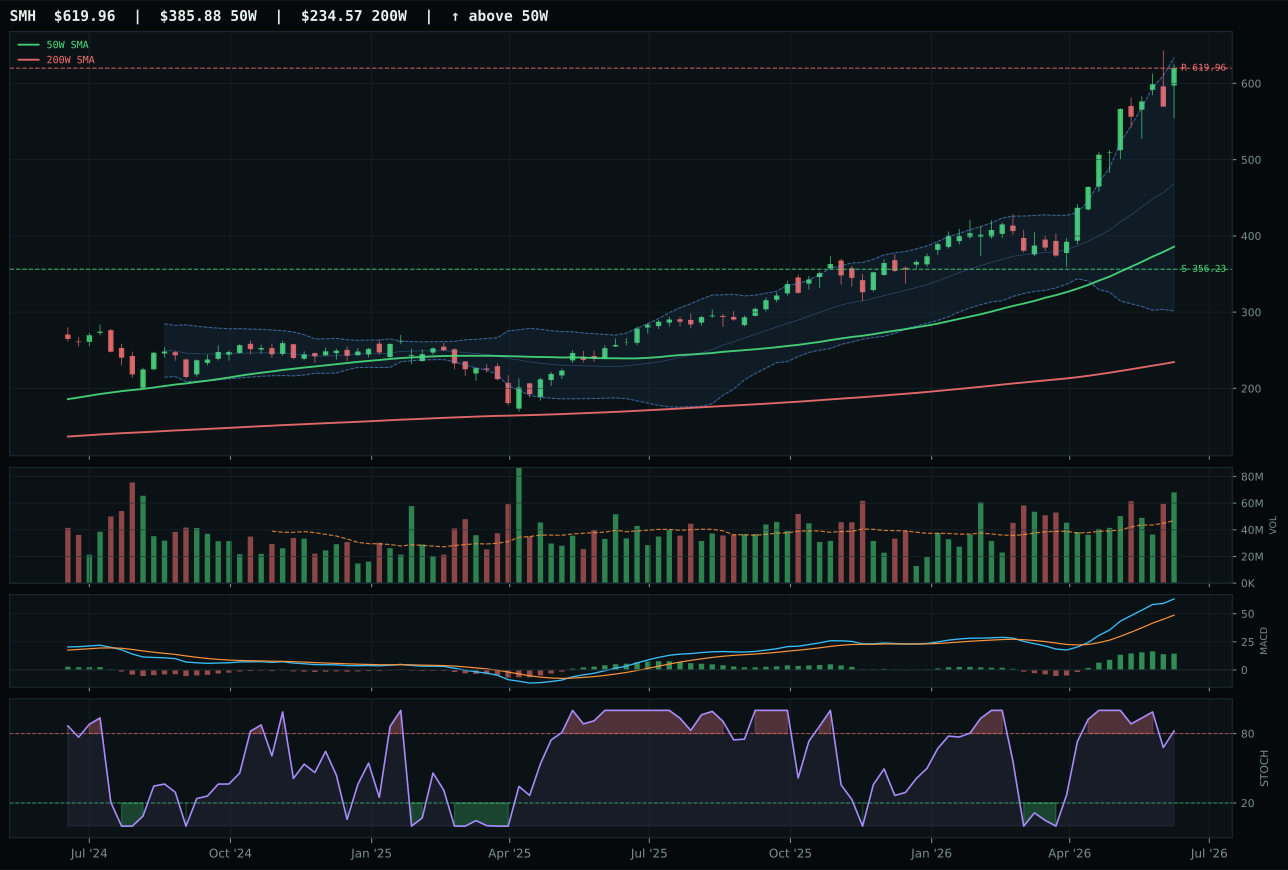
- Category outcome: won category; score 66.3.
CIBR (Technology)
CIBR is a tracked instrument in this allocation universe.
Technology reflects broad tech leadership, enterprise software durability, cybersecurity demand, rates sensitivity, and growth risk appetite. The narrative standing is positive, but the timing still needs to justify fresh overweight capital rather than simply confirming existing strength.
- Trend direction: uptrend.
- Position vs SMAs: close 85.33, 50W 72.79, 100W 68.56, 200W 57.71.
- MA slope summary: 50W 1w 0.3%, 4w 1.4%, 10w 1.9%; 100W 0.4%; 200W 0.4%.
- Distance from 50W SMA: 17.2%. Volume behavior: 0.16x 20W average.
- Volume/MACD/StochRSI/Fib: volume thin participation (40/100), MACD bullish and improving, histogram 2.40, stochastic RSI overbought rolling over at 0.84, Fib zone upper retracement / momentum zone; nearest Fib 0.236 at 86.29.
- Support/resistance: support 60.74, resistance 89.04.
- Trend phase: Phase 4: Extended / late trend. Structure: vertical extension.
- Relative strength: SPY 18.9%, category peers 0.0%.
- Bull case, four-week hold: CIBR has a vertical extension profile with 18.9% 13-week relative strength versus SPY.
- Bear case, four-week hold: A failed hold above support would weaken the setup.
- Verdict: Actionable but governed by invalidation levels.
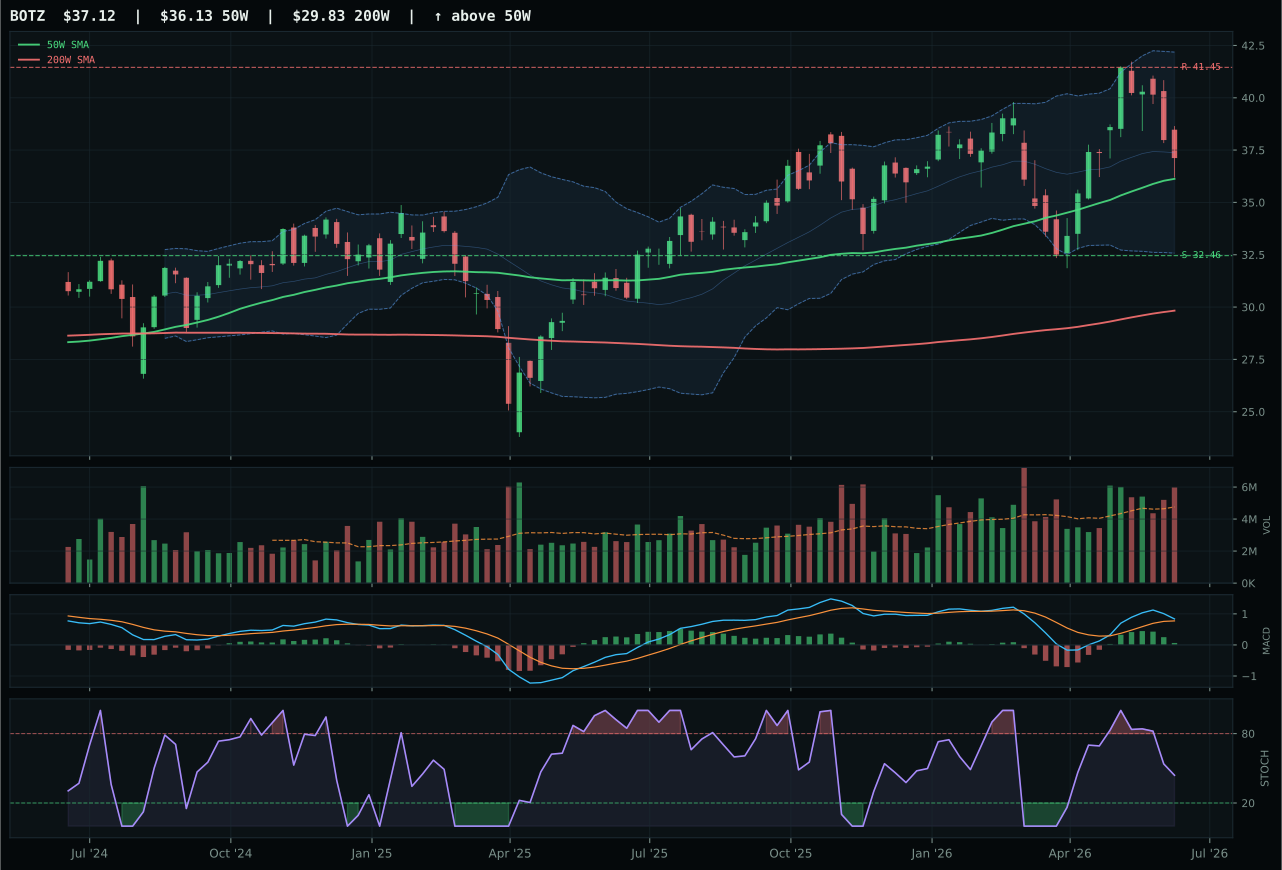
- Category outcome: tracked; score 71.7.
IGV (Technology)
IGV is a software ETF tied to enterprise software, cloud, and recurring-revenue growth equities.
Technology reflects broad tech leadership, enterprise software durability, cybersecurity demand, rates sensitivity, and growth risk appetite. The narrative standing is watchlist-quality rather than leadership-quality until price confirms that the category theme is being rewarded.
- Trend direction: neutral/downtrend.
- Position vs SMAs: close 90.70, 50W 99.48, 100W 98.03, 200W 83.30.
- MA slope summary: 50W 1w -0.4%, 4w -1.0%, 10w -2.6%; 100W 0.1%; 200W 0.2%.
- Distance from 50W SMA: -8.8%. Volume behavior: 0.13x 20W average.
- Volume/MACD/StochRSI/Fib: volume thin participation (40/100), MACD bullish but flattening, histogram 1.73, stochastic RSI falling/neutral at 0.62, Fib zone deep retracement / value zone; nearest Fib 0.618 at 90.76.
- Support/resistance: support 74.67, resistance 108.10.
- Trend phase: Phase 1: Base / accumulation. Structure: neutral structure.
- Relative strength: SPY -5.1%, category peers -24.0%.
- Bull case, four-week hold: IGV has a neutral structure profile with -5.1% 13-week relative strength versus SPY.
- Bear case, four-week hold: A failed hold above support would weaken the setup.
- Verdict: Actionable but governed by invalidation levels.
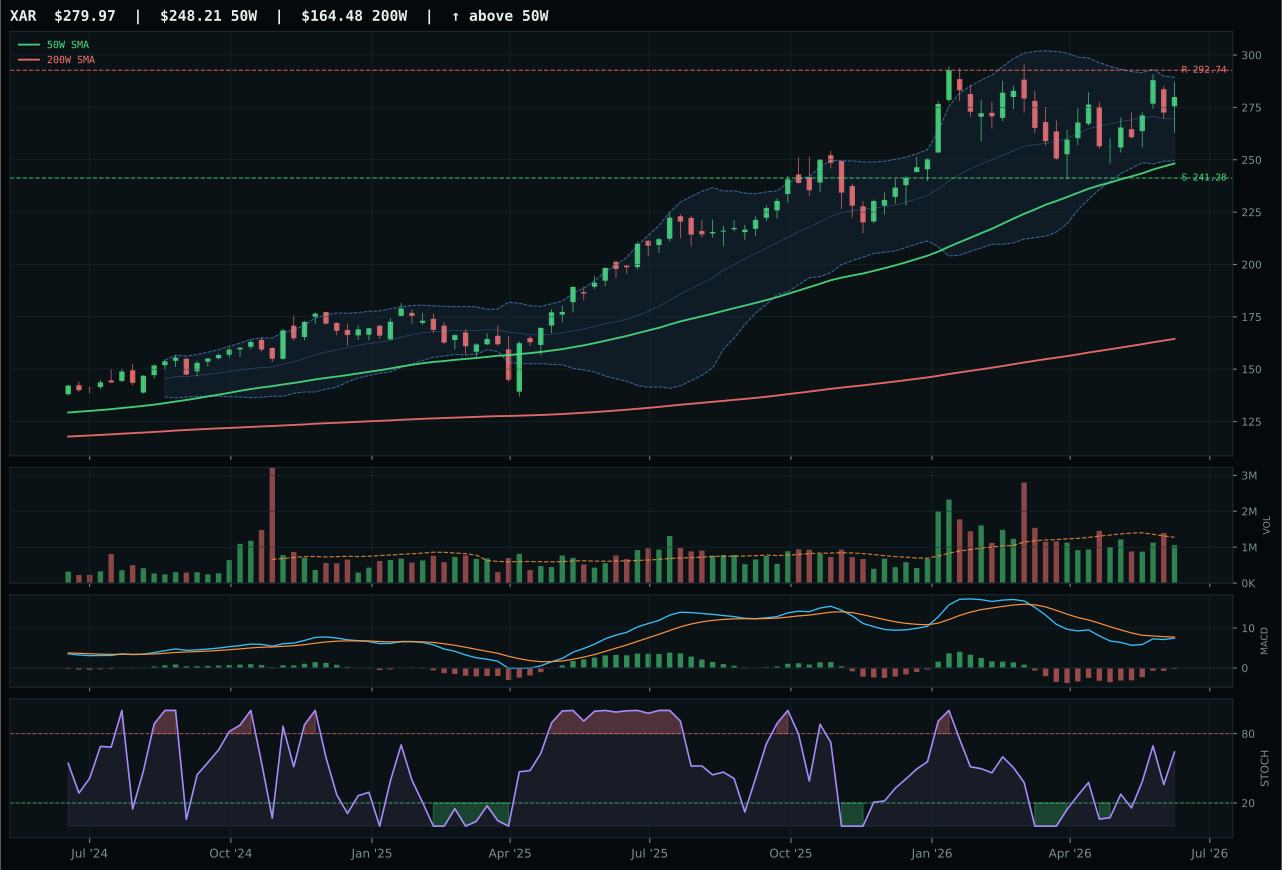
- Category outcome: tracked; score 45.9.
VanEck Semiconductor ETF (SMH, AI)
SMH is a semiconductor ETF concentrated in chip designers, foundries, and equipment names tied to AI compute.
AI leadership is driven by compute, semiconductors, data-center infrastructure, networking, memory, and software adoption tied to the AI capex cycle. The narrative standing is positive, but the timing still needs to justify fresh overweight capital rather than simply confirming existing strength.
- Trend direction: uptrend.
- Position vs SMAs: close 619.96, 50W 392.60, 100W 316.35, 200W 237.09.
- MA slope summary: 50W 1w 1.7%, 4w 7.3%, 10w 18.7%; 100W 1.2%; 200W 1.1%.
- Distance from 50W SMA: 57.9%. Volume behavior: 0.20x 20W average.
- Volume/MACD/StochRSI/Fib: volume thin participation (40/100), MACD bullish but flattening, histogram 13.52, stochastic RSI overbought rolling over at 0.82, Fib zone near 52W high / extension; nearest Fib 0.236 at 551.76.
- Support/resistance: support 365.86, resistance 619.96.
- Trend phase: Phase 4: Extended / late trend. Structure: vertical extension.
- Relative strength: SPY 46.8%, category peers 26.0%.
- Bull case, four-week hold: SMH has a vertical extension profile with 46.8% 13-week relative strength versus SPY.
- Bear case, four-week hold: A failed hold above support would weaken the setup.
- Verdict: Actionable but governed by invalidation levels.
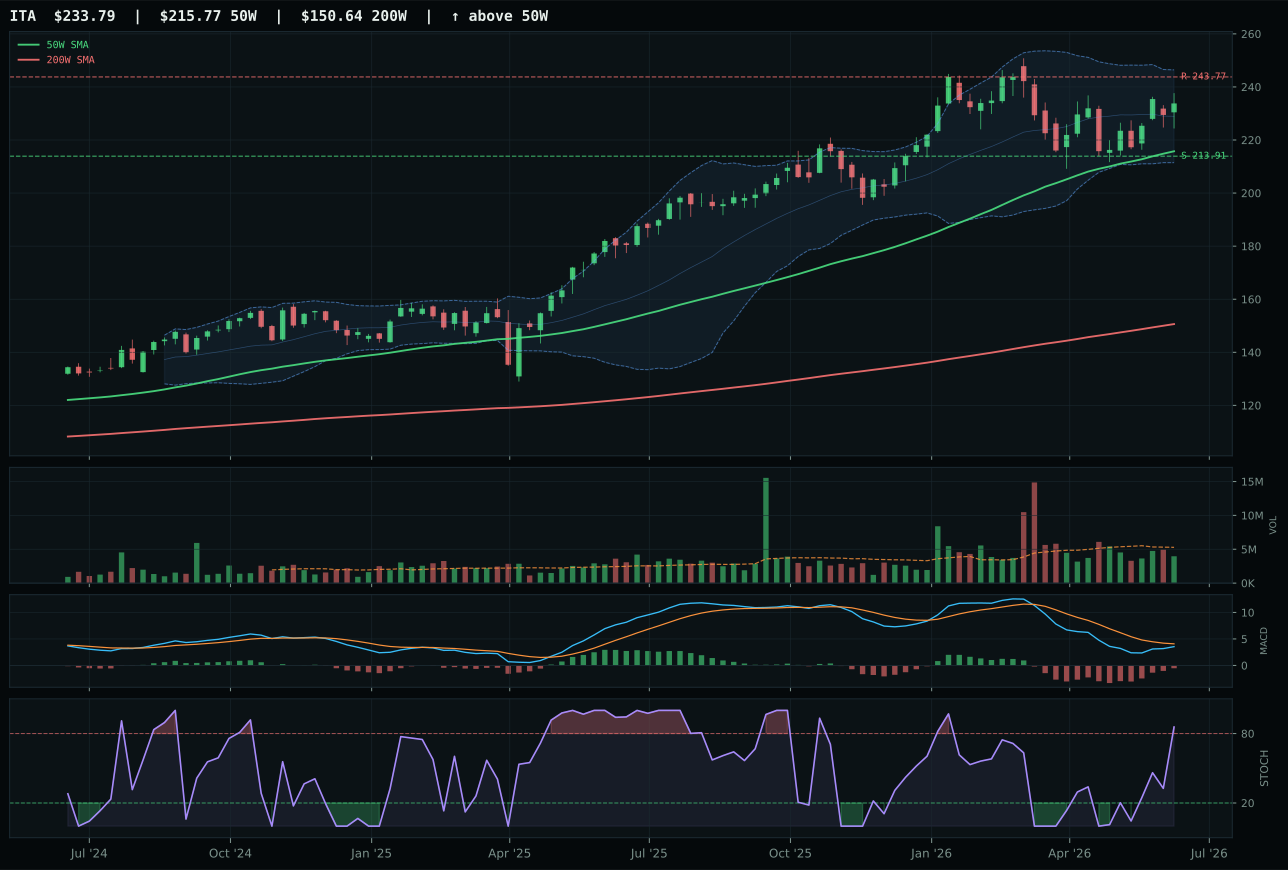
- Category outcome: won category; score 60.6.
Global X Artificial Intelligence & Technology ETF (AIQ, AI)
AIQ is an AI and technology ETF spanning software, semiconductors, automation, and AI-adjacent beneficiaries.
AI leadership is driven by compute, semiconductors, data-center infrastructure, networking, memory, and software adoption tied to the AI capex cycle. The narrative standing is positive, but the timing still needs to justify fresh overweight capital rather than simply confirming existing strength.
- Trend direction: uptrend.
- Position vs SMAs: close 64.00, 50W 51.24, 100W 44.70, 200W 35.98.
- MA slope summary: 50W 1w 0.8%, 4w 3.5%, 10w 8.5%; 100W 0.7%; 200W 0.6%.
- Distance from 50W SMA: 24.9%. Volume behavior: 0.33x 20W average.
- Volume/MACD/StochRSI/Fib: volume thin participation (40/100), MACD bullish but flattening, histogram 1.10, stochastic RSI falling/neutral at 0.73, Fib zone upper retracement / momentum zone; nearest Fib 0.236 at 63.39.
- Support/resistance: support 45.47, resistance 67.32.
- Trend phase: Phase 4: Extended / late trend. Structure: vertical extension.
- Relative strength: SPY 20.7%, category peers 0.0%.
- Bull case, four-week hold: AIQ has a vertical extension profile with 20.7% 13-week relative strength versus SPY.
- Bear case, four-week hold: A failed hold above support would weaken the setup.
- Verdict: Actionable but governed by invalidation levels.
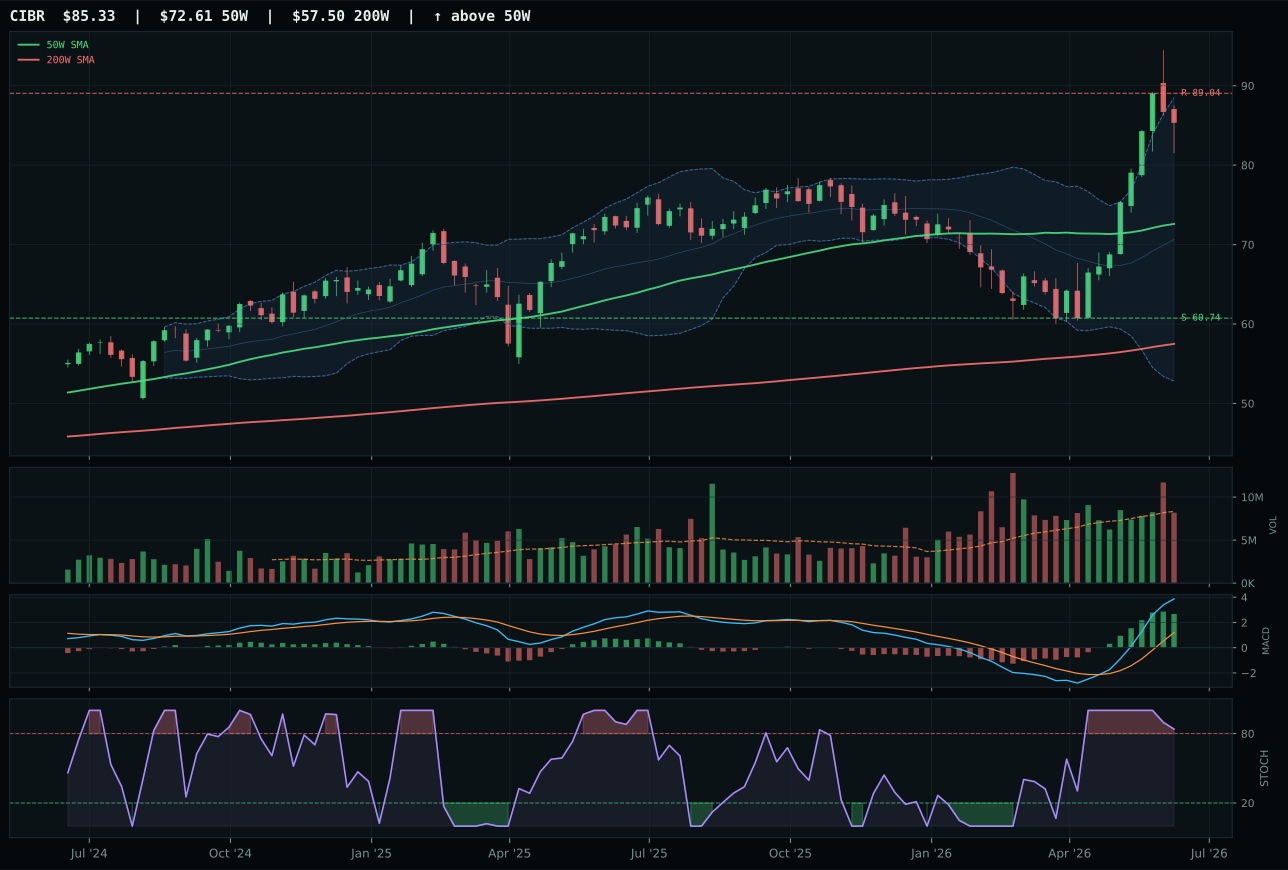
- Category outcome: tracked; score 72.9.
BOTZ (AI)
BOTZ is a robotics and automation ETF tied to industrial automation, AI adoption, and robotics hardware.
AI leadership is driven by compute, semiconductors, data-center infrastructure, networking, memory, and software adoption tied to the AI capex cycle. The current narrative standing is constructive because the asset is participating without forcing the allocator to chase extension.
- Trend direction: uptrend.
- Position vs SMAs: close 37.12, 50W 36.21, 100W 33.76, 200W 29.90.
- MA slope summary: 50W 1w 0.2%, 4w 1.4%, 10w 4.5%; 100W 0.2%; 200W 0.2%.
- Distance from 50W SMA: 2.5%. Volume behavior: 0.17x 20W average.
- Volume/MACD/StochRSI/Fib: volume thin participation (40/100), MACD bearish/weakening, histogram -0.06, stochastic RSI falling/neutral at 0.44, Fib zone middle retracement / decision zone; nearest Fib 0.382 at 37.32.
- Support/resistance: support 32.46, resistance 41.45.
- Trend phase: Phase 2: Breakout / repricing. Structure: compression near 50W.
- Relative strength: SPY -3.9%, category peers -24.6%.
- Bull case, four-week hold: BOTZ has a compression near 50W profile with -3.9% 13-week relative strength versus SPY.
- Bear case, four-week hold: A failed hold above support would weaken the setup.
- Verdict: Actionable but governed by invalidation levels.
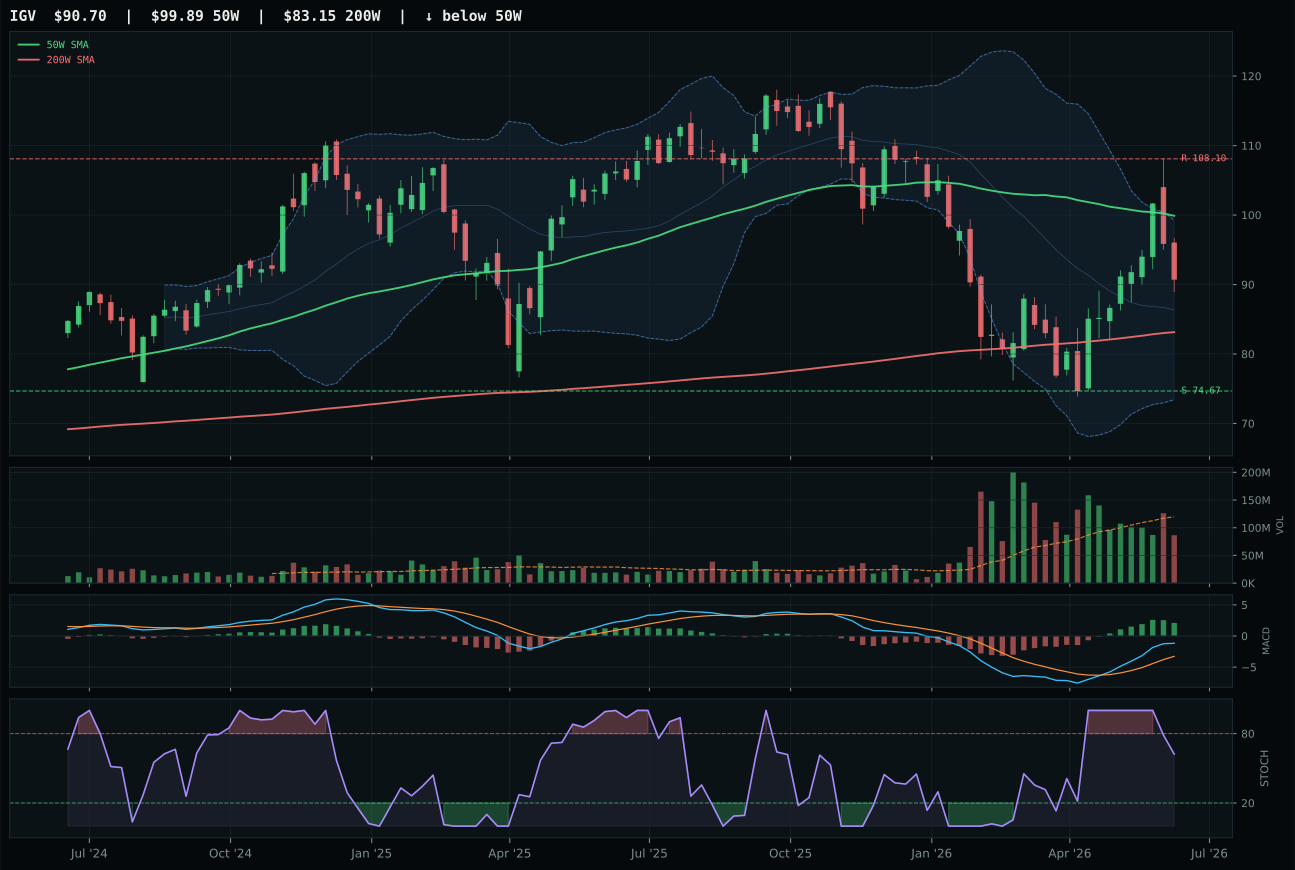
- Category outcome: tracked; score 62.0.
ROKT (Defense & Aerospace)
ROKT is a tracked instrument in this allocation universe.
Defense and aerospace sits at the intersection of geopolitical spending, commercial aviation recovery, defense technology, and industrial backlog quality. The narrative standing is positive, but the timing still needs to justify fresh overweight capital rather than simply confirming existing strength.
- Trend direction: uptrend.
- Position vs SMAs: close 120.01, 50W 91.60, 100W 73.13, 200W 57.30.
- MA slope summary: 50W 1w 1.2%, 4w 5.5%, 10w 14.7%; 100W 1.0%; 200W 0.7%.
- Distance from 50W SMA: 31.0%. Volume behavior: 0.30x 20W average.
- Volume/MACD/StochRSI/Fib: volume thin participation (40/100), MACD bullish but flattening, histogram 0.10, stochastic RSI oversold at 0.03, Fib zone upper retracement / momentum zone; nearest Fib 0.236 at 119.51.
- Support/resistance: support 85.61, resistance 134.47.
- Trend phase: Phase 4: Extended / late trend. Structure: vertical extension.
- Relative strength: SPY 4.4%, category peers 13.8%.
- Bull case, four-week hold: ROKT has a vertical extension profile with 4.4% 13-week relative strength versus SPY.
- Bear case, four-week hold: A failed hold above support would weaken the setup.
- Verdict: Actionable but governed by invalidation levels.
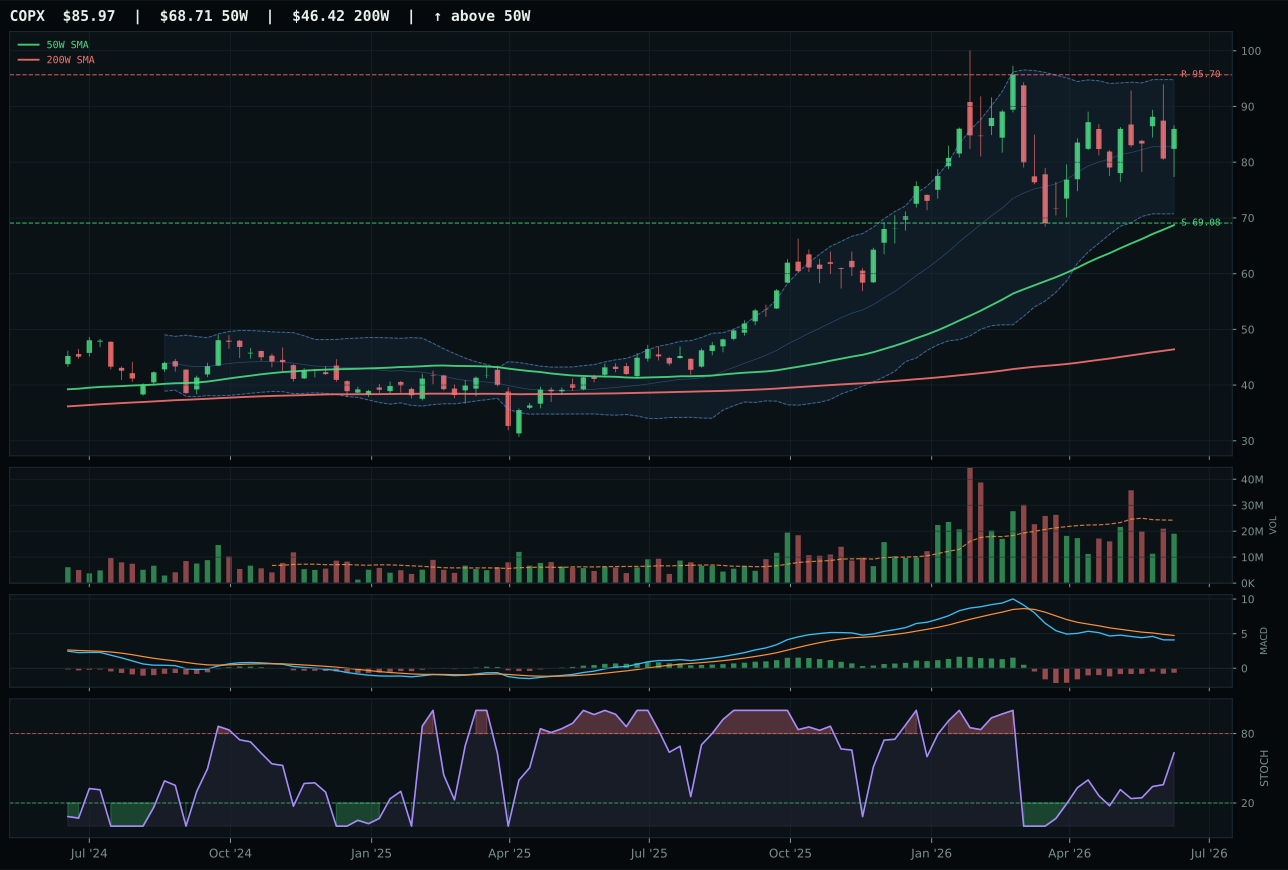
- Category outcome: won category; score 56.4.
Invesco Aerospace & Defense ETF (PPA, Defense & Aerospace)
PPA is an aerospace and defense ETF spanning defense primes, systems providers, and aviation suppliers.
Defense and aerospace sits at the intersection of geopolitical spending, commercial aviation recovery, defense technology, and industrial backlog quality. The narrative standing is positive, but the timing still needs to justify fresh overweight capital rather than simply confirming existing strength.
- Trend direction: uptrend.
- Position vs SMAs: close 174.13, 50W 161.74, 100W 140.47, 200W 113.11.
- MA slope summary: 50W 1w 0.4%, 4w 1.8%, 10w 4.8%; 100W 0.5%; 200W 0.4%.
- Distance from 50W SMA: 7.7%. Volume behavior: 0.17x 20W average.
- Volume/MACD/StochRSI/Fib: volume thin participation (40/100), MACD bearish but improving, histogram -0.62, stochastic RSI rising mid-zone at 0.56, Fib zone upper retracement / momentum zone; nearest Fib 0.236 at 174.24.
- Support/resistance: support 158.94, resistance 181.07.
- Trend phase: Phase 3: Early trend. Structure: neutral structure.
- Relative strength: SPY -11.5%, category peers -2.1%.
- Bull case, four-week hold: PPA has a neutral structure profile with -11.5% 13-week relative strength versus SPY.
- Bear case, four-week hold: A failed hold above support would weaken the setup.
- Verdict: Actionable but governed by invalidation levels.
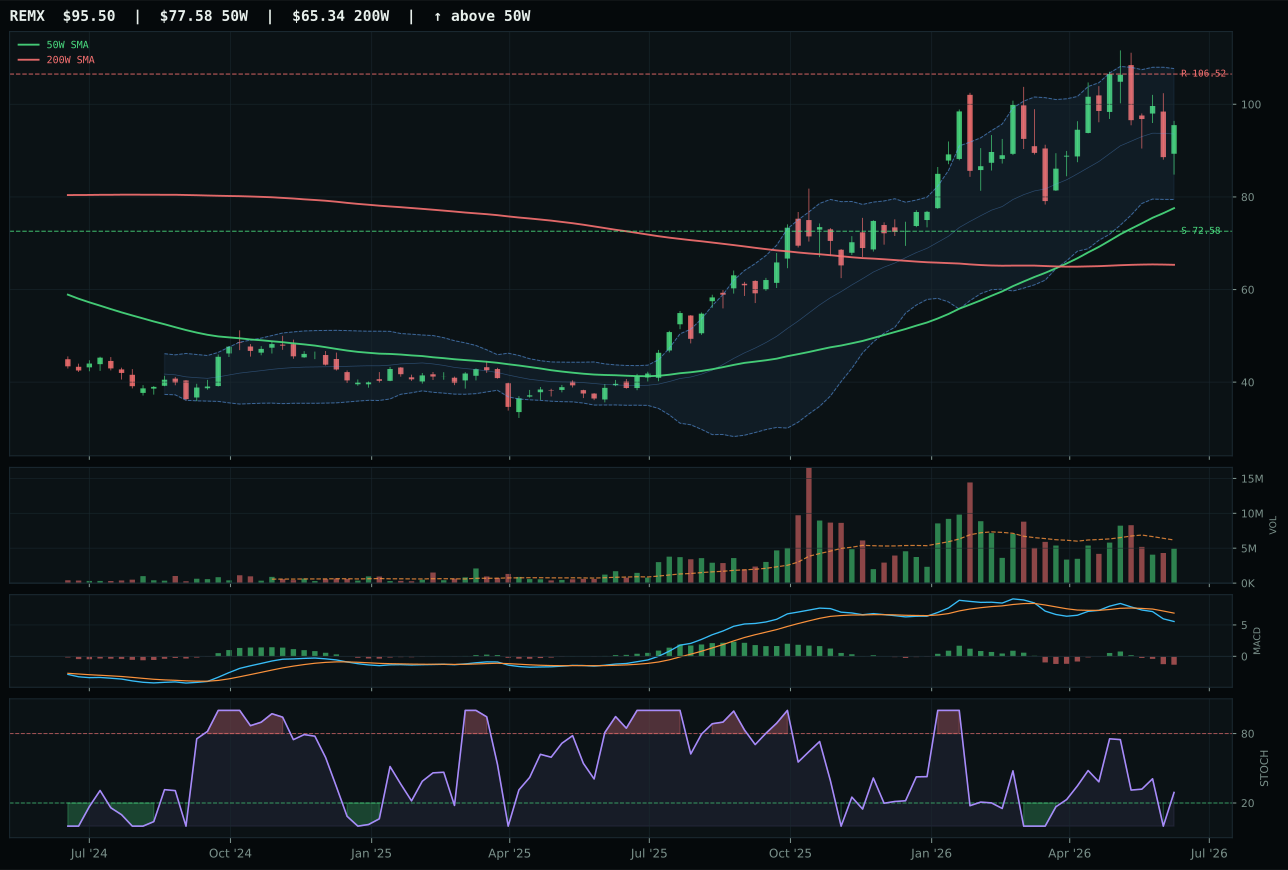
- Category outcome: tracked; score 66.0.
iShares U.S. Aerospace & Defense ETF (ITA, Defense & Aerospace)
ITA is a defense and aerospace ETF with exposure to prime contractors, aircraft suppliers, and defense systems.
Defense and aerospace sits at the intersection of geopolitical spending, commercial aviation recovery, defense technology, and industrial backlog quality. The narrative standing is positive, but the timing still needs to justify fresh overweight capital rather than simply confirming existing strength.
- Trend direction: uptrend.
- Position vs SMAs: close 233.79, 50W 216.71, 100W 185.66, 200W 151.28.
- MA slope summary: 50W 1w 0.4%, 4w 1.9%, 10w 4.8%; 100W 0.5%; 200W 0.4%.
- Distance from 50W SMA: 7.9%. Volume behavior: 0.13x 20W average.
- Volume/MACD/StochRSI/Fib: volume thin participation (40/100), MACD bearish but improving, histogram -0.22, stochastic RSI overbought momentum at 0.86, Fib zone upper retracement / momentum zone; nearest Fib 0.236 at 233.95.
- Support/resistance: support 215.80, resistance 243.77.
- Trend phase: Phase 3: Early trend. Structure: neutral structure.
- Relative strength: SPY -9.3%, category peers 0.0%.
- Bull case, four-week hold: ITA has a neutral structure profile with -9.3% 13-week relative strength versus SPY.
- Bear case, four-week hold: A failed hold above support would weaken the setup.
- Verdict: Actionable but governed by invalidation levels.
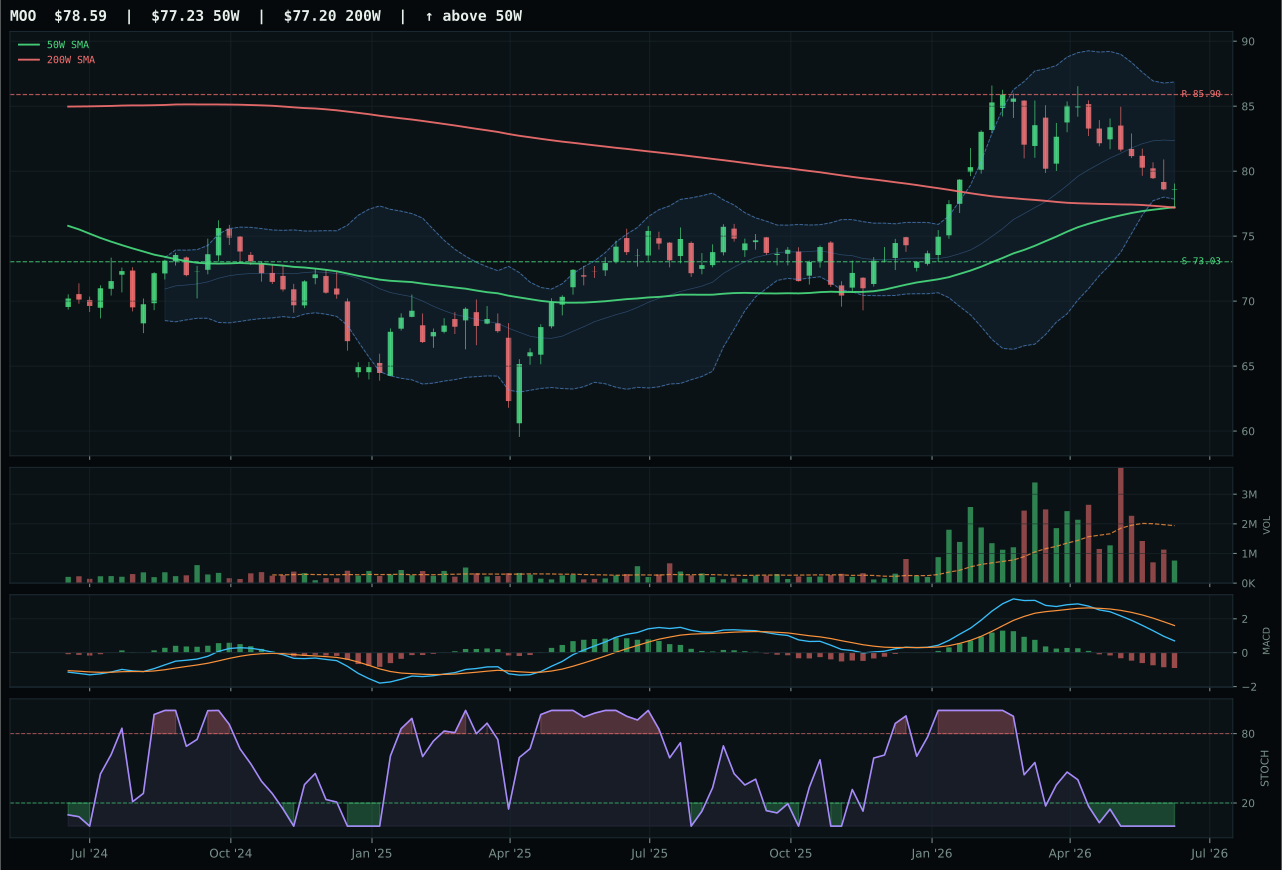
- Category outcome: tracked; score 67.5.
VanEck Agribusiness ETF (MOO, Agriculture & Livestock)
MOO is an agribusiness ETF spanning fertilizer, farm equipment, crop protection, seeds, and food supply-chain equities.
Agriculture and livestock leadership usually matters when food inflation, crop cycles, fertilizer economics, protein margins, or food-security themes are gaining traction. The current narrative standing is constructive because the asset is participating without forcing the allocator to chase extension.
- Trend direction: uptrend.
- Position vs SMAs: close 78.59, 50W 77.29, 100W 73.79, 200W 77.13.
- MA slope summary: 50W 1w 0.1%, 4w 0.5%, 10w 2.1%; 100W 0.1%; 200W -0.1%.
- Distance from 50W SMA: 1.7%. Volume behavior: 0.07x 20W average.
- Volume/MACD/StochRSI/Fib: volume thin participation (40/100), MACD bearish/weakening, histogram -0.90, stochastic RSI oversold turn up at 0.00, Fib zone middle retracement / decision zone; nearest Fib 0.500 at 77.94.
- Support/resistance: support 73.03, resistance 85.90.
- Trend phase: Phase 3: Early trend. Structure: compression near 50W.
- Relative strength: SPY -16.4%, category peers -2.7%.
- Bull case, four-week hold: MOO has a compression near 50W profile with -16.4% 13-week relative strength versus SPY.
- Bear case, four-week hold: A failed hold above support would weaken the setup.
- Verdict: Actionable but governed by invalidation levels.
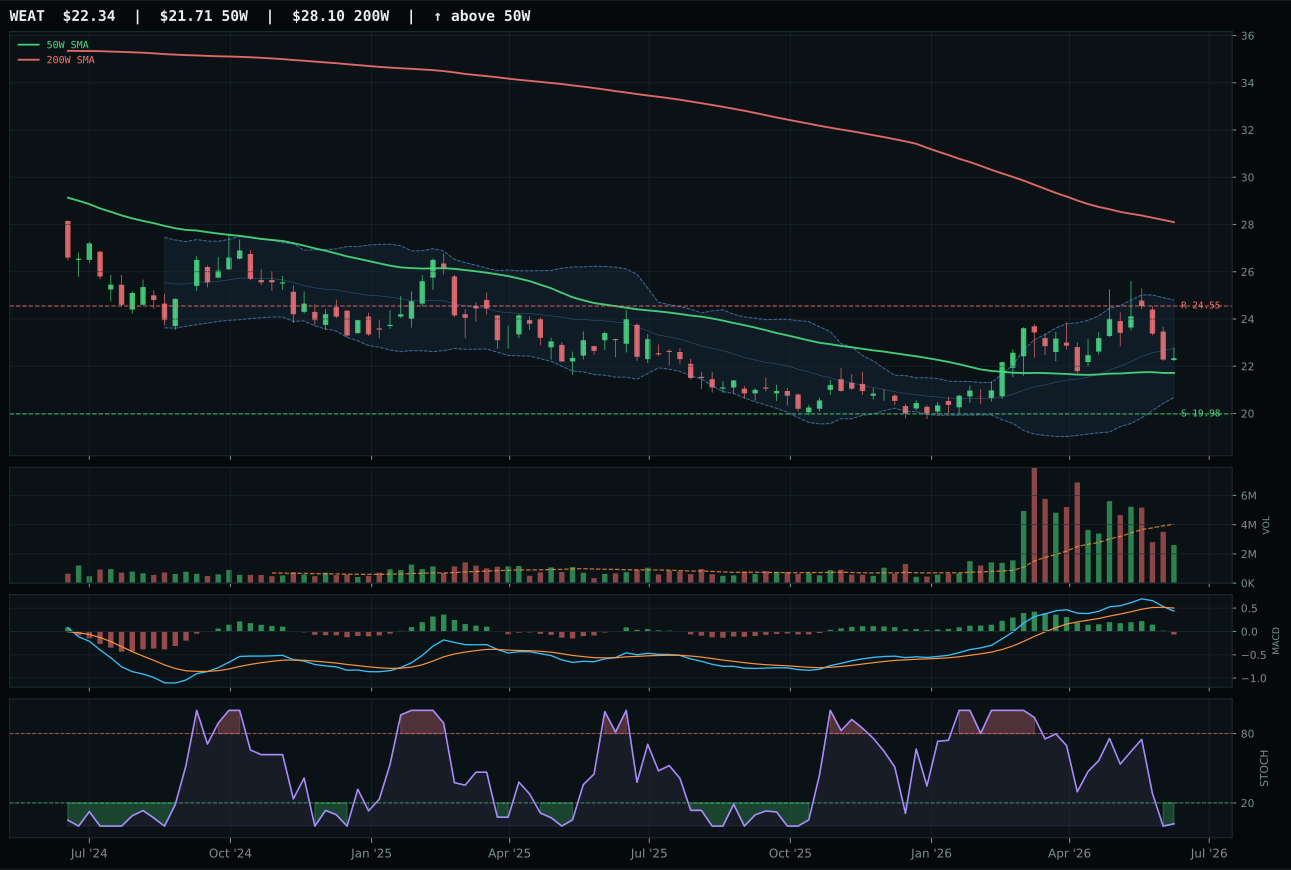
- Category outcome: won category; score 64.8.
iShares MSCI Agriculture Producers ETF (VEGI, Agriculture & Livestock)
VEGI is a global agriculture producers ETF focused on companies tied to farming inputs, machinery, and food production.
Agriculture and livestock leadership usually matters when food inflation, crop cycles, fertilizer economics, protein margins, or food-security themes are gaining traction. The narrative standing is positive, but the timing still needs to justify fresh overweight capital rather than simply confirming existing strength.
- Trend direction: uptrend.
- Position vs SMAs: close 43.94, 50W 41.88, 100W 39.69, 200W 39.62.
- MA slope summary: 50W 1w 0.1%, 4w 0.6%, 10w 2.2%; 100W 0.2%; 200W 0.0%.
- Distance from 50W SMA: 4.9%. Volume behavior: 0.08x 20W average.
- Volume/MACD/StochRSI/Fib: volume thin participation (40/100), MACD bearish/weakening, histogram -0.37, stochastic RSI oversold turn up at 0.03, Fib zone upper retracement / momentum zone; nearest Fib 0.382 at 43.73.
- Support/resistance: support 38.83, resistance 47.16.
- Trend phase: Phase 3: Early trend. Structure: neutral structure.
- Relative strength: SPY -13.7%, category peers 0.0%.
- Bull case, four-week hold: VEGI has a neutral structure profile with -13.7% 13-week relative strength versus SPY.
- Bear case, four-week hold: A failed hold above support would weaken the setup.
- Verdict: Actionable but governed by invalidation levels.
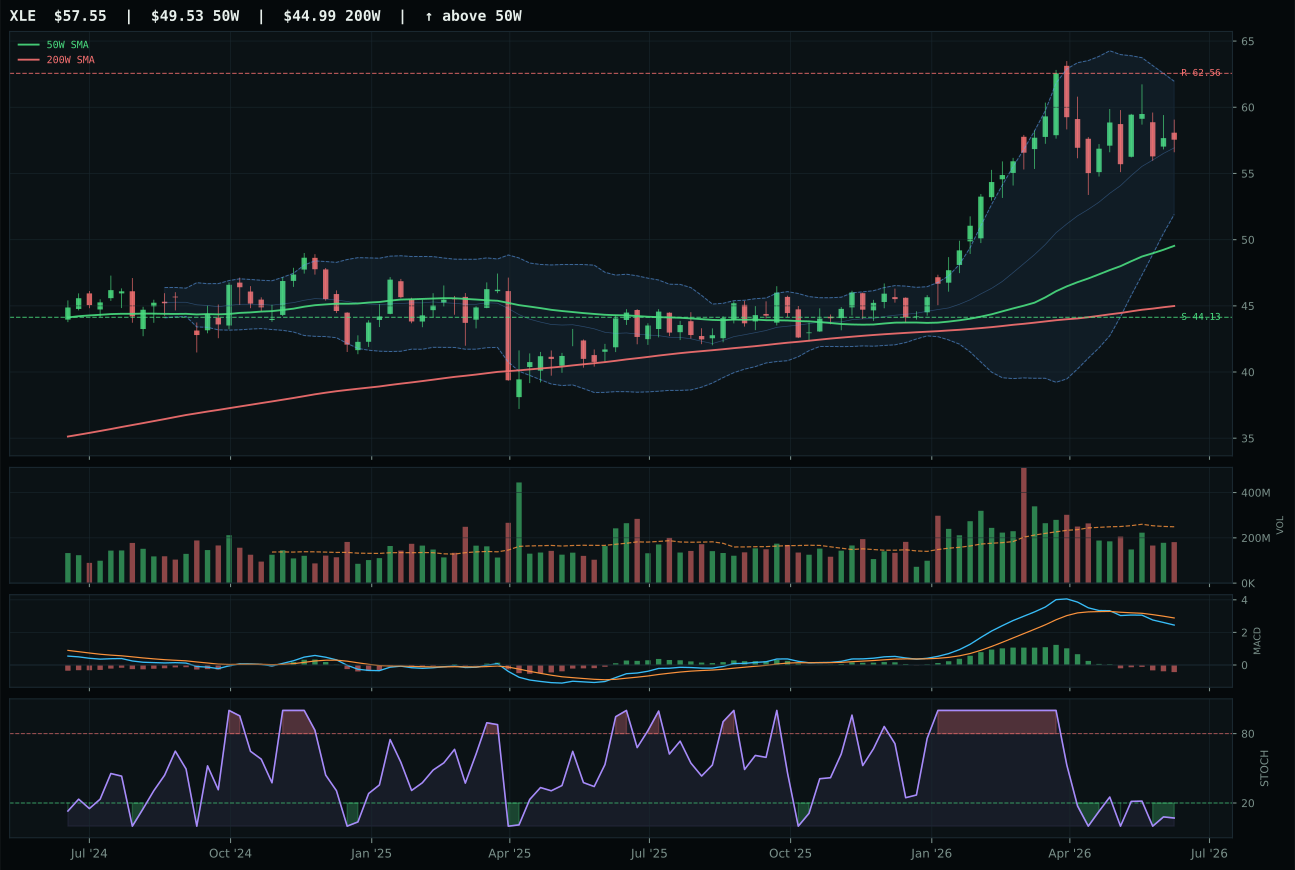
- Category outcome: tracked; score 62.0.
FTAG (Agriculture & Livestock)
FTAG is a tracked instrument in this allocation universe.
Agriculture and livestock leadership usually matters when food inflation, crop cycles, fertilizer economics, protein margins, or food-security themes are gaining traction. The narrative may still be strong, but the allocator treats the setup as lower quality for fresh capital because the hard risk filters are active.
- Trend direction: uptrend.
- Position vs SMAs: close 28.65, 50W 27.62, 100W 26.16, 200W 26.56.
- MA slope summary: 50W 1w 0.1%, 4w 0.7%, 10w 2.5%; 100W 0.2%; 200W -0.0%.
- Distance from 50W SMA: 3.8%. Volume behavior: 0.03x 20W average.
- Volume/MACD/StochRSI/Fib: volume thin participation (40/100), MACD bearish/weakening, histogram -0.25, stochastic RSI oversold turn up at 0.08, Fib zone middle retracement / decision zone; nearest Fib 0.382 at 28.78.
- Support/resistance: support 26.22, resistance 30.60.
- Trend phase: Phase 3: Early trend. Structure: neutral structure.
- Relative strength: SPY -11.9%, category peers 1.7%.
- Bull case, four-week hold: FTAG has a neutral structure profile with -11.9% 13-week relative strength versus SPY.
- Bear case, four-week hold: A failed hold above support would weaken the setup.
- Verdict: Tracked, but not top-2 eligible because: .
- Category outcome: tracked; score 42.1.
iShares Silver Trust (SLV, Precious Metals)
SLV is a silver ETF tied to both precious-metal demand and industrial silver use.
Precious metals balance real-rate pressure, currency confidence, liquidity expectations, and demand for portfolio hedges. The current narrative standing is constructive because the asset is participating without forcing the allocator to chase extension.
- Trend direction: uptrend.
- Position vs SMAs: close 61.29, 50W 57.16, 100W 43.01, 200W 32.43.
- MA slope summary: 50W 1w 1.0%, 4w 4.4%, 10w 14.4%; 100W 0.8%; 200W 0.7%.
- Distance from 50W SMA: 7.2%. Volume behavior: 0.10x 20W average.
- Volume/MACD/StochRSI/Fib: volume thin participation (40/100), MACD bearish/weakening, histogram -2.16, stochastic RSI oversold at 0.00, Fib zone deep retracement / value zone; nearest Fib 0.618 at 61.77.
- Support/resistance: support 61.29, resistance 92.91.
- Trend phase: Phase 2: Breakout / repricing. Structure: pullback into support.
- Relative strength: SPY -14.7%, category peers 0.0%.
- Bull case, four-week hold: SLV has a pullback into support profile with -14.7% 13-week relative strength versus SPY.
- Bear case, four-week hold: A failed hold above support would weaken the setup.
- Verdict: Actionable but governed by invalidation levels.
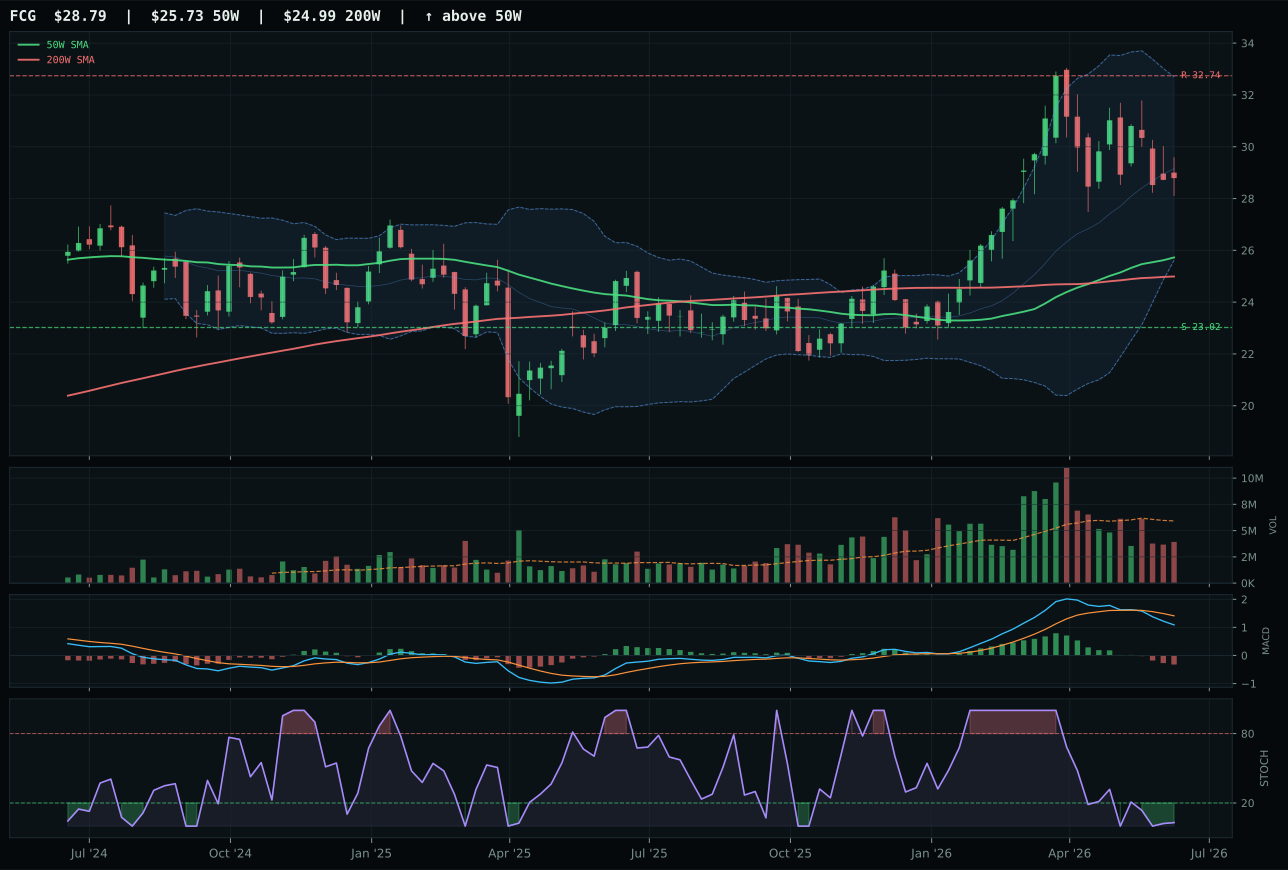
- Category outcome: won category; score 57.4.
VanEck Gold Miners ETF (GDX, Precious Metals)
GDX is a gold miners ETF with operating leverage to gold prices and miner margins.
Precious metals balance real-rate pressure, currency confidence, liquidity expectations, and demand for portfolio hedges. The current narrative standing is constructive because the asset is participating without forcing the allocator to chase extension.
- Trend direction: neutral/downtrend.
- Position vs SMAs: close 80.03, 50W 81.85, 100W 61.93, 200W 46.00.
- MA slope summary: 50W 1w 0.7%, 4w 3.0%, 10w 9.9%; 100W 0.7%; 200W 0.6%.
- Distance from 50W SMA: -2.2%. Volume behavior: 0.21x 20W average.
- Volume/MACD/StochRSI/Fib: volume thin participation (40/100), MACD bearish/weakening, histogram -2.78, stochastic RSI oversold at 0.06, Fib zone middle retracement / decision zone; nearest Fib 0.500 at 83.75.
- Support/resistance: support 78.84, resistance 115.84.
- Trend phase: Phase 1: Base / accumulation. Structure: pullback into support.
- Relative strength: SPY -14.5%, category peers 0.3%.
- Bull case, four-week hold: GDX has a pullback into support profile with -14.5% 13-week relative strength versus SPY.
- Bear case, four-week hold: A failed hold above support would weaken the setup.
- Verdict: Actionable but governed by invalidation levels.
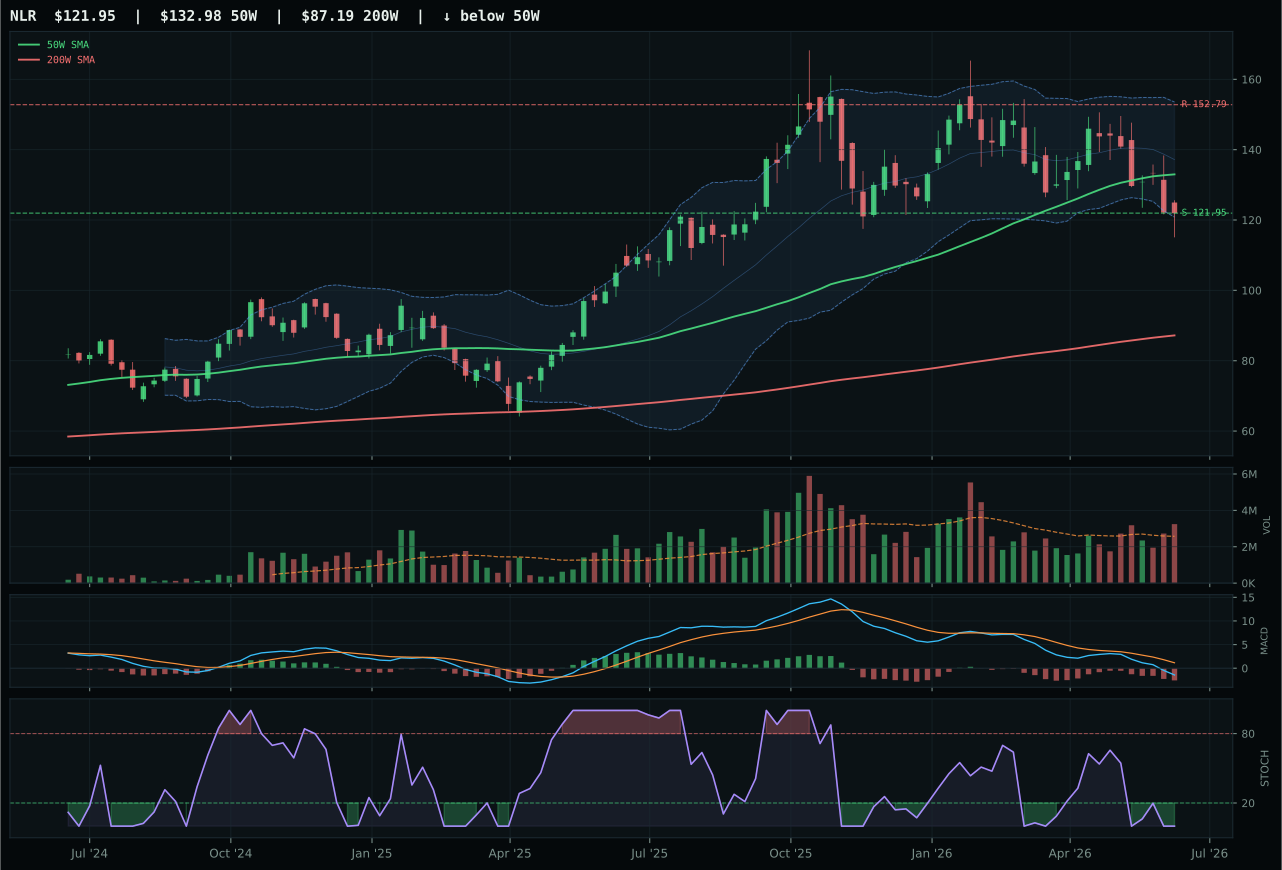
- Category outcome: tracked; score 44.5.
SPDR Gold Shares (GLD, Precious Metals)
GLD is a large physical gold ETF used for institutional bullion exposure.
Precious metals balance real-rate pressure, currency confidence, liquidity expectations, and demand for portfolio hedges. The current narrative standing is constructive because the asset is participating without forcing the allocator to chase extension.
- Trend direction: neutral/downtrend.
- Position vs SMAs: close 386.54, 50W 391.82, 100W 327.78, 200W 256.03.
- MA slope summary: 50W 1w 0.4%, 4w 1.8%, 10w 6.0%; 100W 0.5%; 200W 0.4%.
- Distance from 50W SMA: -1.3%. Volume behavior: 0.14x 20W average.
- Volume/MACD/StochRSI/Fib: volume thin participation (40/100), MACD bearish/weakening, histogram -9.46, stochastic RSI oversold at 0.00, Fib zone middle retracement / decision zone; nearest Fib 0.618 at 380.04.
- Support/resistance: support 386.54, resistance 483.75.
- Trend phase: Phase 1: Base / accumulation. Structure: pullback into support.
- Relative strength: SPY -20.9%, category peers -6.1%.
- Bull case, four-week hold: GLD has a pullback into support profile with -20.9% 13-week relative strength versus SPY.
- Bear case, four-week hold: A failed hold above support would weaken the setup.
- Verdict: Actionable but governed by invalidation levels.
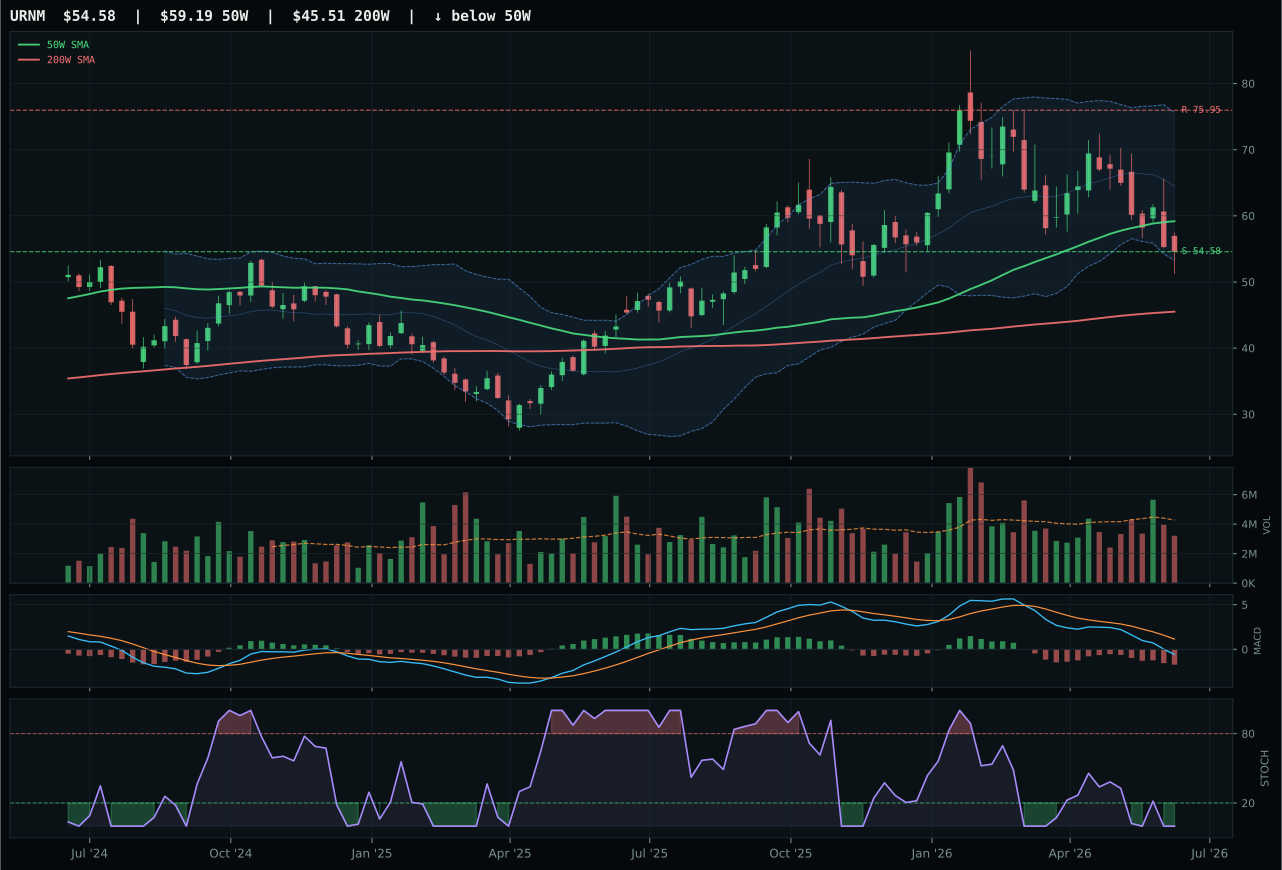
- Category outcome: tracked; score 38.6.
Global X Copper Miners ETF (COPX, Industrial Metals)
COPX is a copper miners ETF tied to copper prices, electrification demand, and mining equity risk appetite.
Industrial metals are the cleanest read on global manufacturing, China demand, electrification, and hard-asset risk appetite. The narrative standing is positive, but the timing still needs to justify fresh overweight capital rather than simply confirming existing strength.
- Trend direction: uptrend.
- Position vs SMAs: close 85.97, 50W 69.50, 100W 55.44, 200W 46.70.
- MA slope summary: 50W 1w 1.2%, 4w 5.0%, 10w 13.8%; 100W 0.8%; 200W 0.6%.
- Distance from 50W SMA: 23.7%. Volume behavior: 0.19x 20W average.
- Volume/MACD/StochRSI/Fib: volume thin participation (40/100), MACD bearish but improving, histogram -0.56, stochastic RSI rising mid-zone at 0.63, Fib zone upper retracement / momentum zone; nearest Fib 0.236 at 86.19.
- Support/resistance: support 69.08, resistance 95.70.
- Trend phase: Phase 4: Extended / late trend. Structure: vertical extension.
- Relative strength: SPY 10.1%, category peers 0.0%.
- Bull case, four-week hold: COPX has a vertical extension profile with 10.1% 13-week relative strength versus SPY.
- Bear case, four-week hold: A failed hold above support would weaken the setup.
- Verdict: Actionable but governed by invalidation levels.
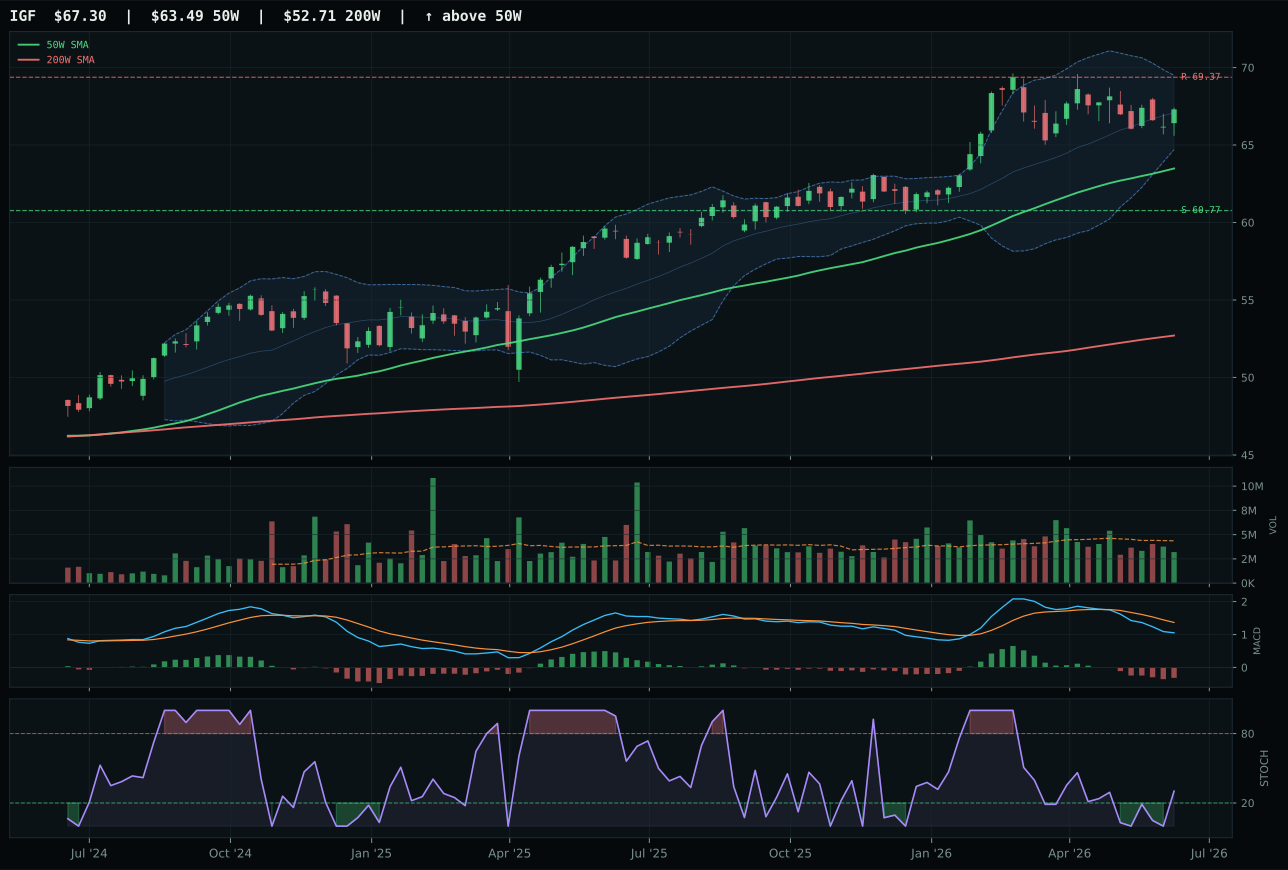
- Category outcome: won category; score 69.7.
iShares MSCI Global Metals & Mining Producers ETF (PICK, Industrial Metals)
PICK is a global metals and mining ETF with exposure across diversified miners, iron ore, copper, and industrial metals.
Industrial metals are the cleanest read on global manufacturing, China demand, electrification, and hard-asset risk appetite. The narrative standing is positive, but the timing still needs to justify fresh overweight capital rather than simply confirming existing strength.
- Trend direction: uptrend.
- Position vs SMAs: close 65.08, 50W 52.04, 100W 44.85, 200W 42.84.
- MA slope summary: 50W 1w 1.0%, 4w 4.3%, 10w 11.4%; 100W 0.6%; 200W 0.3%.
- Distance from 50W SMA: 25.0%. Volume behavior: 0.20x 20W average.
- Volume/MACD/StochRSI/Fib: volume thin participation (40/100), MACD bearish/weakening, histogram -0.09, stochastic RSI rising mid-zone at 0.68, Fib zone upper retracement / momentum zone; nearest Fib 0.236 at 61.11.
- Support/resistance: support 51.83, resistance 66.09.
- Trend phase: Phase 4: Extended / late trend. Structure: vertical extension.
- Relative strength: SPY 11.2%, category peers 1.1%.
- Bull case, four-week hold: PICK has a vertical extension profile with 11.2% 13-week relative strength versus SPY.
- Bear case, four-week hold: A failed hold above support would weaken the setup.
- Verdict: Actionable but governed by invalidation levels.
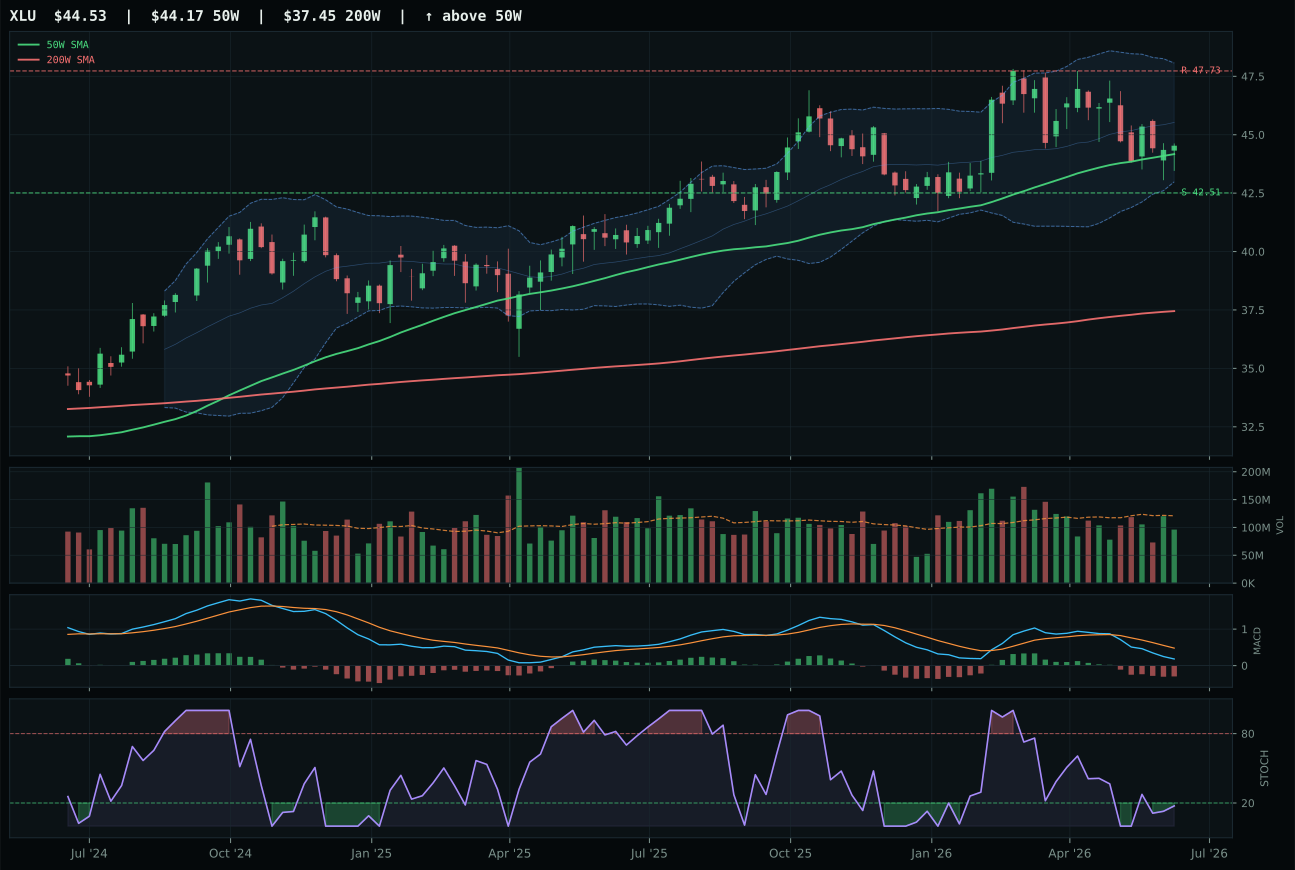
- Category outcome: tracked; score 58.3.
REMX (Industrial Metals)
REMX is a tracked instrument in this allocation universe.
Industrial metals are the cleanest read on global manufacturing, China demand, electrification, and hard-asset risk appetite. The narrative standing is positive, but the timing still needs to justify fresh overweight capital rather than simply confirming existing strength.
- Trend direction: uptrend.
- Position vs SMAs: close 95.50, 50W 78.65, 100W 59.97, 200W 65.34.
- MA slope summary: 50W 1w 1.4%, 4w 5.9%, 10w 17.8%; 100W 0.9%; 200W -0.0%.
- Distance from 50W SMA: 21.4%. Volume behavior: 0.14x 20W average.
- Volume/MACD/StochRSI/Fib: volume thin participation (40/100), MACD bearish/weakening, histogram -1.39, stochastic RSI falling/neutral at 0.29, Fib zone upper retracement / momentum zone; nearest Fib 0.236 at 94.27.
- Support/resistance: support 76.74, resistance 106.52.
- Trend phase: Phase 4: Extended / late trend. Structure: vertical extension.
- Relative strength: SPY 6.4%, category peers -3.7%.
- Bull case, four-week hold: REMX has a vertical extension profile with 6.4% 13-week relative strength versus SPY.
- Bear case, four-week hold: A failed hold above support would weaken the setup.
- Verdict: Actionable but governed by invalidation levels.
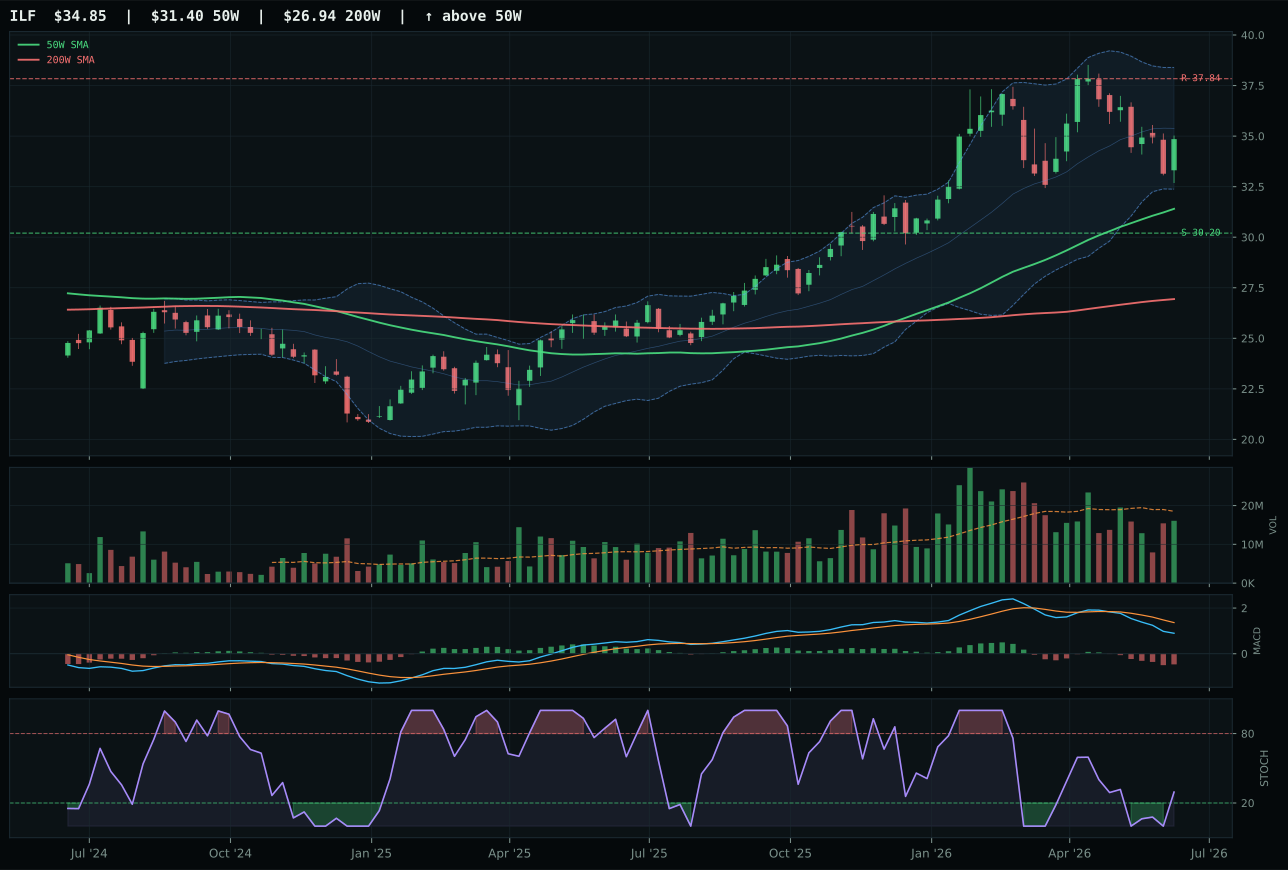
- Category outcome: tracked; score 54.8.
Alerian Energy Infrastructure ETF (ENFR, Natural Gas)
ENFR is an energy infrastructure ETF tied to North American midstream assets, pipeline cash flows, and LNG-linked energy transport.
Natural gas is a tactical commodity sleeve driven by weather, storage, LNG exports, producer discipline, and power demand. The narrative standing is positive, but the timing still needs to justify fresh overweight capital rather than simply confirming existing strength.
- Trend direction: uptrend.
- Position vs SMAs: close 38.79, 50W 34.04, 100W 32.37, 200W 27.53.
- MA slope summary: 50W 1w 0.4%, 4w 1.5%, 10w 4.1%; 100W 0.4%; 200W 0.3%.
- Distance from 50W SMA: 14.0%. Volume behavior: 0.11x 20W average.
- Volume/MACD/StochRSI/Fib: volume thin participation (40/100), MACD bearish/weakening, histogram -0.09, stochastic RSI oversold turn up at 0.16, Fib zone upper retracement / momentum zone; nearest Fib 0.236 at 38.07.
- Support/resistance: support 31.05, resistance 40.29.
- Trend phase: Phase 3: Early trend. Structure: neutral structure.
- Relative strength: SPY -12.1%, category peers 1.1%.
- Bull case, four-week hold: ENFR has a neutral structure profile with -12.1% 13-week relative strength versus SPY.
- Bear case, four-week hold: A failed hold above support would weaken the setup.
- Verdict: Actionable but governed by invalidation levels.
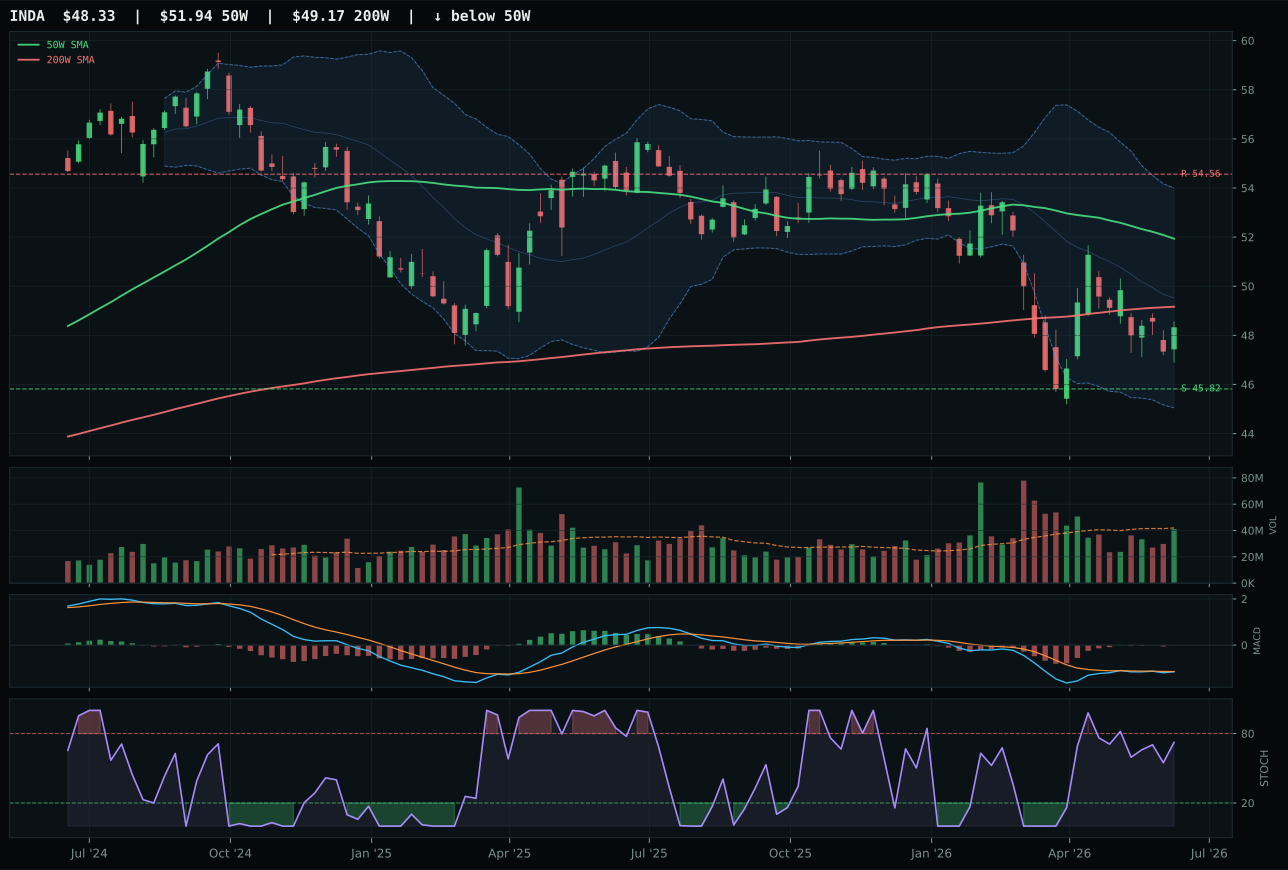
- Category outcome: won category; score 58.7.
First Trust Natural Gas ETF (FCG, Natural Gas)
FCG is a natural gas equity ETF focused on exploration and production companies tied to U.S. gas fundamentals.
Natural gas is a tactical commodity sleeve driven by weather, storage, LNG exports, producer discipline, and power demand. The narrative standing is positive, but the timing still needs to justify fresh overweight capital rather than simply confirming existing strength.
- Trend direction: uptrend.
- Position vs SMAs: close 28.79, 50W 25.83, 100W 24.97, 200W 25.00.
- MA slope summary: 50W 1w 0.4%, 4w 1.4%, 10w 5.2%; 100W 0.1%; 200W 0.1%.
- Distance from 50W SMA: 11.5%. Volume behavior: 0.12x 20W average.
- Volume/MACD/StochRSI/Fib: volume thin participation (40/100), MACD bearish/weakening, histogram -0.35, stochastic RSI oversold turn up at 0.03, Fib zone upper retracement / momentum zone; nearest Fib 0.382 at 28.72.
- Support/resistance: support 23.10, resistance 32.74.
- Trend phase: Phase 2: Breakout / repricing. Structure: neutral structure.
- Relative strength: SPY -21.8%, category peers -8.5%.
- Bull case, four-week hold: FCG has a neutral structure profile with -21.8% 13-week relative strength versus SPY.
- Bear case, four-week hold: A failed hold above support would weaken the setup.
- Verdict: Actionable but governed by invalidation levels.
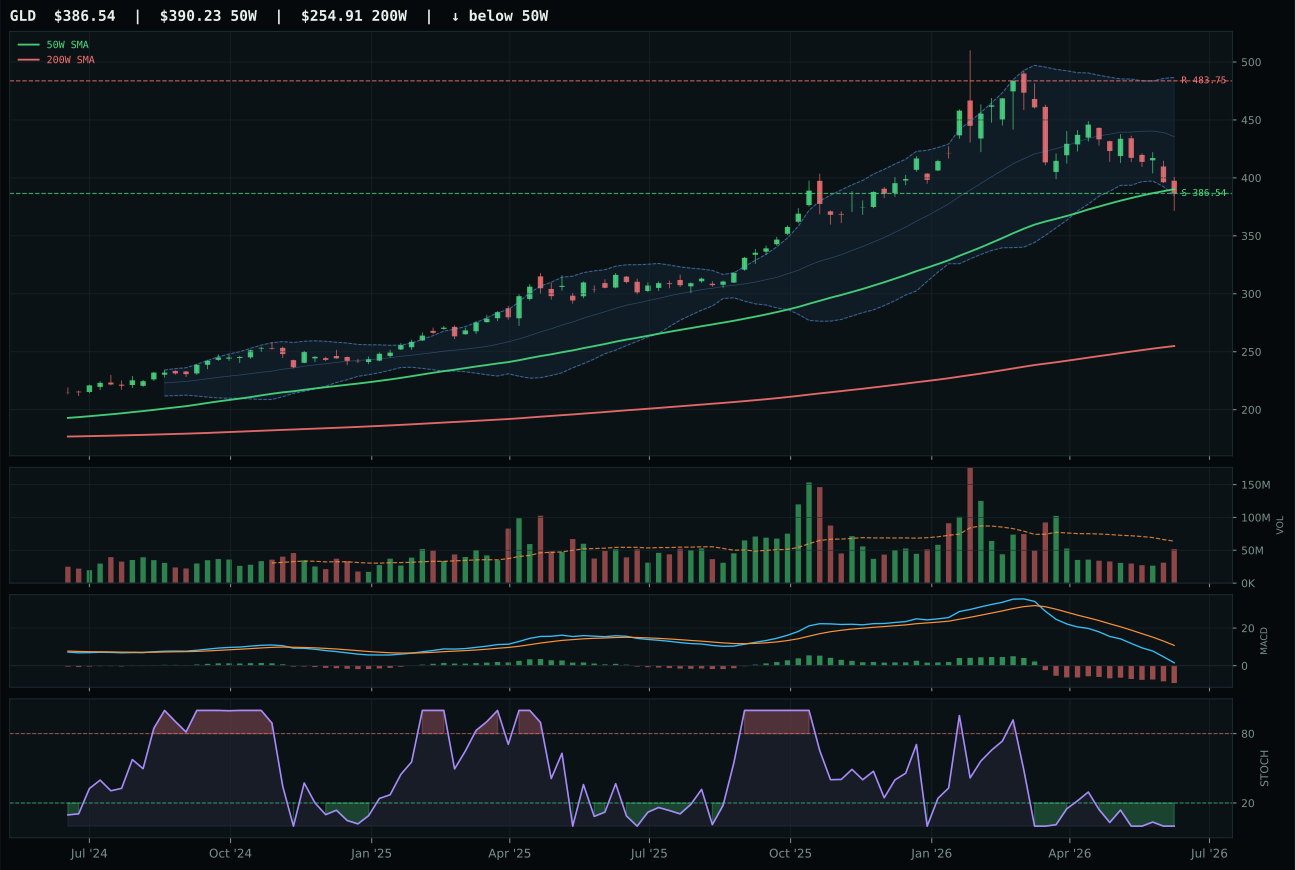
- Category outcome: tracked; score 49.8.
MLPX (Natural Gas)
MLPX is a tracked instrument in this allocation universe.
Natural gas is a tactical commodity sleeve driven by weather, storage, LNG exports, producer discipline, and power demand. The narrative standing is positive, but the timing still needs to justify fresh overweight capital rather than simply confirming existing strength.
- Trend direction: uptrend.
- Position vs SMAs: close 74.18, 50W 65.60, 100W 62.59, 200W 53.03.
- MA slope summary: 50W 1w 0.4%, 4w 1.4%, 10w 3.9%; 100W 0.3%; 200W 0.3%.
- Distance from 50W SMA: 13.1%. Volume behavior: 0.19x 20W average.
- Volume/MACD/StochRSI/Fib: volume thin participation (40/100), MACD bearish/weakening, histogram -0.27, stochastic RSI oversold turn up at 0.15, Fib zone upper retracement / momentum zone; nearest Fib 0.236 at 73.47.
- Support/resistance: support 60.05, resistance 77.33.
- Trend phase: Phase 3: Early trend. Structure: neutral structure.
- Relative strength: SPY -13.2%, category peers 0.0%.
- Bull case, four-week hold: MLPX has a neutral structure profile with -13.2% 13-week relative strength versus SPY.
- Bear case, four-week hold: A failed hold above support would weaken the setup.
- Verdict: Actionable but governed by invalidation levels.
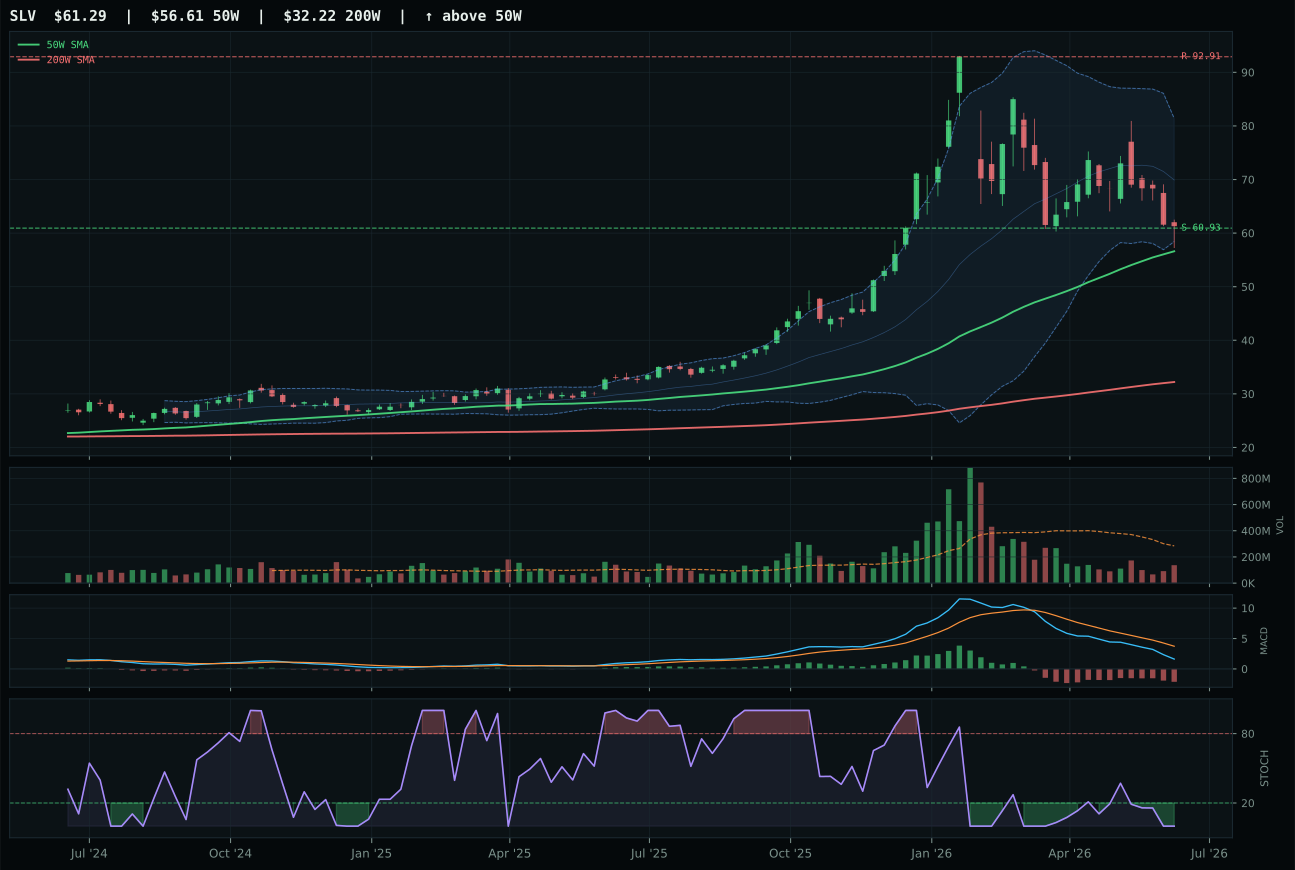
- Category outcome: tracked; score 51.0.
Sprott Uranium Miners ETF (URNM, Uranium)
URNM is a uranium miners ETF with concentrated exposure to uranium producers, developers, and physical uranium vehicles.
Uranium leadership reflects nuclear fuel contracting, reactor demand, supply discipline, energy security, and the power needs of electrification and AI data centers. The current narrative standing is constructive because the asset is participating without forcing the allocator to chase extension.
- Trend direction: neutral/downtrend.
- Position vs SMAs: close 54.58, 50W 59.33, 100W 50.32, 200W 45.63.
- MA slope summary: 50W 1w 0.2%, 4w 1.5%, 10w 7.1%; 100W 0.2%; 200W 0.3%.
- Distance from 50W SMA: -8.0%. Volume behavior: 0.10x 20W average.
- Volume/MACD/StochRSI/Fib: volume thin participation (40/100), MACD bearish/weakening, histogram -1.75, stochastic RSI oversold at 0.00, Fib zone deep retracement / value zone; nearest Fib 0.786 at 52.06.
- Support/resistance: support 54.58, resistance 75.95.
- Trend phase: Phase 1: Base / accumulation. Structure: pullback into support.
- Relative strength: SPY -20.5%, category peers -0.8%.
- Bull case, four-week hold: URNM has a pullback into support profile with -20.5% 13-week relative strength versus SPY.
- Bear case, four-week hold: A failed hold above support would weaken the setup.
- Verdict: Actionable but governed by invalidation levels.
- Category outcome: won category; score 31.7.
VanEck Uranium and Nuclear ETF (NLR, Uranium)
NLR is a nuclear energy ETF tied to uranium, nuclear utilities, reactor technology, and fuel-cycle companies.
Uranium leadership reflects nuclear fuel contracting, reactor demand, supply discipline, energy security, and the power needs of electrification and AI data centers. The current narrative standing is constructive because the asset is participating without forcing the allocator to chase extension.
- Trend direction: neutral/downtrend.
- Position vs SMAs: close 121.95, 50W 133.25, 100W 109.58, 200W 87.52.
- MA slope summary: 50W 1w 0.2%, 4w 1.1%, 10w 5.7%; 100W 0.4%; 200W 0.4%.
- Distance from 50W SMA: -8.5%. Volume behavior: 0.12x 20W average.
- Volume/MACD/StochRSI/Fib: volume thin participation (40/100), MACD bearish/weakening, histogram -2.65, stochastic RSI oversold at 0.00, Fib zone deep retracement / value zone; nearest Fib 0.786 at 117.76.
- Support/resistance: support 121.95, resistance 152.79.
- Trend phase: Phase 1: Base / accumulation. Structure: pullback into support.
- Relative strength: SPY -19.0%, category peers 0.8%.
- Bull case, four-week hold: NLR has a pullback into support profile with -19.0% 13-week relative strength versus SPY.
- Bear case, four-week hold: A failed hold above support would weaken the setup.
- Verdict: Actionable but governed by invalidation levels.
- Category outcome: tracked; score 42.7.
Energy Select Sector SPDR Fund (XLE, Oil)
XLE is the large-cap energy ETF dominated by integrated oil and gas exposure.
Oil is the higher-beta expression of crude balances, OPEC discipline, inventories, geopolitics, and upstream capex. The narrative standing is positive, but the timing still needs to justify fresh overweight capital rather than simply confirming existing strength.
- Trend direction: uptrend.
- Position vs SMAs: close 57.55, 50W 49.81, 100W 46.97, 200W 45.07.
- MA slope summary: 50W 1w 0.6%, 4w 2.2%, 10w 6.5%; 100W 0.2%; 200W 0.2%.
- Distance from 50W SMA: 15.5%. Volume behavior: 0.13x 20W average.
- Volume/MACD/StochRSI/Fib: volume thin participation (40/100), MACD bearish/weakening, histogram -0.47, stochastic RSI oversold turn up at 0.07, Fib zone upper retracement / momentum zone; nearest Fib 0.236 at 58.41.
- Support/resistance: support 44.20, resistance 62.56.
- Trend phase: Phase 4: Extended / late trend. Structure: vertical extension.
- Relative strength: SPY -17.3%, category peers 0.0%.
- Bull case, four-week hold: XLE has a vertical extension profile with -17.3% 13-week relative strength versus SPY.
- Bear case, four-week hold: A failed hold above support would weaken the setup.
- Verdict: Actionable but governed by invalidation levels.
- Category outcome: won category; score 46.1.
VanEck Oil Services ETF (OIH, Oil)
OIH is an oil services ETF tied to drilling, offshore activity, and upstream capex.
Oil is the higher-beta expression of crude balances, OPEC discipline, inventories, geopolitics, and upstream capex. The narrative standing is positive, but the timing still needs to justify fresh overweight capital rather than simply confirming existing strength.
- Trend direction: uptrend.
- Position vs SMAs: close 428.17, 50W 328.44, 100W 298.11, 200W 300.50.
- MA slope summary: 50W 1w 1.1%, 4w 4.6%, 10w 13.7%; 100W 0.3%; 200W 0.3%.
- Distance from 50W SMA: 30.4%. Volume behavior: 0.14x 20W average.
- Volume/MACD/StochRSI/Fib: volume thin participation (40/100), MACD bearish/weakening, histogram -3.31, stochastic RSI oversold turn up at 0.17, Fib zone upper retracement / momentum zone; nearest Fib 0.236 at 404.37.
- Support/resistance: support 281.52, resistance 444.73.
- Trend phase: Phase 4: Extended / late trend. Structure: vertical extension.
- Relative strength: SPY -3.7%, category peers 13.6%.
- Bull case, four-week hold: OIH has a vertical extension profile with -3.7% 13-week relative strength versus SPY.
- Bear case, four-week hold: A failed hold above support would weaken the setup.
- Verdict: Actionable but governed by invalidation levels.
- Category outcome: tracked; score 50.0.
SPDR S&P Oil & Gas Exploration & Production ETF (XOP, Oil)
XOP is an equal-weight oil and gas exploration and production ETF with higher beta to crude and gas.
Oil is the higher-beta expression of crude balances, OPEC discipline, inventories, geopolitics, and upstream capex. The narrative standing is positive, but the timing still needs to justify fresh overweight capital rather than simply confirming existing strength.
- Trend direction: uptrend.
- Position vs SMAs: close 165.34, 50W 144.29, 100W 137.83, 200W 138.78.
- MA slope summary: 50W 1w 0.5%, 4w 1.9%, 10w 6.3%; 100W 0.1%; 200W 0.1%.
- Distance from 50W SMA: 14.6%. Volume behavior: 0.16x 20W average.
- Volume/MACD/StochRSI/Fib: volume thin participation (40/100), MACD bearish/weakening, histogram -1.78, stochastic RSI oversold turn up at 0.02, Fib zone upper retracement / momentum zone; nearest Fib 0.382 at 164.04.
- Support/resistance: support 124.96, resistance 188.18.
- Trend phase: Phase 2: Breakout / repricing. Structure: neutral structure.
- Relative strength: SPY -21.0%, category peers -3.7%.
- Bull case, four-week hold: XOP has a neutral structure profile with -21.0% 13-week relative strength versus SPY.
- Bear case, four-week hold: A failed hold above support would weaken the setup.
- Verdict: Actionable but governed by invalidation levels.
- Category outcome: tracked; score 55.9.
PAVE (Utilities & Infrastructure)
PAVE is a tracked instrument in this allocation universe.
Utilities and infrastructure combine defensive power demand, grid capex, electrification, data-center load growth, and rate-sensitive income demand. The narrative standing is positive, but the timing still needs to justify fresh overweight capital rather than simply confirming existing strength.
- Trend direction: uptrend.
- Position vs SMAs: close 57.76, 50W 50.41, 100W 45.58, 200W 38.45.
- MA slope summary: 50W 1w 0.5%, 4w 2.3%, 10w 6.0%; 100W 0.4%; 200W 0.4%.
- Distance from 50W SMA: 14.6%. Volume behavior: 0.19x 20W average.
- Volume/MACD/StochRSI/Fib: volume thin participation (40/100), MACD bullish and improving, histogram 0.14, stochastic RSI overbought momentum at 0.96, Fib zone near 52W high / extension; nearest Fib 0.236 at 54.56.
- Support/resistance: support 48.85, resistance 57.76.
- Trend phase: Phase 3: Early trend. Structure: neutral structure.
- Relative strength: SPY 3.5%, category peers 14.8%.
- Bull case, four-week hold: PAVE has a neutral structure profile with 3.5% 13-week relative strength versus SPY.
- Bear case, four-week hold: A failed hold above support would weaken the setup.
- Verdict: Actionable but governed by invalidation levels.
- Category outcome: won category; score 81.3.
IGF (Utilities & Infrastructure)
IGF is a tracked instrument in this allocation universe.
Utilities and infrastructure combine defensive power demand, grid capex, electrification, data-center load growth, and rate-sensitive income demand. The narrative standing is positive, but the timing still needs to justify fresh overweight capital rather than simply confirming existing strength.
- Trend direction: uptrend.
- Position vs SMAs: close 67.30, 50W 63.65, 100W 59.05, 200W 52.80.
- MA slope summary: 50W 1w 0.3%, 4w 1.0%, 10w 2.8%; 100W 0.3%; 200W 0.2%.
- Distance from 50W SMA: 5.7%. Volume behavior: 0.10x 20W average.
- Volume/MACD/StochRSI/Fib: volume thin participation (40/100), MACD bearish/weakening, histogram -0.29, stochastic RSI rising mid-zone at 0.30, Fib zone upper retracement / momentum zone; nearest Fib 0.236 at 66.77.
- Support/resistance: support 61.80, resistance 69.37.
- Trend phase: Phase 3: Early trend. Structure: neutral structure.
- Relative strength: SPY -11.3%, category peers 0.0%.
- Bull case, four-week hold: IGF has a neutral structure profile with -11.3% 13-week relative strength versus SPY.
- Bear case, four-week hold: A failed hold above support would weaken the setup.
- Verdict: Actionable but governed by invalidation levels.
- Category outcome: tracked; score 59.0.
Utilities Select Sector SPDR Fund (XLU, Utilities & Infrastructure)
XLU is the large-cap U.S. utilities ETF used as a defensive equity and rates-sensitive proxy.
Utilities and infrastructure combine defensive power demand, grid capex, electrification, data-center load growth, and rate-sensitive income demand. The current narrative standing is constructive because the asset is participating without forcing the allocator to chase extension.
- Trend direction: uptrend.
- Position vs SMAs: close 44.53, 50W 44.24, 100W 41.78, 200W 37.47.
- MA slope summary: 50W 1w 0.2%, 4w 0.7%, 10w 2.1%; 100W 0.2%; 200W 0.1%.
- Distance from 50W SMA: 0.6%. Volume behavior: 0.15x 20W average.
- Volume/MACD/StochRSI/Fib: volume thin participation (40/100), MACD bearish/weakening, histogram -0.28, stochastic RSI rising mid-zone at 0.22, Fib zone middle retracement / decision zone; nearest Fib 0.382 at 44.89.
- Support/resistance: support 42.51, resistance 47.73.
- Trend phase: Phase 3: Early trend. Structure: pullback into support.
- Relative strength: SPY -14.6%, category peers -3.3%.
- Bull case, four-week hold: XLU has a pullback into support profile with -14.6% 13-week relative strength versus SPY.
- Bear case, four-week hold: A failed hold above support would weaken the setup.
- Verdict: Actionable but governed by invalidation levels.
- Category outcome: tracked; score 69.5.
10. Final Top-2 Selection
| Rank | Category | Final Category Score | ETF Basket | Execution Ticker | Asset Score | Tier | Invalidation |
|---|---|---|---|---|---|---|---|
| 1 | Precious Metals | 60.0 | GDX, SLV, GLD | SLV | 57.4 | Tier 1 | 61.29 |
| 2 | Industrial Metals | 58.0 | COPX, PICK, REMX | COPX | 69.7 | Tier 1 | 69.08 |
| 3 | Utilities & Infrastructure | 55.7 | PAVE, XLU, IGF | PAVE | 81.3 | Tier 2 | 48.85 |
| 4 | Defense & Aerospace | 54.6 | ROKT, ITA, PPA | ROKT | 56.4 | Tier 2 | 85.61 |
| 5 | Oil | 52.3 | OIH, XLE, XOP | XLE | 46.1 | Tier 2 | 44.20 |
| 6 | Uranium | 51.3 | NLR, URNM | URNM | 31.7 | Tier 3 | 54.58 |
| 7 | Natural Gas | 41.0 | ENFR, MLPX, FCG | ENFR | 58.7 | Tier 3 | 31.05 |
| 8 | AI | 40.9 | SMH, AIQ, BOTZ | SMH | 60.6 | Tier 3 | 365.86 |
| 9 | Technology | 40.4 | XLK, CIBR, IGV | XLK | 66.3 | Tier 3 | 129.92 |
| 10 | Agriculture & Livestock | 27.7 | FTAG, VEGI, MOO | MOO | 64.8 | Tier 3 | 73.03 |
Top 2 assets: SLV, COPX.
Why selected now: the 30% sleeves are assigned to the top two eligible categories by final proof-burden score. The ticker shown is the chosen representative for that winning category. This prevents a weak category with one isolated outlier, unsupported bounce, or attractive-but-unsponsored support level from receiving an overweight unless the whole ETF basket and active macro stance also confirm.
Rotation triggers: a higher-ranked runner-up with improving timing, a winner losing support, a top-2 breaching invalidation, or a crypto state change.
11. Portfolio Allocation
| Ticker | Category | Weight | Reason |
|---|---|---|---|
| SLV | Precious Metals | 30% | top-2 category winner |
| COPX | Industrial Metals | 30% | top-2 category winner |
| PAVE | Utilities & Infrastructure | 5% | category representative sleeve |
| ROKT | Defense & Aerospace | 5% | category representative sleeve |
| XLE | Oil | 5% | category representative sleeve |
| URNM | Uranium | 5% | category representative sleeve |
| ENFR | Natural Gas | 5% | category representative sleeve |
| SMH | AI | 5% | category representative sleeve |
| XLK | Technology | 5% | category representative sleeve |
| MOO | Agriculture & Livestock | 5% | category representative sleeve |
12. Forward Watchlist
- Assets close to promotion: PAVE, ROKT, XLE.
- Assets at risk of demotion: SMH, XLK, MOO.
- Categories showing improving breadth: those with multiple assets above rising 50W and 200W SMAs.
- Categories showing weakening breadth: those where the winner is liquidity-qualified but peers are structurally broken.
- What would change next week's allocation: crypto state transition, category representative changes, or disqualification/invalidation triggers in current top selections.
13. Performance Tracking
The public scorecard is the four-week rolling portfolio, not the one-week rebalance. Each report creates a 25% tranche bought at the next Monday open and held for four weeks. A completed four-week basket contributes one quarter of its four-week gain or loss to the rolling portfolio record. Historical backtests, when shown, must remain labeled separately from live runs.
- Completed 4W basket return for this report: n/a
- Top-2 versus bottom-8 4W category spread: n/a
14. Data Quality Section
- Data sources used:
| Dataset | Source |
|---|---|
| market_data | live-yahoo-chart |
| btc_spot | live-yahoo-btc-spot |
| others_btc | missing: COINGECKO_API_KEY is required for historical OTHERS/BTC |
| macro | live-fred |
| fear_greed | live-alternative-me |
| macro_regime | computed |
- Timestamp of latest data: 2026-06-15T06:02:23.378894.
- Missing data warnings: Some tracked tickers were excluded due to missing live weekly price data: NUKZ: Yahoo chart NUKZ returned only 126 usable weekly bars, ISM PMI unavailable from FRED; used official ISM page fallback: FRED CSV NAPM failed after 3 attempts: 404 Client Error: Not Found for url: https://fred.stlouisfed.org/graph/fredgraph.csv?id=NAPM&observation_end=2026-06-12.
- Stale macro data: yes.
- Assets excluded due to missing live price data: NUKZ.
- Assets failing liquidity filter: FTAG.